
TL;DR:
- Wedding venue regulations in South Australia are complex and vary based on venue type, location, and activities planned, requiring careful management. Failures to obtain necessary permits and licenses can lead to fines, cancellations, and safety issues, emphasizing early compliance checks. Couples should proactively confirm permits, licences, and land manager requirements to ensure a smooth, legally compliant wedding day.
Many engaged couples assume that once they’ve secured a beautiful venue, the hard work of compliance is done. In reality, wedding venue regulations in South Australia are layered, location-specific, and easy to misunderstand. The rules governing a private vineyard differ enormously from those covering a council-managed beach or a state park. Get them wrong, and you’re facing fines, cancelled permits, or unwanted interruptions on your big day. This guide cuts through the confusion, explaining exactly what couples and planners need to know to stay fully compliant and plan with genuine confidence.
Key Takeaways
| Point | Details |
|---|---|
| Regulations vary by venue | Public and private venues in South Australia have different compliance requirements for weddings. |
| Council and state permits | Permissions may be required from both your local council and state departments depending on the venue type. |
| Liquor licensing is mandatory | Venues must obtain the correct liquor licence for weddings serving alcohol, involving application steps. |
| Notify early to avoid issues | Advance communication with councils and agencies prevents conflicts and last-minute venue setbacks. |
| Regulations protect your event | Complying with all regulations ensures a smoother, stress-free wedding day for everyone. |
Why venue regulations matter for South Australian weddings
Venue regulations are not suggestions. They are legal requirements, and failing to follow them carries real consequences. Fines, forced event cancellations, liability for injuries, and loss of security deposits are all possible outcomes when compliance is overlooked. Beyond the legal risk, regulation gaps cause enormous stress, often surfacing in the final weeks before a wedding when there’s no time to fix them.
Understanding which regulations apply to your wedding depends on several key factors:
- Type of venue: Public land (parks, beaches, reserves) is governed differently to privately owned venues or licensed premises.
- Guest numbers: Many councils apply different rules based on the size of the gathering.
- Activities planned: Serving alcohol, erecting structures such as marquees, or using open flames all trigger additional requirements.
- Land management authority: Some land falls under state government jurisdiction rather than local council.
“A beautiful venue is only half the story. The other half is understanding who manages that land and what permissions you need to celebrate on it legally.”
Regulations also exist for good reasons. They protect your guests from safety risks, prevent environmental damage at sensitive outdoor sites, and ensure fair access to shared public spaces. Venue requirements covering noise, waste management, and crowd control are designed to keep events safe and neighbourhoods undisturbed.
Critically, event agreements or permits may be required from state departments like Environment SA for certain events on public land. This step surprises many couples who assume council approval is the only hurdle. In South Australia, some land is managed at state level, not local government level, meaning council approval alone is insufficient.
With the basics set, let’s drill into how different types of wedding venues are regulated.
Key regulations for different South Australian wedding venue types
Knowing why regulations exist, the next step is to understand how these rules differ by venue type. South Australia offers an enviable range of wedding settings, from beachside ceremonies to rustic barn receptions. Each setting comes with its own regulatory framework.
Public spaces: Parks and beaches
Public spaces are popular for ceremonies because of their natural beauty and relatively low cost. However, they come with important restrictions. According to City of Holdfast Bay guidelines, small private weddings of up to 40 attendees do not require formal event approval or fees. That said, no exclusive use is granted, restrictions apply to marquees, fires, glass containers, and certain specific locations.
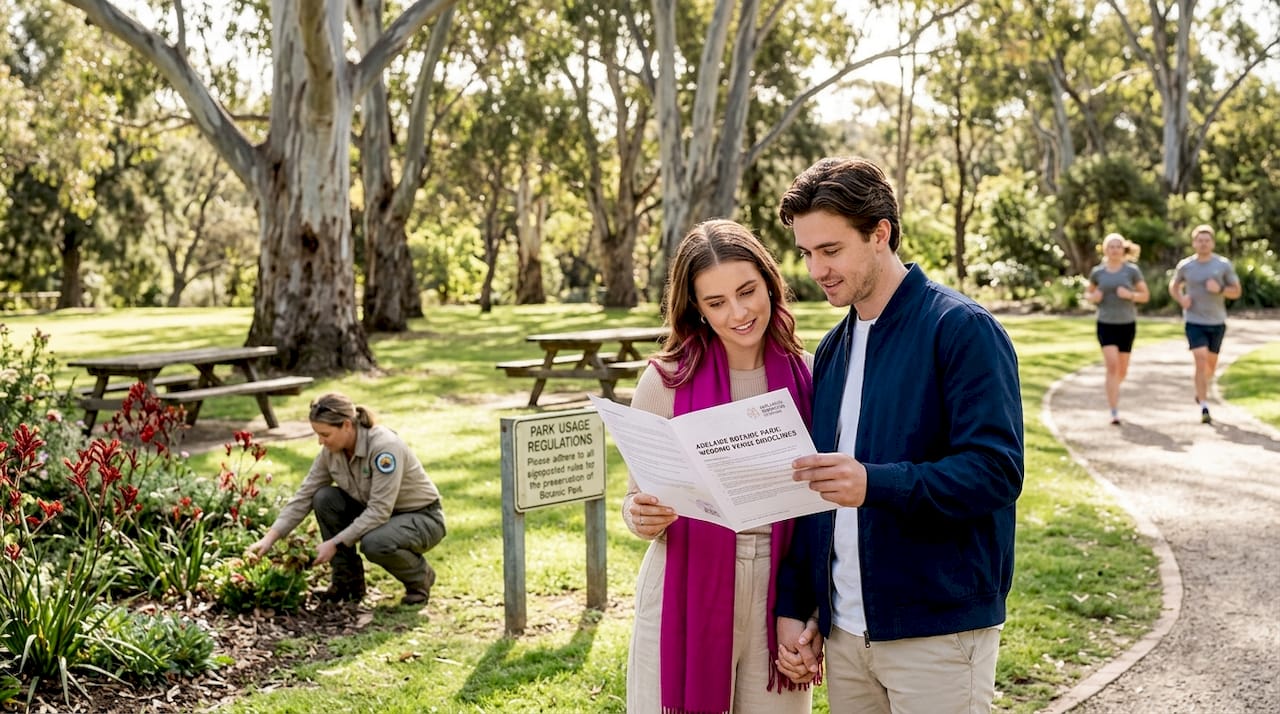
This means that even if your ceremony is entirely compliant, members of the public may walk through your event space. You cannot rope off a beach or park to keep strangers out. Understanding this before you commit to a public outdoor location prevents disappointment on the day. Exploring curated outdoor wedding venues can help couples find options that balance open-air settings with appropriate access controls.
Private venues
Private venues, including wineries, function centres, and heritage properties, generally handle most legal compliance internally. They hold their own licences, manage their own insurance, and have established relationships with local councils. As a couple, your responsibility is to review venue contracts carefully and confirm that the venue’s permits cover your planned activities.
State-managed land
Some of South Australia’s most breathtaking settings, such as national parks and coastal reserves, fall under state government management. Couples planning ceremonies in these areas need to seek approval from Environment SA in addition to, or instead of, local council.
The following table summarises the key differences across venue types:
| Venue type | Approval required | Exclusivity | Key restrictions |
|---|---|---|---|
| Public beach or park (under 40 guests) | Notify council | None | No marquees, no fires, no glass |
| Public beach or park (over 40 guests) | Formal event approval | Limited | Structures, noise, waste management |
| Private venue (licensed) | Venue manages | Full | Review contract terms |
| State-managed land | Environment SA permit | Limited or none | Site-specific conditions |
| Council-owned function space | Council booking | Full | Venue-specific rules |
Pro Tip: Always ask whether a venue holds its own event permits and liquor licence before signing any agreement. Venues that manage these internally save you significant time and paperwork.
When evaluating your options, reviewing ceremony venue options across different settings helps you match the look you want with a location that won’t create compliance headaches.
Council and state requirements: Permits, notifications, and licences
With venue types compared, it’s vital to grasp what permissions, notifications, and statutory licences are needed for your chosen site. The approval process in South Australia involves multiple authorities, and the steps vary depending on your venue choice.
Step-by-step: Navigating the approval process
- Identify the land manager. Determine whether your venue is on local council land, state-managed land, or privately owned land. This determines who you need to contact first.
- Contact the relevant council. For council-managed public spaces, notify the local council of your event details including date, time, expected guest numbers, and planned activities.
- Apply for any required event permits. Larger events or those involving structures, amplified sound, or catering may require a formal permit application, often accompanied by site plans and insurance documentation.
- Check Environment SA requirements. If any part of your event touches state-managed land or waterways, event agreements or permits from Environment SA may be required.
- Confirm liquor licensing. If alcohol will be served, this is a separate and significant requirement.
Liquor licensing in South Australia
Alcohol service at weddings is one of the most commonly misunderstood areas of compliance. Liquor licensing for venues is managed by Consumer and Business Services (CBS) SA. Venues must hold appropriate licences, such as a hotel licence or club licence, for alcohol to be served legally at weddings. Applications require council consent, floor plans, and public advertising.
Key insight: If you’re planning to hire a private location that doesn’t already hold a liquor licence, you cannot simply bring your own alcohol and serve it freely. A separate licence or permit is required, and obtaining one involves a formal application process that can take weeks.
Permit and licence summary table
| Requirement | Authority | When it applies | Processing time |
|---|---|---|---|
| Event notification | Local council | Public land events, any size | 2 to 4 weeks |
| Formal event permit | Local council | Over 40 guests or structures | 4 to 8 weeks |
| Environment SA agreement | Environment SA | State-managed land or waterways | 6 to 12 weeks |
| Liquor licence | CBS SA | Venues serving alcohol | 8 to 12 weeks |
Processing times alone make a strong case for starting your compliance checks as early as possible. A thorough understanding of venue contracts and approvals will set you up well for this process.
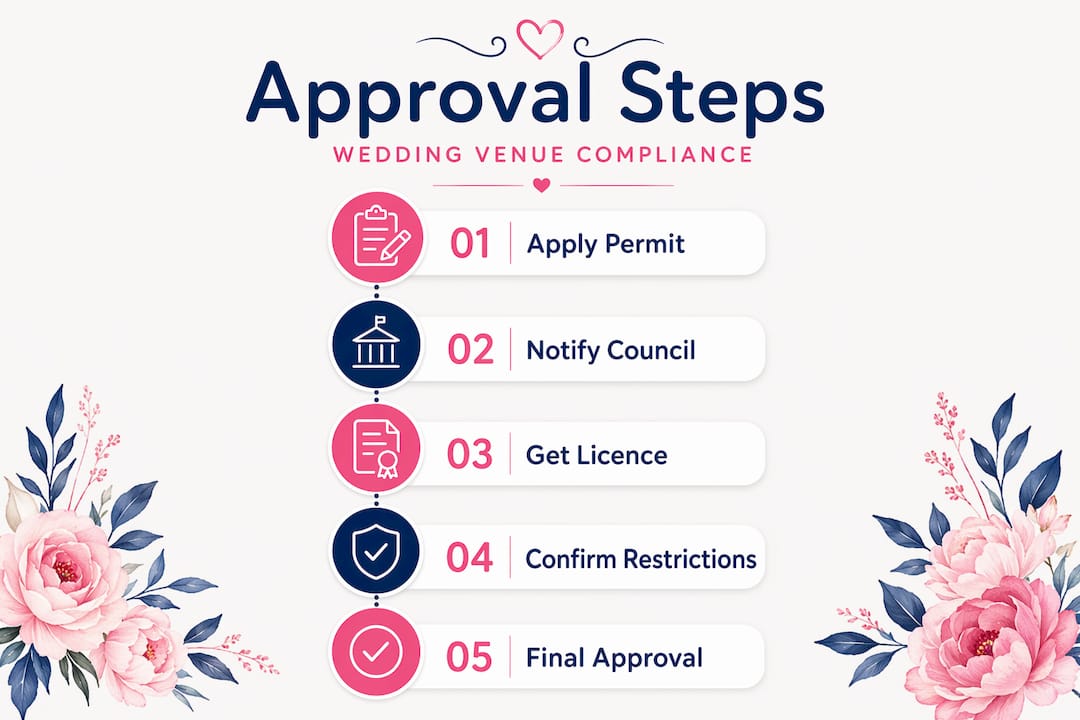
Couples should also refer to a solid wedding checklist for compliance to track every approval milestone alongside the broader planning timeline.
Common pitfalls and expert tips for smooth approval
Now that permits are explained, let’s look at where couples and planners often go wrong, and how to sidestep these issues.
Pitfall 1: Skipping council notification
One of the most frequent mistakes is assuming that a public space is freely available without any notification. Without notifying the council, another group could legitimately book the same location, or council workers could be scheduled for maintenance on your wedding day. Notifying your council early avoids these conflicts, even for small events where formal approval isn’t required.
Pitfall 2: Assuming exclusive access
Many couples fall in love with a public beach or park location and picture it deserted for their ceremony. Public land does not work this way. Community access is maintained at all times, and no council or state authority will shut a public area exclusively for a private wedding without a formal event agreement and justified need. This misunderstanding regularly leads to disappointed couples on the day.
Pitfall 3: Underestimating processing times
As the table above illustrates, some permits and licences take up to twelve weeks to process. Couples who leave these enquiries too late often find themselves scrambling to change venue plans or, worse, proceeding without proper approval.
Pitfall 4: Not getting restrictions in writing
Verbal assurances from venue staff or council officers are not enforceable. If a venue representative tells you that glass is permitted on the beach for your toast, get that in writing. If council staff say your sound system is fine, ask for written confirmation. Documentation protects you if something goes wrong.
Here are the key actions to take:
- Contact the relevant council or land manager at least three months before your event date.
- Confirm whether your venue holds its own liquor licence and what it covers.
- Ask your venue coordinator for written confirmation of any restrictions or approvals.
- Check whether Environment SA approval is needed if your venue includes natural waterways, coastal reserves, or national park land.
- Build permit processing time into your planning timeline, not as an afterthought.
Pro Tip: When choosing your wedding venue, ask venue managers directly: “What permits and licences do you currently hold, and what will we need to arrange ourselves?” The answer tells you a great deal about how organised and experienced the venue is.
“The couples who have the smoothest approval processes are those who ask questions early and document every answer. Confidence comes from clarity, not guesswork.”
Our take: Venue regulations are your wedding’s silent backbone
Having covered all the must-know facts, what’s our honest advice for couples and planners? Here it is: regulations are not the enemy of romance. They are the framework that makes your celebration possible.
Most last-minute wedding disasters we hear about trace back to a compliance gap that was visible months earlier but ignored or overlooked. A venue that turns out to lack a liquor licence. A public beach booking that was never confirmed with council. A marquee that couldn’t be erected because the permit wasn’t secured. These are not unpredictable misfortunes. They are the predictable results of treating compliance as someone else’s problem.
The couples and planners who genuinely enjoy their wedding day are the ones who treated their compliance checklist the same way they treated their guest list or their floral arrangements: as something worthy of time, attention, and professional guidance. When you know your permits are in order, your venue is properly licensed, and your council has been notified, you stop worrying. That mental freedom is priceless on a wedding day.
There is also real value in understanding how venue capacity and cost insights connect to regulatory requirements. Larger guest numbers almost always mean a higher regulatory burden. Knowing this early helps couples make informed decisions about scale, not just aesthetics.
Our view is direct: flip the mindset. Stop seeing regulations as a barrier to your dream wedding and start seeing them as the conditions that make your dream wedding legally possible, practically safe, and genuinely enjoyable. Every rule exists for a reason. When you understand those reasons, the process becomes logical rather than frustrating.
Find your ideal wedding venue with confidence
Ready to put your knowledge into action? Navigating venue regulations is far easier when you start with venues that are already known for their professionalism and compliance track record.
Adelaide Wedding Venues is South Australia’s dedicated online directory for finding exceptional wedding venues across Adelaide and the broader state. For a wider range of options, browse All Adelaide Wedding Venues. Use our venue selection guide to filter venues by location, style, size, and budget, ensuring you find options that meet both your vision and your compliance needs. Many venues listed on the Adelaide Wedding Venues platform manage their own licences and permits, which simplifies the approval process considerably. Let our directory take the guesswork out of venue selection, so you can focus on celebrating.
Frequently asked questions
Do I need approval for a small beach or park wedding in South Australia?
You don’t need formal approval for private weddings under 40 guests in most council areas, but restrictions still apply to structures such as marquees, open fires, glass containers, and certain locations.
What is needed to serve alcohol at my wedding venue?
Your venue must hold an appropriate liquor licence from CBS SA, which requires council consent, floor plans, and public advertising as part of the application process.
Can I have exclusive use of a public venue like a beach on my wedding day?
Public beaches and parks generally do not offer exclusive use for private events, meaning other community members may be present during your ceremony.
Who do I notify for a park wedding beyond council approval?
If the venue is on state-managed land, you may also need an event agreement from Environment SA in addition to notifying your local council.
