
Licensed venues in Australia operate within a clear legal framework, and understanding the role of legal requirements in venues is the foundation of responsible, lawful operation. Two primary bodies of law govern most venues: state and territory Liquor Acts (such as the Liquor Act 1992 in Queensland) and the Work Health and Safety (WHS) Acts, which apply nationally. Regulatory bodies including state Liquor and Gambling Commissions, Consumer and Business Services (CBS), and SafeWork authorities oversee compliance and can inspect venues at any time. Getting this right protects your patrons, your staff, your licence, and your community.
Every licensed venue operator carries these core legal roles:
- Hold a current, valid liquor licence appropriate to the venue type
- Maintain a trained, certified workforce with valid Responsible Service of Alcohol (RSA) credentials
- Conduct and document ongoing risk assessments
- Preserve the amenity of the surrounding neighbourhood
- Prevent underage drinking and manage intoxicated patrons
- Keep accurate records of incidents, training, and compliance activities
- Renew licences annually and pay required fees on time
Failing to meet these obligations carries real consequences. In South Australia, operating without an approved responsible person on duty can attract an on-the-spot fine of $1,200 and a maximum penalty of $20,000.
What are the key legal obligations for licensed venues?
Legal compliance in venues covers a broader range of duties than many operators initially expect. Licence type determines the specific conditions that apply, and understanding those distinctions is the first step.
Licence types and conditions
Australian states offer several licence categories. On-premises licences cover restaurants, bars, and function centres where alcohol is consumed on site. Packaged liquor licences apply to bottle shops and direct sales. Each type carries its own trading hours, signage requirements, and patron management obligations. In NSW, every liquor licence is subject to conditions imposed automatically by liquor laws, with additional conditions possible after a serious complaint or incident.
Key obligations across most licence types include:
- Displaying the licence prominently at or near the venue entrance
- Ensuring an approved responsible person is on duty whenever the venue is open
- Verifying patron age using accepted identification before serving alcohol
- Confiscating false or altered ID documents and reporting them to police within seven days
- Prohibiting entry to anyone wearing items associated with declared criminal organisations
- Controlling noise and patron behaviour inside and outside the premises
- Providing free cold drinking water to patrons on request (mandatory for many licence types in Queensland)
- Keeping an incident register and making it available to licensing officers on request
- Paying annual licence renewal fees by the due date (30 June in South Australia)
Pro Tip: Review your licence conditions document at least once a year, not just at renewal time. Conditions can be added after a complaint or incident, and staff need to know about any changes before the next trading night.
Fire safety and emergency planning sit alongside liquor obligations. Under WHS legislation, venue operators must have a documented emergency plan that covers evacuation procedures, emergency contact details, and crowd management protocols. For events, applications for limited licences in NSW must be lodged at least 28 days before the event date.

How should venues approach risk assessment and licence compliance?
Regulators treat compliance as a continuous cycle, not a one-off task. A venue that conducts a risk assessment once at licence application and never revisits it is already behind.
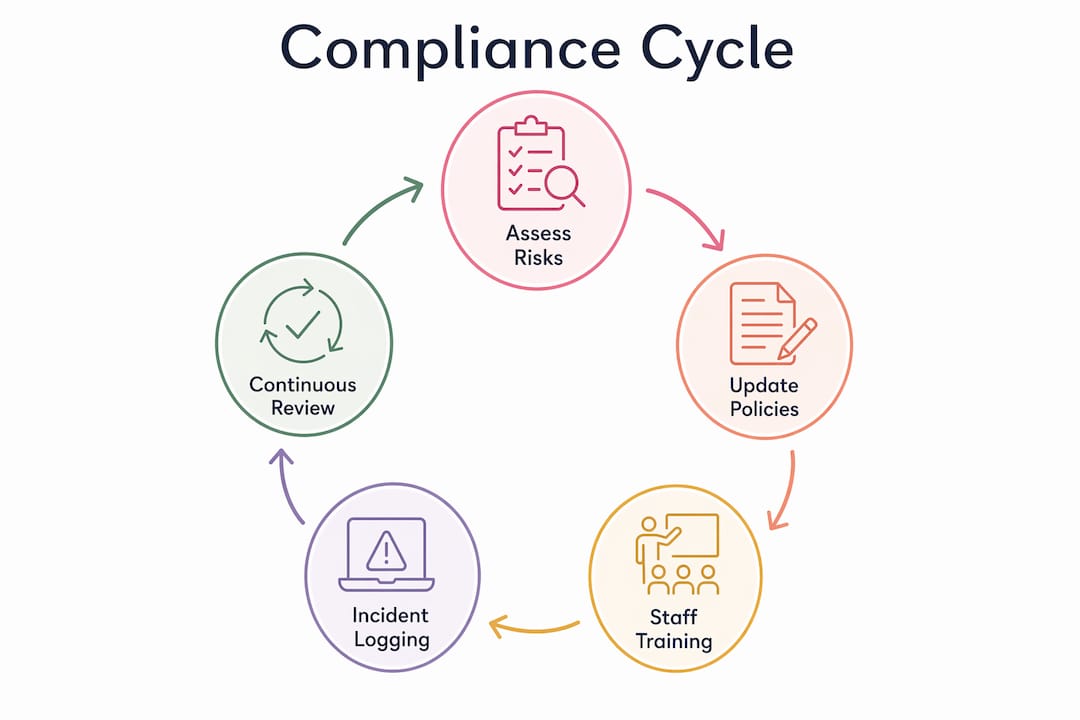
The Liquor Plan of Management (LPoM) is the central compliance document for most licensed venues. It outlines how the venue will serve alcohol responsibly, manage intoxication, handle complaints, and protect the surrounding neighbourhood. Critically, it must be updated whenever the business model or licence conditions change, not simply filed away.
Key areas every risk assessment should address:
- Intoxication management: how staff identify and respond to signs of intoxication
- Crowd control: maximum patron numbers, entry and exit management, and queue behaviour
- Noise: measures to limit amplified sound and patron noise in outdoor or late-night settings
- Security arrangements: CCTV coverage, lighting adequacy, and security personnel deployment
- Drink spiking prevention: staff protocols and patron awareness measures
- Incident recording: what gets logged, by whom, and how records are stored
Pro Tip: Treat the LPoM as a living document. Brief staff on any update at the next team meeting, keep a dated record of each revision, and store copies where staff can access them during a shift.
Strong documentation of incidents, training sessions, and compliance activities forms a compliance archive that can prevent licence suspension if a complaint or investigation arises. Regulators look for evidence of genuine, ongoing effort, not just a tidy folder produced on the day of an inspection.
What staff training and certifications does the law require?
RSA certification is mandatory for every person who sells, serves, or supplies alcohol at a licensed venue in Australia. That scope is wider than many operators realise.
Under RSA requirements in NSW, the obligation extends to salespersons, promotional staff, RSA marshals, security staff and crowd controllers, and volunteers. In Western Australia, new staff must complete the RSA course within 28 days of commencing employment and provide a copy of their certificate to the employer. Interstate RSA cards are generally not accepted as equivalent, so staff moving between states need to check local requirements.
Training obligations by role:
- All alcohol service staff: nationally accredited RSA course, with refresher training as required
- Security and crowd control personnel: RSA certification plus any state-specific crowd controller licensing
- Approved managers: in Western Australia, the Course in Management of Licensed Premises is required before applying for an unrestricted approved manager card
- Volunteers: same RSA requirements as paid staff in most jurisdictions
- Licensees: Responsible Management of Licensed Venues (RMLV) training is required in Queensland and recommended in other states as best practice
Scenario-based training covering intoxication management, drink spiking, and refusal of service gives staff practical skills they can apply under pressure. Beyond compliance, RSA training reduces alcohol-related harm, improves staff morale, and lowers staff turnover. Document every training session with the date, attendees, and content covered. That record is your evidence if a licensing officer asks.
What is a venue’s duty of care and how does amenity preservation work?
Under the Work Health and Safety Act 2011, venue owners and managers are classified as Persons Conducting a Business or Undertaking (PCBUs). That classification carries a primary duty of care for the health and safety of workers, patrons, and any member of the public affected by the venue’s operation. The standard applied is “reasonable practicability,” meaning the duty is proactive and site-specific, not generic.
Practical steps to meet that duty include:
- Adequate lighting inside and outside the venue to deter drug dealing, harassment, and loitering
- A documented emergency plan with clear evacuation routes and emergency contacts
- Regular safety checks of the physical premises, including exits, flooring, and equipment
- Protocols for managing intoxicated patrons, including transport options
- Procedures for responding to drink spiking incidents
- Active monitoring of patron behaviour at entry, exit, and in surrounding areas
Amenity preservation is a distinct but related obligation. Under the Liquor Act 1992 (QLD), a licensee must take reasonable steps to ensure the venue’s use does not adversely affect the amenity of the nearby area, and that patron behaviour entering or leaving the premises does not disturb neighbours. Surveillance both inside and in the vicinity of the premises, combined with a genuine response to complaints from nearby residents, is the standard regulators expect.
A venue that monitors its car park, responds to noise complaints within 24 hours, and keeps a written log of those responses is demonstrating exactly the kind of reasonable, ongoing effort that satisfies the amenity preservation obligation under Queensland’s Liquor Act 1992.
One point that surprises many operators: outsourcing security or event services does not transfer your legal liability. The venue retains ultimate compliance responsibility. Vet your contractors’ credentials, confirm their licences are current, and include compliance expectations in any service agreement.
Planning a wedding or event at a venue that takes these obligations seriously? Adelaideweddingvenues lists venues across South Australia that operate with full liquor licensing compliance in mind, and also highlights the importance of transport insurance for event equipment to safeguard logistics. For couples selecting a venue, understanding how a venue manages its legal duties is part of choosing the right location. Explore ideal wedding venues that balance beauty with responsible, lawful operation.
Key takeaways
Legal compliance in Australian licensed venues requires continuous effort across licensing, staff training, risk management, and community responsibility, not a single sign-off at the point of licence grant.
| Point | Details |
|---|---|
| RSA is mandatory for all staff | Every person selling, serving, or supplying alcohol must hold valid RSA certification, including volunteers and security personnel. |
| Penalties for non-compliance are serious | Operating without an approved responsible person on duty in South Australia can result in an on-the-spot fine of $1,200, and the court can impose a maximum penalty of $20,000. |
| The LPoM must stay current | Update your Liquor Plan of Management whenever your business model or licence conditions change, and brief staff on every revision. |
| Outsourcing does not remove liability | Venue operators retain full legal responsibility even when security or event services are contracted out. |
| Documentation is your best defence | Detailed records of incidents, training, and compliance activities can prevent licence suspension during an investigation. |
FAQ
What duty of care do venue managers have under Australian law?
Under the Work Health and Safety Act 2011, venue managers classified as PCBUs must, so far as is reasonably practicable, protect the health and safety of workers, patrons, and the public. That duty includes proactive hazard assessments specific to the venue’s layout and clientele.
What are the basic obligations for businesses under liquor legislation?
Licensed venues must hold a current liquor licence, display it at the entrance, ensure an approved responsible person is on duty at all times, verify patron age, refuse service to intoxicated or underage persons, and keep accurate incident records.
What measures can a licensee take to create a safer environment?
Licensees can improve safety by maintaining adequate lighting inside and outside the venue, deploying trained security staff, keeping a current Liquor Plan of Management, providing free drinking water, monitoring patron behaviour at entry and exit points, and responding promptly to neighbour complaints about noise or disturbances.
Why do legal requirements matter for venue operations?
Legal requirements set the minimum standards for patron safety, community amenity, and responsible alcohol service. Meeting them protects the venue’s licence, reduces the risk of harm, and builds trust with the surrounding community.
Do RSA requirements apply to volunteers at events?
Yes. In most Australian jurisdictions, volunteers who sell, serve, or supply alcohol at a licensed venue or event must hold valid RSA certification, the same as paid staff.
