
TL;DR:
- True venue accessibility includes step-free entrances, wide doorways, accessible restrooms, and sensory spaces.
- Couples should verify accessibility features in person, asking specific questions and testing routes.
- Prioritizing inclusivity creates memorable experiences for all guests and enhances venue reputation.
Most couples assume venue accessibility means a ramp at the front door. It doesn’t. True accessibility covers step-free entrances, wide doorways, accessible restrooms, hearing loops, sensory-friendly spaces, and clear communication support. For Adelaide couples planning their wedding, thinking beyond the basics means every guest, from grandparents to parents with prams to friends with disabilities, can attend comfortably and participate fully. This guide breaks down what venue accessibility really means, what to look for during site visits, and how to avoid the common mistakes that leave some guests feeling like an afterthought on one of the most important days of your life.
Key Takeaways
| Point | Details |
|---|---|
| Accessibility is holistic | Venue accessibility covers physical, sensory, and communication needs for all guests. |
| Check features in person | Always inspect venues for ramps, restrooms, and access aids before booking to avoid surprises. |
| Ask detailed questions | Don’t rely on brochures—ask venues about specific accessibility features and feedback. |
| Inclusion benefits everyone | Accessible weddings create lasting memories for all guests, not just those with disabilities. |
What does venue accessibility really mean?
Accessibility is one of those words that gets used loosely. Venues tick a box, print it in a brochure, and move on. But for couples who have guests with diverse needs, the reality is far more layered.
True accessibility covers step-free entrances, accessible restrooms, communication support, and sensory needs, and it requires verification during tours, not just trust in what a venue claims online. That’s a meaningful distinction. A venue might have a ramp but restrooms that are too narrow for a wheelchair. Another might have wide doors but no hearing loop for guests with hearing impairments.
In practical terms, accessible venues should offer:
- Step-free or ramped entrances at all entry points
- Doorways at least 820mm wide (the Australian standard)
- Accessible restrooms with grab rails, wide cubicles, and non-slip flooring
- Level or gently graded pathways throughout the venue, indoors and outdoors
- Designated accessible parking close to the entrance
- Good lighting throughout, including for lip-reading and navigation
- Clear signage with tactile or visual options
- Quiet or low-sensory spaces for guests who need a break
- Communication aids such as hearing loops or written materials
“Accessibility benefits everyone, not just guests with permanent disabilities. Parents with prams, older relatives, and anyone recovering from an injury all benefit from thoughtful venue design.” Stacey Ferguson, Wedding Venue Expert
This is a point worth sitting with. When you prioritise accessibility, you’re not catering to a small minority. You’re making the entire experience better for a broad range of guests. Understanding why amenities matter is the first step toward asking the right questions.
Accessibility is not a tick-box exercise. It’s a genuine commitment to ensuring every person at your wedding feels welcome, comfortable, and included from arrival to farewell.
Key elements of accessible wedding venues
Now that we understand the broad definition, it’s time to break down exactly what to look for. When you’re assessing venues, having a structured checklist makes the process far less overwhelming.
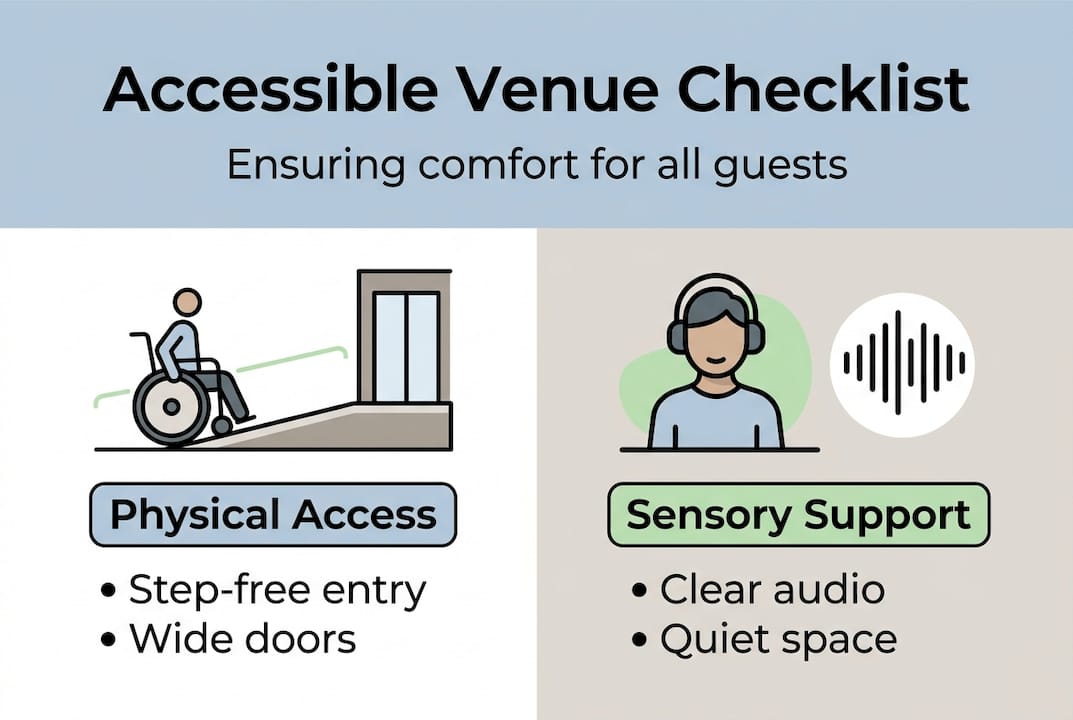
Step-free entries, ramps, wide doors, and accessible restrooms form the foundation of any wheelchair-friendly event space. But the list goes further than that.
| Feature | What to look for |
|---|---|
| Entry access | Step-free or ramped, firm and level surface |
| Door width | Minimum 820mm clear opening |
| Pathways | Level, firm, no loose gravel or uneven paving |
| Restrooms | Wide cubicles, grab rails, non-slip floors |
| Parking | Accessible bays close to the entrance |
| Hearing support | Hearing loop or PA system with clear audio |
| Signage | Large print, tactile, or visual cues |
| Sensory space | Quiet room or low-stimulation area available |
| Communication | Auslan interpreter option, captions, written materials |
Beyond the physical features, think about audio and visual supports. A PA system that crackles or a room with poor acoustics can make speeches completely inaccessible for guests with hearing loss. Clear, well-positioned signage helps guests with cognitive or visual differences navigate confidently.
Dietary communication is also part of accessibility. Guests with severe allergies or specific dietary needs should be able to access clear, written information about the menu. This is often overlooked but matters enormously.
A solid venue checklist will help you stay organised during site visits. Pairing it with research into key venue features gives you a strong foundation before you even step through the door.
Pro Tip: Don’t rely on photos or website descriptions alone. Visit the venue in person and physically test the access routes yourself. Walk the full path a guest using a wheelchair or pram would take, from the car park to the ceremony space to the restrooms.
Common misconceptions about accessibility
It’s easy to assume you know what accessibility looks like, but let’s separate myth from reality. Several common misconceptions lead couples to book venues that fall short for their guests.
Accessibility is broader than most realise, and confirmation is needed beyond what venues claim online. Here are the most frequent myths:
- “The venue says it’s accessible, so it is.” Labels on websites are not regulated. A venue might meet minimum legal requirements but still be impractical for many guests.
- “A ramp at the entrance is enough.” Ramps address one barrier. Door widths, restroom design, pathway surfaces, and sensory needs are separate issues that require separate checks.
- “Accessibility is only for wheelchair users.” Guests with vision impairments, hearing loss, cognitive differences, chronic fatigue, or anxiety all have distinct needs that ramps don’t address.
- “Heritage or rustic venues can’t be accessible.” Many older venues in Adelaide have made thoughtful modifications. Don’t rule them out without checking directly.
- “The venue coordinator would have told us if there were issues.” Coordinators may not be aware of every guest’s specific needs unless you ask targeted questions.
“Couples should never assume a venue’s accessibility claims are complete. Ask for specifics, request a demonstration, and speak to recent couples who’ve hosted events there.”
Knowing the right questions for venues makes a real difference. You can also review a broader list of venue questions to make sure nothing slips through.
Pro Tip: Ask the venue to walk you through the full guest journey for someone using a wheelchair. If they hesitate or can’t answer clearly, that’s a signal worth noting.
How to assess accessibility when viewing venues
With common myths in mind, here’s how to make sure your venue will truly work for everyone. A structured approach turns a general site visit into a thorough accessibility audit.
Verifying accessibility claims during tours means looking for specifics, not accepting vague assurances. Follow this sequence:
- Research before you visit. Review the venue’s website, photos, and any guest reviews that mention accessibility.
- Ask targeted questions before booking a tour. Confirm door widths, restroom specs, and parking availability in advance.
- Tour with purpose. Walk every route a guest with mobility, sensory, or communication needs would use.
- Check the details. Test doors, inspect restrooms, look at pathway surfaces, and assess lighting levels.
- Confirm in writing. Any accessibility features the venue promises should be documented before you sign a contract.
| What to check | Specific detail to confirm |
|---|---|
| Entry ramp | Gradient no steeper than 1:14, firm surface |
| Door width | 820mm minimum clear opening |
| Restroom | Turning circle 1500mm, grab rails fitted |
| Parking | Accessible bay within 50m of entrance |
| Hearing loop | Installed and tested, covers ceremony space |
| Quiet space | Available and clearly signposted |
| Pathways | No loose gravel, no steep grades |
For broader wheelchair accessibility advice, specialist resources can help you understand what standards to expect. Pairing that with disaster avoidance tips and a clear list of key venue questions puts you in a strong position.
Pro Tip: If you have a guest with lived experience of disability, invite them to the site visit. Their perspective will reveal things you’d never notice on your own.
Why inclusive weddings create memorable experiences for all
Once accessibility is embedded in your choices, the results go beyond logistics. They shape memories. When every guest can move freely, participate fully, and feel genuinely welcomed, the atmosphere of your wedding changes.
Accessibility benefits a wide range of guests, not just those with permanent disabilities. Think about what full participation looks like in practice:
- A grandparent who uses a walker can sit close to the ceremony without navigating steps
- A guest with hearing loss can follow the speeches clearly with a working PA system
- A parent with a newborn can use a quiet room without missing the reception
- A friend with anxiety has a low-sensory space to retreat to if the crowd becomes overwhelming
- A guest with a temporary injury doesn’t have to feel like a burden navigating the venue
Inclusion is a mark of care. It signals to every person at your wedding that their presence matters and that you thought of them when making decisions. That feeling is something guests remember long after the flowers have wilted.
For venues, accessibility also builds reputation. Couples talk. When a venue handles diverse needs with grace and preparation, word spreads. It becomes a point of difference that attracts future bookings.
Planning an inclusive wedding starts with choosing the perfect venue with the right priorities in mind. Accessibility doesn’t limit your options. It focuses them.
Key stat: According to the Australian Bureau of Statistics, approximately 1 in 5 Australians lives with some form of disability. At a wedding of 100 guests, that’s potentially 20 people whose experience depends on how well your venue is designed.
Perspective: Why ‘good enough’ isn’t enough — what we’ve seen couples miss
After working closely with Adelaide venues and couples, a clear pattern emerges. The details that get missed aren’t the obvious ones. Nobody forgets to ask about ramps. What gets overlooked is almost always the restrooms, the quiet spaces, and the communication supports.
Accessible restrooms are, without question, the most underprepared feature at otherwise well-intentioned venues. A venue might have a wide entrance and a smooth pathway, but if the accessible restroom is shared with a storage cupboard or located at the opposite end of the building, it creates real stress on the day.
Quiet spaces are rarely listed in venue brochures, but they’re invaluable. Guests with sensory sensitivities, anxiety, or fatigue need somewhere to decompress without leaving the event entirely. Ask venues directly whether this exists and where it is.
Our honest advice: ask venues to demonstrate their accessibility features, not just describe them. Walk the restroom. Test the hearing loop. Check the venue must-haves against what you actually see. And seek feedback from couples who’ve recently held events there. A recent review from a guest who uses a wheelchair is worth more than any brochure.
Find accessible Adelaide wedding venues with ease
Finding a venue that genuinely meets your accessibility needs doesn’t have to be a process of trial and error. The right tools make it far simpler.
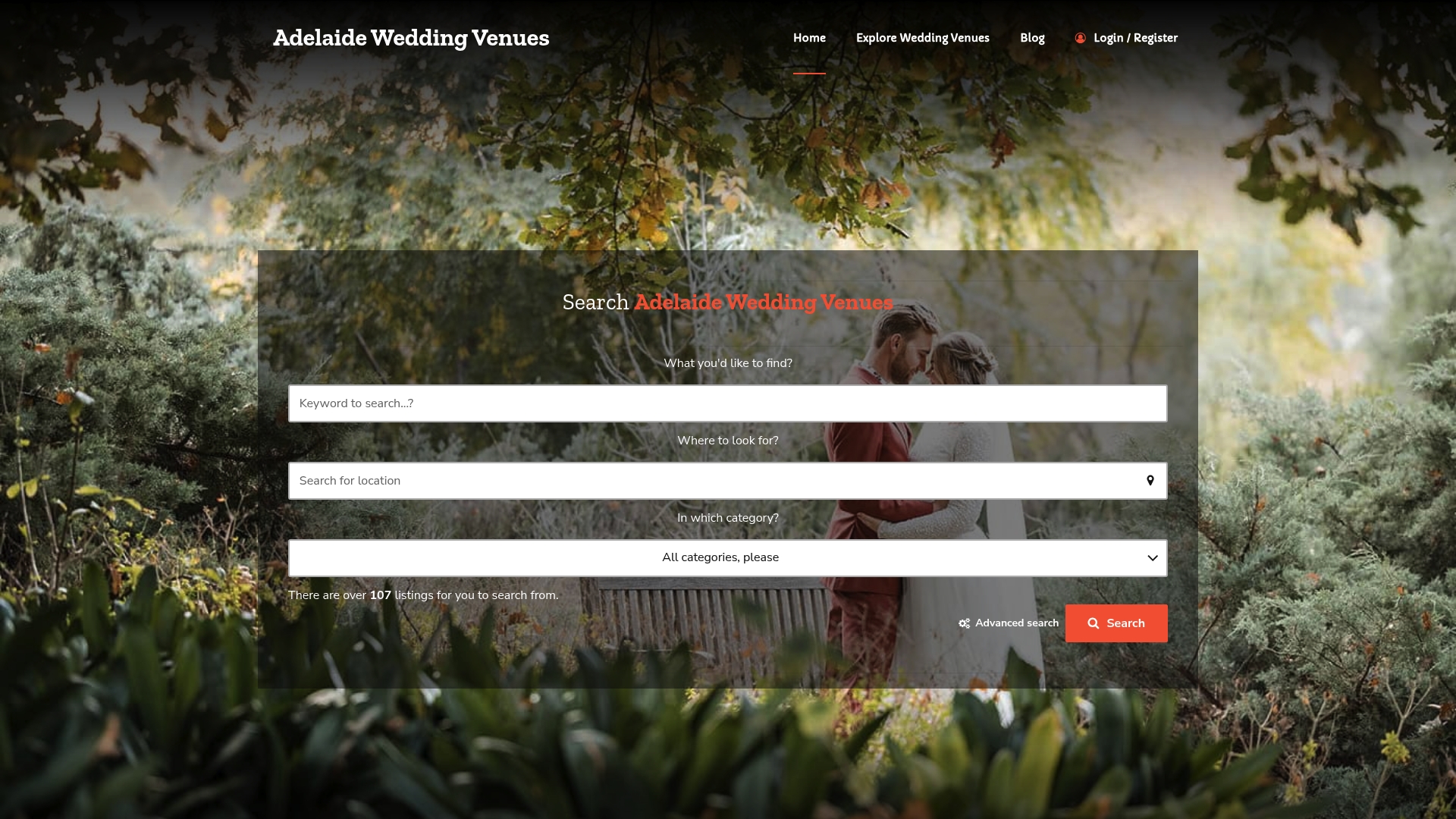
At Adelaide Wedding Venues, we’ve built a directory specifically to help couples like you find venues that match your priorities, including accessibility features, location, size, and style. Whether you’re drawn to rustic barns or beachside settings, our curated lists make it easy to shortlist venues worth visiting. Browse the best Adelaide venues and use our filters to narrow your search. The Adelaide Wedding Venues directory is your starting point for finding a space where every guest feels at home.
Frequently asked questions
What is venue accessibility in an Adelaide wedding context?
Venue accessibility means a wedding location enables all guests, regardless of mobility, sensory, or communication needs, to attend and participate comfortably. This includes step-free entrances, ramps, wide doorways, and accessible restrooms as a minimum standard.
Do all Adelaide venues have to be wheelchair accessible?
Not every venue is legally required to be fully wheelchair accessible, but the best wedding venues follow Australian standards and prioritise inclusivity as part of their service offering.
What should I check during a site visit for venue accessibility?
Check for step-free access, ramp gradients, restroom features, accessible parking, and confirm whether communication support or quiet spaces are available. Verify accessibility claims with specifics during the tour rather than relying on brochure descriptions.
Why does accessibility matter for our wedding guests?
Accessibility ensures all loved ones, from grandparents to parents with young children, can fully enjoy your celebration. Accessibility benefits all, not just guests who use mobility aids, making it a worthwhile priority for every couple.
