
TL;DR:
- Venue reputation is the most reliable indicator of successful events because it reflects operational reliability and consistency. Professional planners prioritize responsiveness, transparency, and endorsements, while couples seek social proof and emotional assurance from reviews and visibility. Maintaining a strong reputation requires ongoing delivery of quality service, clear communication, and community trust, which directly influence booking decisions.
Venue reputation is the single most reliable indicator of whether a wedding or event will unfold as planned or unravel under pressure. For engaged couples and professional event planners alike, reputation signals far more than aesthetics. It communicates reliability, operational maturity, and the likelihood of a stress-free experience. Research from Tripleseat’s Q1 2026 Consumer Event Planning Insights confirms that 77% of consumers identify a venue’s responsiveness to inquiries as a highly important decision factor. That single statistic reframes the entire venue selection conversation: couples and planners are not simply buying a beautiful space. They are purchasing confidence.
How venue reputation shapes event planner decisions
Professional event planners treat venue selection as a form of risk management. When a planner recommends a venue to a client, their own professional credibility is attached to that recommendation. Expert Heather Apse, cited by Tripleseat, confirms that planners book venues as a risk-mitigation strategy, relying specifically on venues that project clear communication and professionalism. A venue that responds slowly, provides vague information, or lacks transparent processes is not just inconvenient. It is a liability.
The signals planners read early in the inquiry process are telling. How quickly does the venue respond? Is the information clear and complete? Are there online payment portals, digital contracts, or organised booking systems in place? These are not minor conveniences. Consistent communication and organisational professionalism reduce a planner’s cognitive load and directly drive booking decisions. A venue that handles the administrative side smoothly is far more likely to handle the high-pressure moments of an actual event with the same composure.
Tripleseat’s analysis of planner psychology makes the competitive dynamic clear: in a saturated market, the venue providing the most certainty through technology and transparency wins over those with just the most striking décor. This is a counterintuitive but important truth. A breathtaking ballroom with disorganised management will lose bookings to a modest hall with a flawless communication record.
Here is what professional planners specifically look for when assessing a venue’s reputation:
- Inquiry response time. A slow reply to an initial enquiry is treated as a preview of event-day communication.
- Clarity of contracts and pricing. Ambiguity in documentation signals potential disputes later.
- Technology integration. Online portals, digital proposals, and automated confirmations indicate operational maturity.
- Staff consistency. High staff turnover at a venue is a red flag for planners who need reliable points of contact.
- Peer endorsements. Recommendations from other planners carry more weight than any marketing material.
Pro Tip: Before committing to a venue, send an initial enquiry and note exactly how long it takes to receive a substantive reply. A venue that responds within a few hours with clear, personalised information is demonstrating the same attentiveness it will show your guests on the day.
What do couples look for in a venue’s reputation?
Engaged couples approach venue reputation from a different but equally valid angle. Where planners prioritise operational reliability, couples prioritise emotional assurance. They want to know that their wedding day will feel as magical as the photos suggest, without any behind-the-scenes chaos bleeding through. The gap between a venue’s marketing imagery and its actual operational reality is precisely where reputation does its most important work.

Online reviews and real event storytelling help planners and couples form confident expectations before site visits even occur. Reading about another couple’s experience at a venue, including the specific details about how staff handled a last-minute weather change or a catering delay, provides a level of reassurance that no brochure can replicate. Adelaideweddingvenues encourages couples to read venue reviews in wedding planning as a foundational step, not an afterthought.
Couples also rely on social proof in ways that are sometimes unconscious. A venue that has hosted high-profile or visually documented weddings carries an implicit endorsement. When a couple sees a venue featured repeatedly in wedding blogs, local publications, or the portfolios of respected photographers, that visibility functions as a trust signal. It tells them that other discerning people have already vetted the space and found it worthy.
The key reputation factors couples weigh include:
- Verified testimonials from real couples, ideally with specific details about service quality and staff responsiveness.
- Authentic event recaps in blog or social media format that show the venue in real use, not just styled shoots.
- Photographer and vendor endorsements, since suppliers who regularly work at a venue know its operational strengths and weaknesses intimately.
- Consistency of presentation, meaning the venue looks and functions the same across multiple events, not just on its best day.
What builds and sustains a strong venue reputation?
Venue reputation is not built overnight, and it cannot be manufactured through marketing alone. According to analysis by Vogue of fashion and luxury event venues, lasting credibility comes through consistent delivery, community-building, and trusted insider networks. This principle applies equally to wedding venues in Adelaide and South Australia. The venues that earn the strongest reputations are those that show up reliably, event after event, year after year.
The following factors are the primary drivers of long-term venue reputation:
- Consistent event delivery. Every event is a public performance. A venue that delivers on its promises across dozens of weddings builds a compounding record of trust.
- High-profile event endorsements. Hosting a notable event, whether a charity gala, a high-profile corporate function, or a widely photographed wedding, generates a halo effect. Research on mega-event branding confirms that high-profile endorsements elevate a venue’s reputation considerably, while logistics failures can damage it just as quickly.
- Insider network relationships. Endorsements from artists and agents significantly influence a venue’s reputation beyond its public marketing. In the wedding industry, the equivalent is the endorsement of photographers, florists, and caterers who work across many venues and speak candidly within their professional networks.
- Backstage hospitality. How a venue treats its vendors and suppliers matters. Vendors who are well-supported, given adequate space, and treated with respect become advocates. Those who are not become quiet detractors.
- Cultural literacy. Venues that understand the specific needs of their niche, whether that is intimate garden weddings, large multicultural celebrations, or heritage property events, build reputations as specialists rather than generalists.
“Venues that consistently deliver a stress-free experience earn long-term insider endorsements that transcend budget or location.” — Twitchcon venue expert insights, 2026
The risk side of this equation deserves equal attention. A single logistics failure at a high-visibility event can undo years of goodwill. Venues that build exposure through community engagement understand that reputation is a continuous investment, not a one-time achievement.
How to assess venue reputation before you book
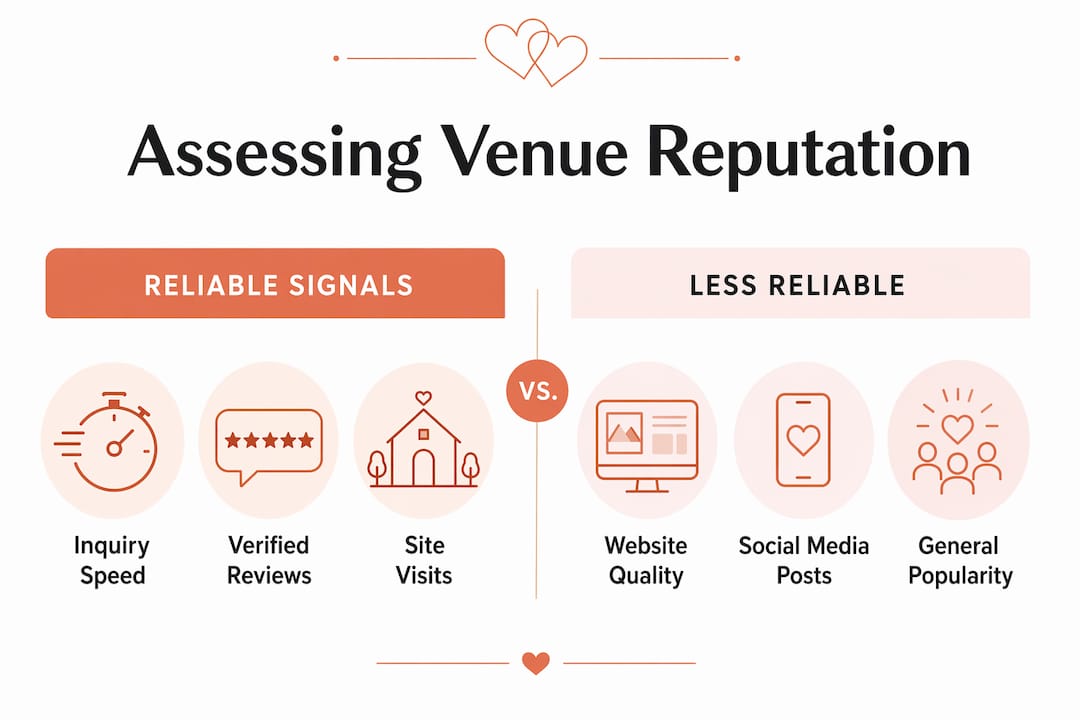
Assessing a venue’s reputation requires looking beyond its website and social media presence. The most reliable signals come from behaviour, not branding. Rapid and transparent responses build trust and influence selection before site visits even occur, which means the inquiry process itself is a reputation test.
The table below compares the most useful reputation signals against the less reliable ones:
| Reliable reputation signal | Less reliable indicator |
|---|---|
| Response time to initial enquiry | Quality of venue photography on website |
| Specificity and clarity of initial proposal | Number of social media followers |
| Verified reviews with event-specific detail | Generic five-star ratings without context |
| Vendor and photographer endorsements | Awards listed without independent verification |
| Transparency of contract and pricing terms | Testimonials displayed only on the venue’s own website |
Touring a venue in person remains one of the most effective ways to validate its reputation. Adelaideweddingvenues recommends that couples tour venues before booking to confirm that the real experience matches what the reputation suggests. Pay attention to how staff interact with each other, how the space is maintained on a non-event day, and whether the coordinator answers questions directly or deflects.
A venue’s online presence in 2026 also functions as a reputation signal. Venues that actively maintain their listings, respond to reviews publicly, and keep their information current are demonstrating the same attentiveness they bring to event management.
Pro Tip: Ask the venue coordinator for the contact details of two or three couples who held their wedding there in the past 12 months. A venue confident in its reputation will provide these without hesitation. One that deflects or offers only curated testimonials is worth approaching with caution.
Key takeaways
Venue reputation is the most dependable predictor of event success because it reflects consistent operational performance, not just visual appeal.
| Point | Details |
|---|---|
| Reputation signals reliability | How a venue handles enquiries predicts how it will manage your event under pressure. |
| Planners prioritise certainty over aesthetics | Transparent processes and fast communication win bookings over beautiful spaces with poor organisation. |
| Couples rely on social proof | Verified reviews, vendor endorsements, and authentic event recaps build genuine confidence. |
| Reputation is built through consistency | High-profile endorsements and insider networks compound over time to create lasting credibility. |
| Assess behaviour, not branding | Inquiry response time and contract clarity are more reliable than photography or follower counts. |
Why reputation matters more than ever in 2026
I have spent considerable time working with venues across South Australia, and the pattern I keep returning to is this: the venues that couples remember fondly are almost never the ones with the most dramatic architecture. They are the ones where nothing went wrong, or where something did go wrong and the team handled it so smoothly that the couple barely noticed.
What I find genuinely underappreciated is how much of a venue’s reputation is formed in the weeks before the event, not on the day itself. The way a coordinator responds to a nervous email at 10pm, the clarity of a revised quote, the speed with which a floor plan question gets answered. These micro-interactions accumulate into an overall impression that either builds or erodes confidence. By the time the wedding day arrives, couples who have experienced attentive pre-event communication are already relaxed. Those who have been chasing responses are already on edge.
The digital communication environment of 2026 has accelerated this dynamic considerably. Couples now expect replies within hours, not days. Venues that have not adapted their communication practices to this expectation are losing bookings to competitors who have, regardless of how beautiful their spaces are. I also think there is a meaningful difference between a venue that looks good on Instagram and one that operates well under pressure. The former is easy to identify. The latter requires the kind of careful assessment this article describes. Invest the time early. It pays off far more reliably than any amount of scrolling through venue galleries.
— Steven
Find your ideal venue on Adelaideweddingvenues
Adelaideweddingvenues brings together a curated selection of wedding venues across Adelaide and South Australia, making it straightforward to compare spaces by style, capacity, location, and budget. Every listing is maintained by industry professionals who understand what couples and planners actually need from a venue, not just what looks good in a photograph.
Whether you are drawn to a heritage property in the Adelaide Hills, a beachside setting on the Fleurieu Peninsula, or an intimate garden venue in the city, the platform’s search tools help you find spaces that match your vision and your standards. Start with the ideal wedding venue guide to understand how to weigh reputation, style, and practicality together. For couples who want a structured approach to the full decision, the perfect venue guide covers every consideration from first enquiry to final booking.
FAQ
What does venue reputation actually mean?
Venue reputation is the collective perception of a venue’s reliability, communication quality, and ability to deliver a successful event, formed through reviews, endorsements, and consistent performance over time. It is distinct from visual appeal and reflects operational reality rather than marketing presentation.
How does venue reputation affect wedding planning decisions?
Venue reputation affects wedding planning by providing couples and planners with confidence that the space will perform as promised. Research shows that responsiveness to enquiries is a top decision factor for 77% of consumers, making communication behaviour a direct driver of booking choices.
What are the most reliable ways of assessing venue reputation?
The most reliable methods include checking inquiry response times, reading verified reviews with event-specific detail, speaking directly with past clients, and touring the venue on a non-event day to observe staff behaviour and facility maintenance.
Why do event planners prioritise venue reputation over aesthetics?
Professional planners prioritise reputation because their own credibility is tied to the venues they recommend. A venue with dependable communication and professionalism reduces the planner’s professional risk, while a visually impressive but disorganised venue creates liability regardless of how beautiful it photographs.
Can a venue recover from a damaged reputation?
A venue can recover, but it requires sustained consistent performance over time rather than a single corrective action. High-profile event endorsements can accelerate recovery, but insider networks within the wedding and events industry retain institutional memory, making prevention far more effective than repair.
