
There is no single wedding alcohol closing time in South Australia. Authorised trading hours are set on the venue’s own liquor licence under the Liquor Licensing Act 1997, so two reception venues five minutes apart can have completely different cutoffs. Extending past those licensed hours means the venue applies to Consumer and Business Services (CBS), which can trigger a community impact submission if the request pushes service past 2:00 am. An approved responsible person and RSA-trained staff are non-negotiable regardless of what time drinks stop flowing.
TL;DR:
- Most venues cannot extend alcohol service past their authorized trading hours without a formal application, which can take weeks and may be rejected due to community concerns.
- Liquor licensing categories influence venue hours; on-premises licenses often allow later service, while club and restaurant licenses can impose tighter restrictions.
- All staff serving alcohol must have current RSA certification, and the responsible person who is on-site must be approved and identifiable at the venue.
- Venue owners must comply with the late-night trading code if trading past 2:00 am, which limits patron re-entry after 3:00 am, affecting guest movement plans.
- Clarify license and responsible person details in writing before booking, and request specific contract terms to avoid last-minute compliance issues.
Quick checklist for booking a wedding venue
Before you sign anything, get these five answers in writing. A venue that hesitates on any of them is telling you something.
- Ask for the venue’s authorised trading hours, ideally a copy or summary of the actual liquor licence, not a verbal assurance.
- Confirm who the approved responsible person will be for your event and that they’ll be on-site the entire time, not just for opening.
- Check that every server holds current RSA certification and that the venue keeps records of this on the premises.
- Ask whether the venue is willing to apply to vary trading hours if you want service later than standard, and how long that process realistically takes.
- Check for council or planning conditions that might cap noise or trading hours tighter than the liquor licence itself allows.
That last point catches a lot of couples out. A venue can hold a perfectly valid liquor licence for, say, 1:00 am trading, while a planning consent or noise condition from the local council quietly caps amplified music at 11:00 pm. Two different rulebooks, two different authorities, and only one of them shows up if you just ask “what time do drinks stop?”
How licence types shape your wedding’s drink service hours
Authorised trading hours are the specific windows written into a venue’s liquor licence, and they’re the only legally binding answer to “when does alcohol service end at weddings.” There’s no default; each licence sets its own hours, and CBS guidance is explicit that trading outside those hours simply isn’t permitted, wedding or not.
The licence category matters more than most couples realise. On-premises licences (common for function centres and hotels) tend to carry the broadest hours, often extending into the evening or beyond. Club licences, held by places like golf clubs, RSLs, and sporting associations, are usually tied to member trading patterns and can be more restrictive for a Saturday wedding than you’d expect. Restaurant and catering licences frequently limit alcohol service to accompany a meal, which matters if your reception runs into a late-night bar service after the formal dinner wraps. Small venue licences, designed for boutique operators, often come with lower capacity limits attached to the trading hours themselves.
Where a venue trades past 2:00 am, the late-night trading code of practice kicks in, and it bans entry or re-entry of patrons after 3:00 am. For a wedding, that’s the detail nobody mentions until it’s a problem: if guests step outside for air or a smoke after 3:00 am, they may not be let back in. Plan guest movement around that if your reception runs that late.
None of this means “licensed” equals “available at any hour you want.” A venue holding a valid liquor licence still has to trade within its own authorised hours, and those hours are fixed unless formally varied. It pays to read how licence categories map to venue types before you fall in love with a room, and understanding South Australian wedding venue regulations is a useful starting point if the terminology is new to you.
RSA rules and the responsible person your venue must have on-site
RSA training is mandatory for anyone who sells, offers for sale, or serves alcohol in South Australia, and that net is wider than most couples expect. It captures paid bar staff, sure, but also volunteers pouring wine at a family-run venue and any friend roped in to help behind a makeshift bar, unless a genuinely narrow exemption applies.
New staff aren’t always caught out immediately. Someone freshly hired may have up to three months to complete accredited RSA training before they’re technically non-compliant, but the venue still has to retain evidence of that training on-site. If a venue can’t produce it when asked, that’s a real red flag.
Separately from RSA, an approved responsible person must be physically present whenever the venue is open to the public, and this obligation sits directly in the Liquor Licensing Act 1997. The RP is approved by the Liquor and Gambling Commissioner, wears identification while on duty, and is the person legally accountable for recognising intoxication, refusing service, and making safety calls on the night. CBS guidance on RP approval confirms one approval can cover a person supervising multiple licensed locations, which matters for venues that run several event spaces under one operator.
Practically, this gives you two things to sight before your wedding day:
- The RP’s approval and identification, confirming they’re legitimately authorised for that venue.
- The RSA records for all servers, showing training is current and kept on the premises.
Pro Tip: Ask the venue coordinator to name the responsible person for your specific date at least a month out, not just “someone will be rostered.” Staff rosters shift, and you want a named, confirmed RP locked into your contract, not a promise.
Applying to extend wedding drink service hours: what actually happens
If your venue’s standard hours don’t stretch late enough, the fix isn’t a phone call on the week of the wedding. Venues apply through Liquor and Gaming Online, CBS’s licensing portal, and the application usually needs supporting detail: expected patron numbers, security arrangements, and how noise and crowd movement will be managed.
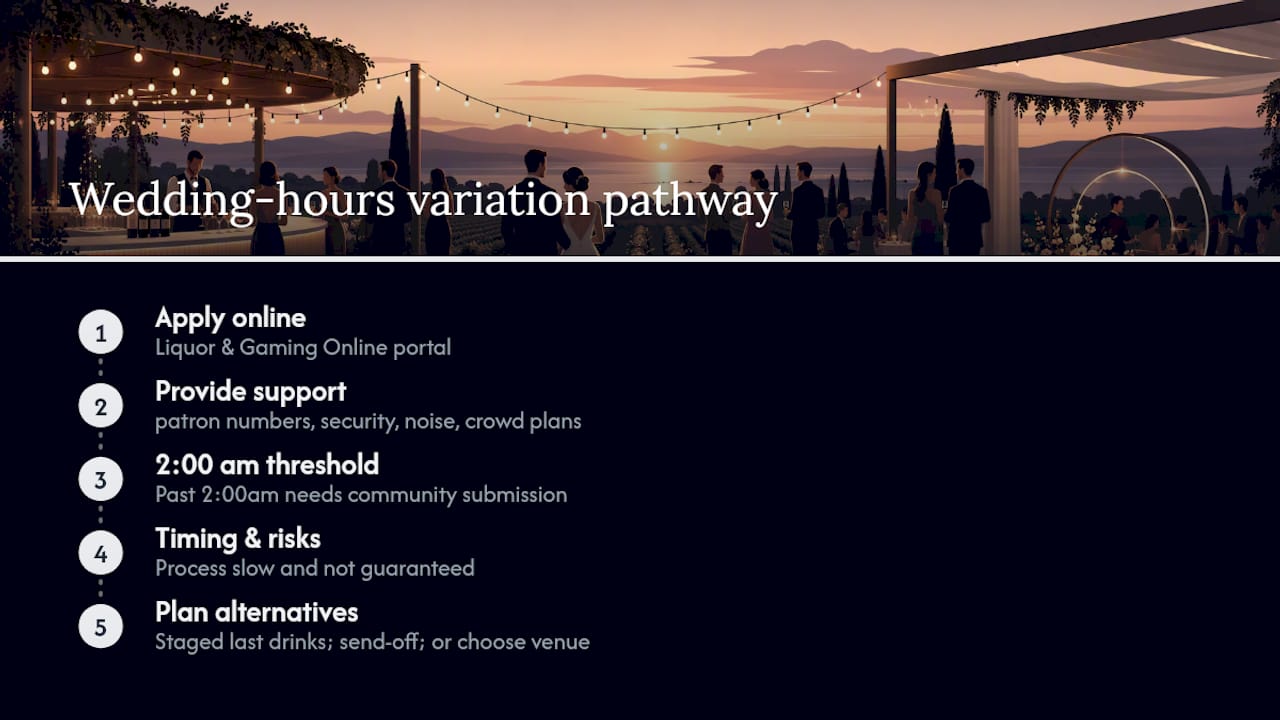
The threshold that matters most for weddings is 2:00 am. Increasing trading hours past that point for on-premises and club licences generally requires a community impact submission, unless the venue already holds authorisation for those later hours. That submission process isn’t fast, and it isn’t guaranteed to succeed.
Build in real lead time. Ask your venue how long their last successful variation took, not how long the process is meant to take in theory. Common reasons applications get knocked back include noise complaints from neighbouring residents, previous incidents on the licence, or council concerns about cumulative impact from repeated late-trading events at the same address. None of these are things a couple can influence from the outside.
If a variation looks unlikely or too slow for your timeline, plan around it instead of against it. A staged “last drinks” call thirty minutes before the licensed cutoff, a champagne send-off instead of a full bar extension, or simply choosing a venue whose standard hours already suit your reception plan, all sidestep the entire variation process.
Questions and scripts to ask your Adelaide venue about alcohol service
Send these as a short, direct email once you’re seriously considering a venue. A good coordinator will answer all of it without blinking.
- “Can you send me a copy or summary of your liquor licence’s authorised trading hours?” This gets you the actual legal answer, not a marketing one.
- “Who will be the approved responsible person for our date, and will they be present the entire event?” Push for a name closer to the date if they can’t confirm one now.
- “Will every staff member serving alcohol at our wedding hold current RSA, and will records be available on the day if we ask?” This is a fair, standard question, not an accusatory one.
- “If we wanted service past your standard hours, would you apply for a variation, and what’s the realistic timeline and cost?” This flags early whether a later reception is even feasible.
- “Can our contract specify the exact end time for alcohol service, and any extra fees for extended hours?” Get it in writing, not verbally promised.
Locking these answers into the venue contract, rather than trusting a verbal chat months out, is the single biggest thing that separates a smooth reception from a last-drinks argument in front of your guests. The essential questions to ask your Adelaide wedding venue guide expands on contract language worth requesting alongside these five.
The real cost of getting it wrong
Non-compliance isn’t a theoretical risk. CBS enforcement can include on-the-spot fines, formal licence review, suspension, or prosecution for serious or repeated breaches, and none of that falls on you directly, but it can absolutely derail your wedding if it happens mid-event.
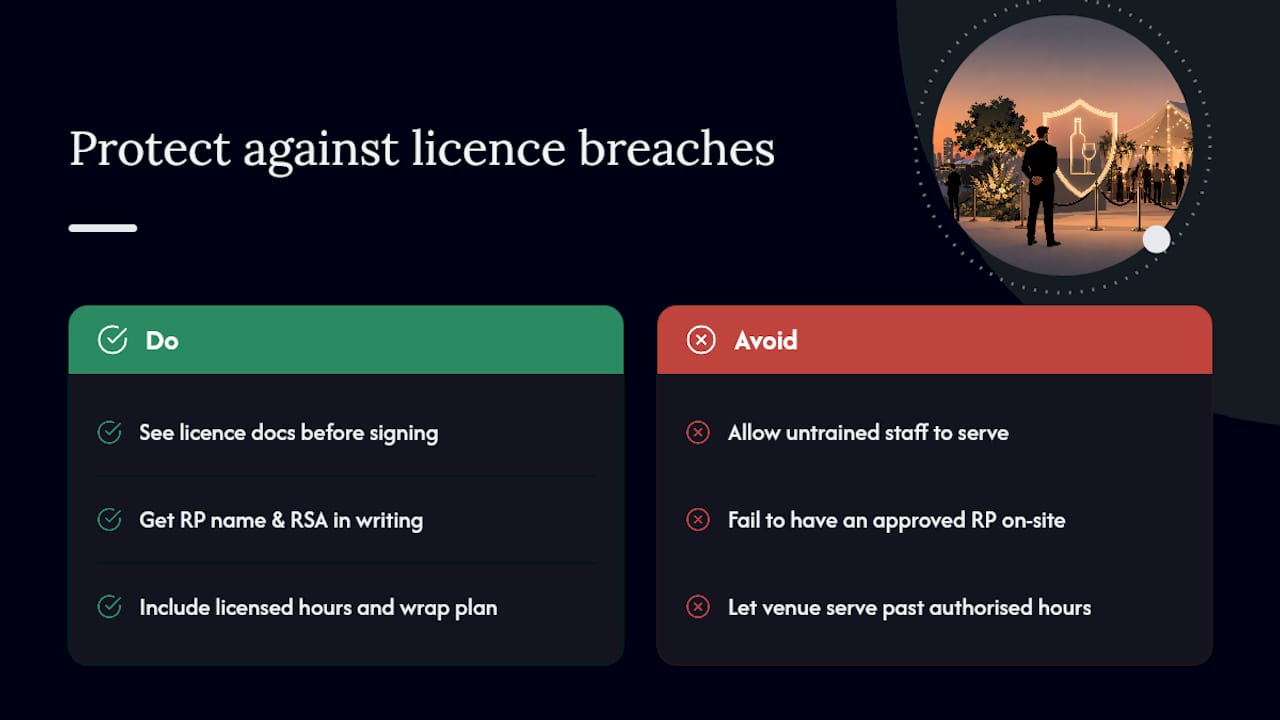
The failures that trigger this are consistently the same: untrained staff serving without RSA, no approved responsible person on-site, or a venue quietly serving past its authorised hours because “it’s just a wedding, no one will notice.” Someone always notices, usually a neighbour who calls it in.
Protecting yourself is straightforward. Insist on seeing licence documentation before you sign, get the RP’s name and RSA confirmation in writing, and have your contract explicitly state the licensed hours and what happens if the event needs to wrap earlier than planned.
How Adelaide Wedding Venues helps you shortlist compliant venues
Sorting through Adelaide’s wedding venues one phone call at a time is slow, and licence conditions vary so much between properties that generic searching wastes time. Adelaideweddingvenues lets you filter by venue type, size, and amenities, narrowing the field to venues more likely to suit the hours and staffing your reception actually needs before you start asking detailed licence questions.
The site’s editorial guides, including breakdowns of how South Australian venue types and licences relate, give you a head start on the terminology before you’re on the phone with a coordinator. Free venue listings mean the directory reflects a genuinely wide slice of Adelaide’s market, not just venues with the biggest advertising budget.
An editor’s take on avoiding licence headaches
Most licence disputes at weddings aren’t really about the law. They’re about a couple assuming “the venue will sort it” and never getting a named responsible person or an end time in writing. Photographers and suppliers feel this first: an unclear finish time means overtime negotiations at 11:00 pm instead of a clean handover.
The fix is unglamorous. Stage your last drinks call before the licensed cutoff, ask for concessions on amplified music rather than a full trading hours variation, and put every agreed change in a contract addendum or email. Paper trails, not promises, are what protect your wedding night.
— Steven
Find a licensed Adelaide venue that already suits your reception timeline
Instead of chasing licence paperwork after you’ve fallen for a venue, Adelaideweddingvenues lets you filter for the right fit from the start, comparing venue type, capacity, and amenities side by side without a single cold call. That’s the real time saving over ringing around Adelaide one venue at a time hoping someone answers the trading hours question honestly.
Every listing links through to venue profiles built for exactly this kind of planning conversation, and the directory’s guide on choosing your ideal wedding venue walks through the practical trade-offs between venue types before you commit. Start your search, shortlist a handful of venues that match your desired hours and guest numbers, then take the checklist questions from this article straight into your first enquiry email.
Sources
- Liquor and Gaming Online (LGO) help — Consumer and Business Services
- Sa
- Liquor Licensing Act 1997 — section 97 (austlii)
For case-specific questions, contact CBS directly on 131 882 or liquorandgaming@sa.gov.au.
FAQ
What time can you legally serve alcohol in South Australia?
There’s no fixed statewide time. Alcohol service must stay within the authorised trading hours listed on the specific venue’s liquor licence, which varies venue to venue.
What is the SA approval process for a responsible person at a wedding?
The Liquor and Gambling Commissioner grants responsible person approval, and that person must be present and wearing identification whenever the venue is open to the public during your reception.
Can you serve alcohol at a wedding without RSA certification in SA?
No. RSA is mandatory for anyone selling, offering, or serving alcohol, including volunteers and friends helping out, with only a very narrow exemption applying outside standard staff roles.
What are the current drink service rules for late-night weddings in South Australia?
Venues trading past 2:00 am must follow the late-night trading code of practice, which prohibits entry or re-entry of patrons after 3:00 am, something worth planning guest movement around.
How long does it take to vary a venue’s trading hours for a wedding?
Timelines vary, but any increase past 2:00 am for on-premises or club licences typically needs a community impact submission, so apply well ahead of your date rather than close to it.
Recommended
- Planning a dry wedding reception in Adelaide: your guide
- Protecting Your Business and Customers: Legal Obligations of Venue Liquor License Holders in South Australia
- Quiet Please! How to Keep Your Wedding Within Noise Restrictions in South Australia
- Understanding South Australian wedding venue regulations
