
TL;DR:
- Compare wedding venue packages carefully by understanding inclusions, exclusions, and hidden costs.
- Use cost per head and detailed comparison tables to evaluate value across venues.
- Ask specific questions about policies, customisation options, and upfront details to avoid surprises.
Choosing a wedding venue in Adelaide should be exciting, but for many couples, it quickly becomes overwhelming. You receive multiple packages, all promising the perfect day, yet each one looks slightly different. Some include catering, others don’t. Some mention decorations, but only in vague terms. The differences between packages are rarely obvious at first glance, and the hidden costs can add up fast. This guide walks you through a clear, step-by-step process for comparing venue packages, so you can make a confident, informed decision without blowing your budget or losing sleep over the details.
Key Takeaways
| Point | Details |
|---|---|
| Compare actual inclusions | Not all venue packages include the same services, so read details carefully. |
| Watch for hidden costs | Unexpected fees can make an affordable venue pricey—ask for all costs upfront. |
| Ask direct questions | Clarify every detail to avoid misunderstandings later. |
| Customise when possible | Negotiate small changes early to make the package fit your needs. |
Understand what’s included in venue packages
To start any comparison, you need to be crystal clear about what’s on offer. Wedding venue packages in Adelaide can look remarkably similar on the surface, but the details tell a very different story. Venue packages can vary widely in included services, such as catering and decorations, which means two packages priced at the same rate could offer completely different value.
Most standard packages include some combination of the following:
- Room hire for the ceremony, reception, or both
- Catering such as a set menu, buffet, or canapes
- Basic decorations including table centrepieces or chair covers
- Audio-visual equipment such as a microphone, speakers, or projector
- Staffing including waitstaff and a venue coordinator
However, many items are commonly left out of the base price. Alcohol is one of the biggest extras, often charged separately as a beverage package or on consumption. Setup and cleanup fees, overtime charges if your event runs long, and parking arrangements are also frequently excluded. Some venues charge extra for cake cutting, external supplier access fees, or even the use of a bridal suite.
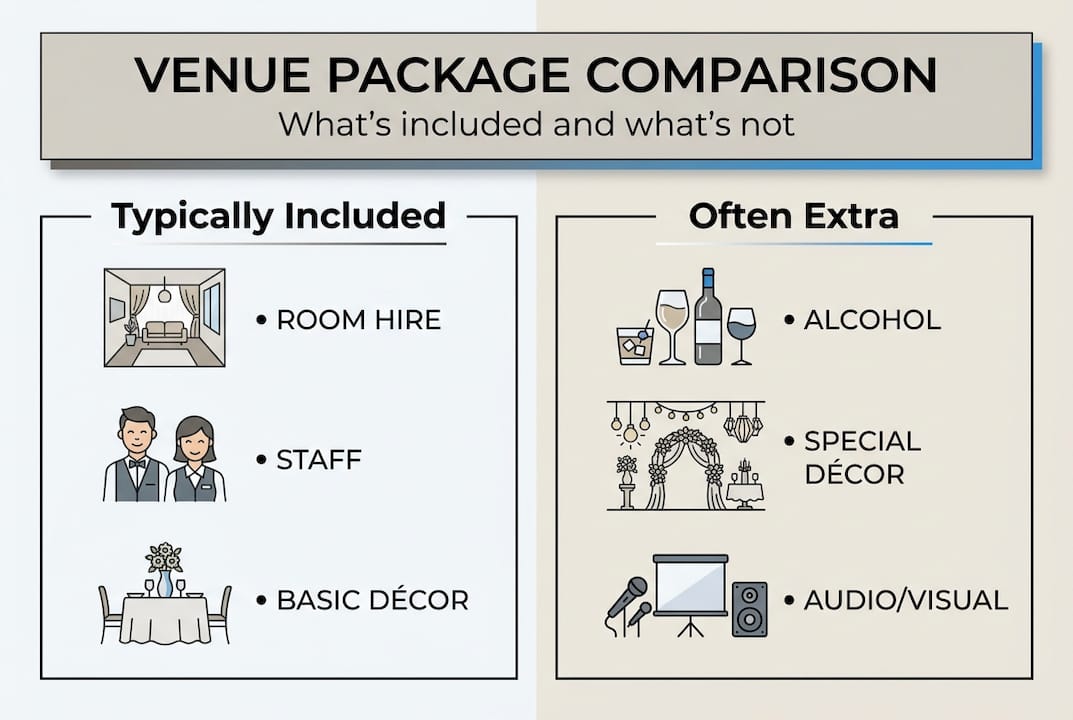
It helps to understand the difference between all-inclusive packages and à la carte pricing. All-inclusive packages bundle everything together at one price, making budgeting simpler but sometimes less flexible. À la carte pricing lets you build your own package, which can be cost-effective if you already have some suppliers locked in, but it requires more careful tracking to avoid overspending.
Here is a general overview of what tends to be included or excluded across common package types:
| Item | All-inclusive package | À la carte package |
|---|---|---|
| Room hire | Usually included | Separate fee |
| Catering (food) | Usually included | Optional add-on |
| Beverages/alcohol | Sometimes included | Usually separate |
| Decorations | Basic inclusions | Optional add-on |
| Staffing | Usually included | Sometimes extra |
| Setup and cleanup | Sometimes included | Often extra |
| AV equipment | Often included | Sometimes extra |
Understanding key factors for wedding venues before you begin comparing packages gives you a clearer sense of what genuinely matters for your day.
Pro Tip: Ask each venue to provide a full written list of inclusions and exclusions before you compare prices. A verbal summary is easy to misremember and can lead to misunderstandings later.
Compare costs and value across venues
Once you know what’s in the package, it’s time to put numbers side-by-side. Comparing venue costs fairly requires more than looking at the headline price. You need to break down every component so you’re comparing like with like.
Start by calculating the cost per head. Divide the total package price by the number of guests it covers. This gives you a useful baseline figure that makes it easier to compare venues with different guest capacities. A venue quoting $8,000 for 80 guests is actually cheaper per person than one quoting $7,500 for 60 guests.
Next, list out all the extras you’d need to add to make each package complete for your day. This is where the real differences emerge. Hidden charges can quickly increase the total wedding venue cost well beyond what the initial quote suggests. Common surprise costs include corkage fees, external catering surcharges, and charges for late finishes.
Venue costs are consistently one of the largest items in a couple’s total wedding budget, often accounting for 30 to 50 per cent of overall spend. That makes getting the comparison right especially important.
Use a simple comparison table like this to keep track:
| Venue | Base price | Extras needed | Estimated total | Cost per head |
|---|---|---|---|---|
| Venue A | $6,500 | $1,200 | $7,700 | $96 |
| Venue B | $5,800 | $2,400 | $8,200 | $103 |
| Venue C | $7,200 | $400 | $7,600 | $95 |
In this example, Venue C offers the best overall value despite having the highest base price, because its extras are minimal.
Here is a step-by-step approach to cost comparison:
- Request itemised quotes from every venue you’re seriously considering.
- Add the cost of any missing inclusions to each quote.
- Calculate the cost per head for each venue.
- Note any value-adds such as complimentary tastings, extra hire time, or included styling.
- Flag any limitations such as noise curfews, guest caps, or restricted vendor lists.
Reviewing unexpected wedding expenses before you finalise any comparison is a smart move. Equally, working through a wedding venue budget checklist helps you track every line item without missing anything.
Ask the right questions before booking
Even a side-by-side table won’t help if key questions go unasked. Some of the most important details about a venue package are never written in the brochure. Knowing what to ask can prevent costly mistakes and miscommunications that are difficult to resolve after you’ve signed a contract.
When you meet with a venue coordinator, come prepared with a clear list of questions. Here are the most important ones to cover:
- What is the minimum spend requirement, and does it change by day of the week?
- What is the maximum guest capacity for both ceremony and reception spaces?
- What is the payment schedule, and when is the final balance due?
- Are external caterers or suppliers permitted, and are there any associated fees?
- What happens if we need to extend the event beyond the agreed finish time?
- Is there a dedicated coordinator on the day, or will staff change over?
- What is the wet weather or contingency plan for outdoor ceremonies?
- What are the cancellation and date-change policies?
Always ask for written confirmation of every detail discussed during your venue inspection. Verbal agreements are difficult to enforce, and memories fade between the initial visit and the wedding day itself.
Cancellation policies deserve particular attention. Some venues charge a flat fee for cancellations within a certain timeframe, while others retain a percentage of the total booking value. Date-change policies also vary widely. Some venues allow one free date change, while others treat it as a new booking entirely.
Reviewing questions for your venue before your inspection ensures you don’t leave anything important uncovered. It also helps to work through a wedding venue checklist to confirm every practical detail is addressed.
Pro Tip: Take notes during every venue visit and follow up with a brief email summarising what was discussed. This creates a written record and gives the venue coordinator a chance to correct anything that was misunderstood.
Tailor the package to fit your unique day
After you’ve compared and asked questions, personalising is the last piece of the puzzle. Most couples assume that a venue package is fixed, but that’s rarely the case. Many venues are open to some level of package customisation if asked politely and early in the process.
Here is a practical approach to negotiating and tailoring a package:
- Identify your non-negotiables first. Know which elements are essential before you enter any negotiation. For example, if you need halal catering or a specific ceremony time, raise these early.
- Ask about off-peak discounts. Venues are often more flexible on price for weekday weddings, winter dates, or events booked well in advance.
- Request menu upgrades or substitutions. Many venues will swap a standard menu item for something that better suits your guests’ dietary needs without a significant price increase.
- Negotiate additional time. If the standard package ends at 10pm but you’d like midnight, ask what the cost would be to extend. Sometimes this is negotiable, especially for larger bookings.
- Ask about complimentary extras. Venues sometimes offer added value such as a complimentary tasting, upgraded linen, or a later checkout for the bridal suite, especially if you book early or refer other couples.
Cultural and accessibility requirements are also worth raising directly. Adelaide venues are increasingly experienced with multicultural weddings and dietary requirements including vegan, gluten-free, and kosher menus. Accessibility considerations such as ramp access, accessible bathrooms, and parking proximity matter for guests with mobility needs and should be confirmed in writing.
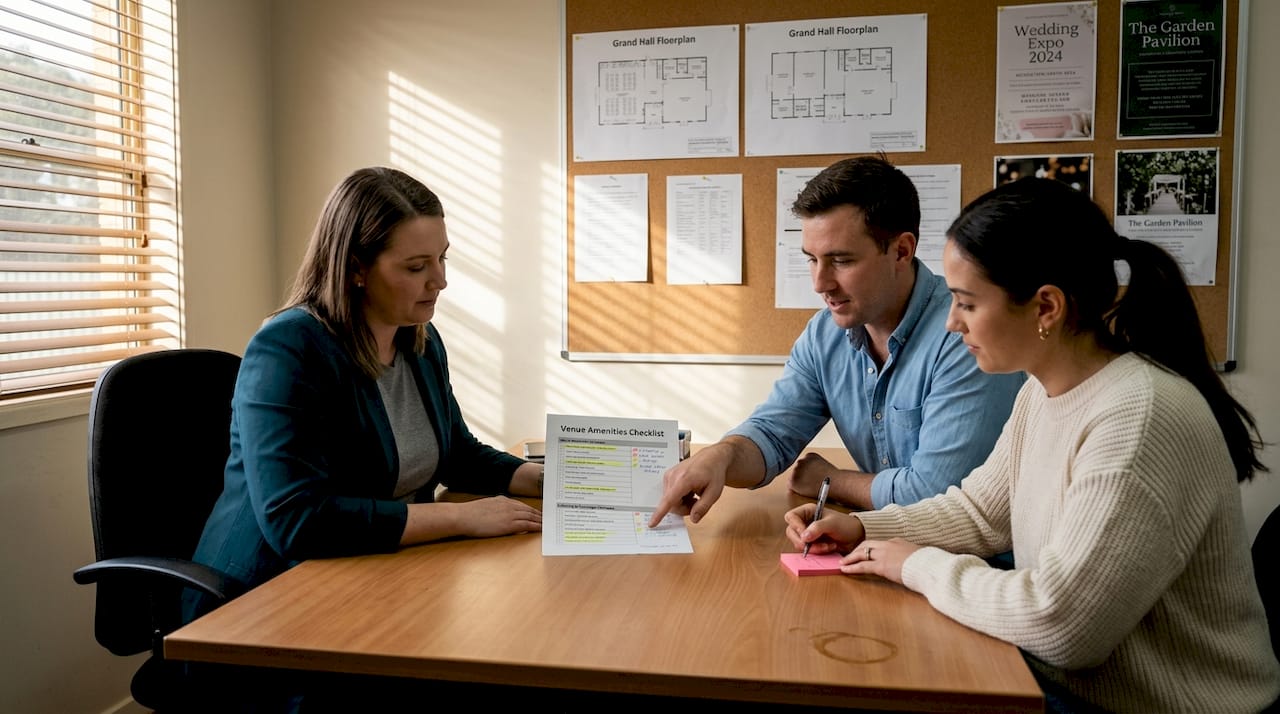
Exploring amenities at luxury venues can also give you a clearer picture of what’s possible when you negotiate upgrades. Reviewing tips on negotiating venue packages before your next venue meeting will help you approach the conversation with confidence.
Pro Tip: Frame your requests around what you value most, not just what you want to save. Venues respond better when they understand your vision rather than feeling like they’re simply being asked for a discount.
Our experience: What most couples miss when comparing venue packages
After working with dozens of Adelaide couples through the venue selection process, a few truths have become clear. The most common mistake is focusing almost entirely on price while overlooking fit, flexibility, and the quality of support offered by the venue team.
A venue that’s transparent about its packages from the very first enquiry is worth more than one that offers a lower price but requires constant follow-up to clarify what’s actually included. Transparency saves time, reduces stress, and builds trust before the wedding day even arrives.
Comparison overload is also a real problem. Couples who visit ten venues without a clear sense of their own priorities often feel more confused at the end than at the start. Narrowing your values early, whether that’s outdoor space, in-house catering, or a specific guest count, makes every comparison more meaningful.
Using structured tools like comparison tables and checklists isn’t just practical. It actively reduces anxiety by turning a subjective, emotional decision into something you can evaluate clearly. Reviewing a venue decision guide before you begin shortlisting can help you build a framework that reflects what actually matters to you as a couple.
Find and compare your perfect Adelaide venue
Ready to apply what you’ve learned? Here’s the easiest way to move forward.
Adelaide Wedding Venues makes it straightforward to browse, filter, and compare real venue packages across South Australia. Whether you’re looking for a garden ceremony, a waterfront reception, or something entirely unexpected, the Adelaide Wedding Venues platform lets you search by location, capacity, and style all in one place. Explore unique wedding venues in Adelaide to discover options you might not have considered, or use the guidance on how to choose your ideal wedding venue to refine your shortlist. The right venue is out there, and the right tools make finding it much less stressful.
Frequently asked questions
What should I look for in a wedding venue package?
Check what is included such as catering, decorations, setup, and any extras to avoid hidden surprises. Venue packages can include or exclude key elements like food and decorations, so always request a full written breakdown.
How do I compare wedding venue prices fairly?
Break down costs per guest, factor in extras and hidden fees, and use a comparison table to view all costs side by side. Hidden charges can quickly increase the total venue cost beyond the initial quote.
Can I negotiate with a venue to get a better package?
Yes, many venues are open to customisations or slight discounts, especially for off-peak dates or larger groups. Venues can be flexible if you ask for specific customisations early in the booking process.
What are common mistakes when comparing venue packages?
Not clarifying inclusions and exclusions, ignoring minimum spends and payment timelines, or overlooking extra charges for overtime and add-ons. Knowing what to ask helps couples avoid booking mistakes that are costly to fix later.
