
An industry professional turns hands‑on, specialist knowledge into decisions, delivery and capability building that internal teams often cannot supply alone. They advise on strategy, validate technical approaches, oversee execution, train others and clarify compliance requirements that would otherwise cost an organisation time or money to work out independently.
The role generally covers:
- Advice — providing an outside, experience‑based view on plans, risks and options.
- Validation — checking that a design, process or budget will actually hold up in practice.
- Execution oversight — managing delivery so plans survive contact with the real world.
- Capability building — training staff, mentoring juniors and lifting the skill level of a team.
- Compliance and technical clarification — interpreting standards, licences and regulatory detail non‑specialists can misread.
The sections below unpack each of these functions, show how organisations actually engage professionals, and set out how to evaluate one before you sign a contract.
Key Takeaways
The role of industry professionals is to translate hands‑on, sector‑specific experience into decisions, execution and capability building that internal teams cannot reliably deliver alone.
| Point | Details |
|---|---|
| Function over title | Judge a professional by demonstrable projects and references, not by their job title alone. |
| Match the engagement model | Choose advisory panels, consultants or embedded contractors based on scope, cost and timeline needs. |
| Benefits split by audience | Organisations gain speed and risk reduction; learners gain mentorship and employability skills. |
| Scope before you hire | A tight brief with clear success criteria prevents most disputes that surface later. |
| Reputation compounds slowly | Credible expertise builds through visibility, continuous learning and consistent delivered outcomes. |
Core functions of industry professionals
Industry professionals earn their keep in five recurring functions, and most engagements draw on more than one at once.
Technical execution and implementation. This is the hands‑on work: building the thing, running the process, or fixing the fault that internal staff can identify but not resolve. A structural engineer called in to certify a load‑bearing change on a heritage building does not just write a report. They specify the fix, and that fix has to satisfy a building surveyor before anyone can proceed.
Advisory and strategy translation. Executives often know what outcome they want but not how the mechanics of an industry actually work. A professional’s job here is translating a market or technical reality into a decision an organisation can act on. This is where an outside expert differs from an internal analyst: they have seen the same problem play out in other organisations, so they can flag what tends to go wrong before it does.
Operational troubleshooting. Plans fail in the field for reasons nobody wrote into the brief. An experienced practitioner spots these failures early because they recognise the pattern from prior jobs, not because they read about it. In event and venue work, early supplier coordination and a single point of accountability materially reduce day‑of risk, because problems get caught during setup rather than during the event itself.

Regulatory and standards interpretation. Rules change, and the gap between what a regulation says and what it means in a specific context is often where organisations get caught out. Professionals working inside a sector day to day tend to notice shifts in regulatory or operational risk before those shifts show up in any public dataset. That field‑level vigilance is one of the least visible but most valuable parts of the job.
Training and mentoring. A professional who only delivers the outcome and leaves teaches an organisation nothing. One who explains the reasoning behind a decision builds capability that outlasts the engagement.
Pro Tip: Ask a professional to document their reasoning, not just their recommendation, during the engagement. Organisations that capture the “why” behind a decision get far more long‑term value from a consultancy than those that only keep the final deliverable.
It is worth being honest about a limitation here too. A single expert’s view is inherently subjective, shaped by the sectors and clients they have worked with. Effective organisations synthesise input across several professionals rather than treating one person’s opinion as gospel, particularly for high‑stakes decisions.
How do organisations bring in industry professionals?
Organisations rarely hire “an expert” in the abstract. They choose an engagement model that matches the scope, timeline and risk of the problem in front of them, and each model comes with a different cost shape.
- Advisory panels suit ongoing, high‑level guidance where no single deliverable is expected, just informed input at key decision points.
- Short‑term consultants suit a defined problem with a clear start and end, such as a feasibility study or a process audit.
- Embedded contractors suit situations needing sustained, day‑to‑day technical input inside a team, often when internal capacity is temporarily stretched.
- Trainers suit capability gaps, where the goal is to lift a team’s skill level rather than solve one specific problem.
- Expert witnesses suit legal or regulatory disputes requiring an independent, defensible technical opinion.
These models differ sharply in scope and cost. An advisory panel role is typically low‑intensity and billed per session or retainer, with the expectation of input rather than a written deliverable. A short‑term consultancy is scoped, priced against a defined outcome, and produces a report or plan. An embedded contractor is billed like a temporary staff member and produces ongoing work product rather than a single report. Independent industry professionals give organisations experience‑based context that complements other research rather than replacing it, which is why most serious engagements combine expert input with internal data or additional specialists.
Timelines vary by model but follow rough patterns. A one‑off advisory workshop runs a single day. A focused consultancy typically runs four to twelve weeks, scoped around a specific deliverable. A retained advisor arrangement can run indefinitely, reviewed annually or per project. Professional services pricing has moved away from the traditional billable hour in many sectors, with fixed-fee and outcome-based structures becoming more common, particularly for consultancy and advisory work.
For readers evaluating suppliers or professionals for a specific event, the wedding location decision process offers a useful template for comparing options against fixed criteria rather than gut feel.
What benefits do industry professionals deliver?
The benefits split cleanly by who is on the receiving end.
For organisations: faster, better‑informed decisions; reduced risk of costly technical errors; access to skills that would be too expensive to hire full‑time; and a credible, external voice when justifying a decision to a board or client.
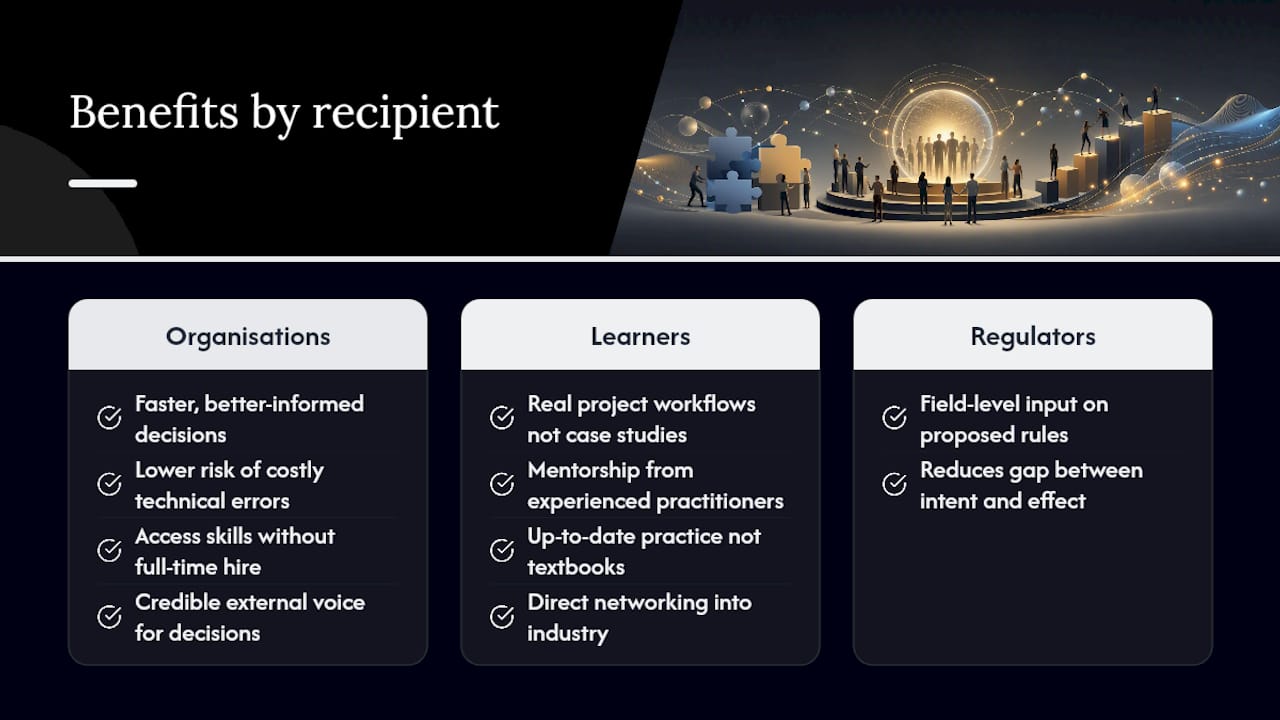
For learners and trainees: exposure to real project workflows rather than theoretical case studies; mentorship from someone who has actually done the job; up‑to‑date practice rather than outdated textbook methods; and direct networking opportunities into an industry. Being taught by industry professionals delivers measurable employability gains, largely because learners connect to real project workflows and networks rather than abstract coursework.
For regulators and policymakers: grounded, field‑level input on how a proposed rule will actually play out, which reduces the gap between regulatory intent and regulatory effect.
Statistic callout: Industry‑taught programs report benefits across five distinct dimensions, real‑world perspective, mentorship, employability skills, current practice, and networking, according to research from Enable College. That breadth is precisely why the benefit compounds rather than being limited to one skill area.
The benefit is highest in complex, regulated or rapidly changing environments, where the cost of an internal team getting it wrong is far greater than the cost of bringing in someone who has already solved the problem elsewhere.
What does the role look like across different sectors?
The mechanics of the role stay consistent, but the deliverables change completely depending on the sector.
- Engineering: a structural or civil engineer certifies designs, signs off on safety compliance, and troubleshoots on‑site problems that only appear once construction starts.
- Health: a clinical specialist advises on protocol, trains junior staff on procedure, and provides second‑opinion validation on complex cases.
- Events and venues: a venue coordinator manages supplier logistics, timeline sequencing and on‑the‑day problem‑solving, functions covered in detail in the ultimate guide to on‑site wedding coordination.
- Information technology: a systems architect designs infrastructure, advises on security posture, and mentors internal developers on best practice. Roles like data scientists and IT project managers show consistently strong labour‑market demand according to O*NET’s industry and occupation data.
- Legal and finance: a specialist advisor interprets regulation, structures a transaction, or provides an expert opinion for a dispute.
- Creative industries: a brand or design consultant translates a commercial objective into a visual or narrative solution the internal team then executes against.
Events and venues make a particularly clear case study because the stakes are immediate and highly visible, highlighting the crucial role of event electricians at weddings in ensuring smooth execution. A missed supplier delivery or a poorly sequenced timeline shows up in front of guests within hours, not months, which is why the sector leans so heavily on experienced coordinators to manage risk in real time.
What skills and credentials actually matter?
Titles are easy to print on a business card. Evidence of capability is harder to fake, and it is what should actually drive a hiring decision.
Look for these signals of genuine credibility:
- Demonstrable projects — a portfolio of completed work relevant to your problem, not a general career summary.
- References — people who will speak candidly about how the professional actually performed under pressure.
- Industry licences or certifications — essential in regulated fields such as engineering, electrical work or law, where practising without one is not just risky but often illegal.
- Peer recognition — mentions, referrals or invitations from others already established in the field.
- Publications or speaking engagements — a signal of depth, though not a substitute for delivered work.
Professional services occupations typically require formal training, a professional degree, or a licence, and how a provider markets themselves, whether as a sole practitioner, partnership or larger firm, often reflects their capacity and the scale of work they can take on.
Certifications matter most where safety, legal standing or financial exposure are at stake: a licensed electrician wiring a venue, a chartered engineer certifying a structure, a registered financial advisor managing client funds. In lower‑stakes creative or strategic work, a strong portfolio and clear references often tell you more than a certificate ever could. Credibility, ultimately, is built from demonstrable outcomes and reputation rather than self‑description. A title alone tells you what someone is allowed to do. It does not tell you whether they do it well.
How do you evaluate and brief an industry professional?
Getting real value from an industry professional starts well before the engagement, at the briefing stage.
Ask these questions during the interview process:
- What is the most recent project you delivered that resembles this one?
- Who can I speak to who has worked with you on a comparable brief?
- What would you flag as the biggest risk in this project, based on what you already know?
- How do you handle a situation where the brief changes halfway through?
- What does a successful outcome look like to you, in concrete terms?
Watch for these red flags:
- Vague answers about past work, with no names, dates or outcomes attached.
- Reluctance to provide a reference or a portfolio example.
- Overconfidence about timelines with no acknowledgement of risk.
- Pricing that seems disconnected from the scope described.
A simple scoping template helps keep a brief tight:
- Problem statement — what specifically needs solving, in one or two sentences.
- Success criteria — what “done well” looks like, measurable where possible.
- Timeline and milestones — key dates and checkpoints, not just a final deadline.
- Constraints — budget ceiling, regulatory requirements, existing commitments.
- Decision rights — who signs off on the final recommendation or deliverable.
Contract clarity matters just as much as the brief itself. The guide to navigating wedding venue contracts is a useful reference for the kind of specificity worth building into any professional services agreement, not just venue hire.
How do industry professionals support workforce development?
Beyond individual engagements, industry professionals feed directly into how a workforce builds its skills over time. Advisory bodies, industry panels, apprenticeships and workplace training partnerships all rely on practitioners who are still active in the field, not academics working from historical case studies.
Statistic callout: A parliamentary review found that industry contributes directly to identifying current and future skill needs and to developing workforce skills through structured stakeholder engagement, rather than skills planning happening in isolation from working practitioners.
At a state level, bodies such as Skills SA coordinate apprenticeships and training pathways that depend on practising professionals volunteering time as mentors, assessors or advisory panel members. A small business can replicate this at a modest scale simply by offering a structured work placement or mentoring a junior staff member through a professional body’s certification pathway. The mechanism scales down as easily as it scales up.
E‑E‑A‑T case study: event and venue professionals in practice
Wedding and event delivery makes the value of an industry professional unusually visible, because problems surface in real time, in front of guests, with no second chance.
A typical engagement follows a clear sequence:
- Pre‑event scoping — the coordinator walks the venue, confirms capacity and logistics, and flags constraints before any supplier is booked.
- Supplier coordination — timing, access and contingency plans are locked in across caterers, florists and AV providers well ahead of the day.
- On‑site management — the coordinator runs the timeline live, catching and correcting problems before guests notice them.
- Post‑event review — outcomes are checked against the brief, and lessons are carried into the next event.
The setup and teardown process behind a wedding venue shows how much of this work happens invisibly, hours before a guest arrives. A supplier delay caught during setup, rather than during the ceremony, is the difference between a footnote and a crisis. That is the applied value of an experienced practitioner: not charisma, but the habit of catching the problem early enough that nobody else ever has to know it existed.
How do you build a career as an industry professional?
Becoming a credible industry professional is less about one big credential and more about a compounding set of habits.
- Specialise early. Broad competence is common; deep, specific expertise is rare and far more valuable to hire.
- Build demonstrable work. Seek projects that produce a visible, referenceable outcome, not just experience you can describe verbally.
- Publish or teach. Writing, speaking or mentoring forces you to sharpen your thinking and puts your name in front of the right people.
- Network deliberately. Reputation spreads through referral chains, not job boards, so invest time in relationships within your sector.
- Pursue relevant CPD and professional association membership. Ongoing professional development keeps skills current and signals commitment to peers and clients alike.
Becoming a recognised go‑to expert in a field requires sustained visibility, curiosity and consistent output over years, not a single credential earned once and then relied on indefinitely. Personal branding, in this context, is not self‑promotion for its own sake. It is the ongoing evidence trail that lets a stranger judge your credibility before they ever meet you.
What working with venue professionals has taught me
Watching venue coordinators and suppliers operate over the years, the pattern that stands out is how rarely the best professionals talk about their own expertise. They just show up early, ask sharper questions than anyone else in the room, and quietly fix problems before the client ever sees them.
A few behavioural rules hold up consistently:
- Do ask a professional what could go wrong, not just what will go right.
- Do check references from people who worked with them under pressure, not just in ideal conditions.
- Don’t hire on charisma alone. Confidence is cheap; a track record is not.
- Don’t assume a big title guarantees hands‑on competence.
- Don’t skip the scoping conversation to save time. It is where most later problems get prevented.
These habits echo the evaluation questions and red flags covered earlier: the professionals worth hiring are the ones whose answers to hard questions get more specific, not vaguer, the deeper you dig.
Sources
- Industry experts: how organisations use practical expertise — Silverlight Research
- Chapter 6 – The role of industry and other stakeholders — Parliament of Australia
- Five benefits of being taught by industry professionals — Enable College
For couples or planners looking to put these evaluation principles into practice, the guide on choosing your ideal wedding venue applies the same scoping and evaluation logic to selecting a venue and its supporting professionals.
FAQ
What does it mean to be an industry expert?
It means having demonstrable, hands‑on experience in a field, backed by a track record others can verify, rather than simply holding a relevant qualification or job title.
What does “professional industry” mean?
It refers to sectors built around specialised, expertise‑based services, such as engineering, law, health and consulting, where formal training or licensing is often required to practise.
What is industry professional services?
Industry professional services are specialised, expertise‑based offerings, like advisory, technical execution or training, delivered by qualified practitioners rather than produced as a standard commercial product.
How do I know if an industry professional is worth hiring?
Check demonstrable past projects, speak to real references, and assess how specifically they answer questions about risk and past outcomes during the briefing stage.
What is the difference between an industry professional and a consultant?
A consultant is one engagement model among several; an industry professional can work as a consultant, an embedded contractor, a trainer or an advisory panel member depending on the need.
