
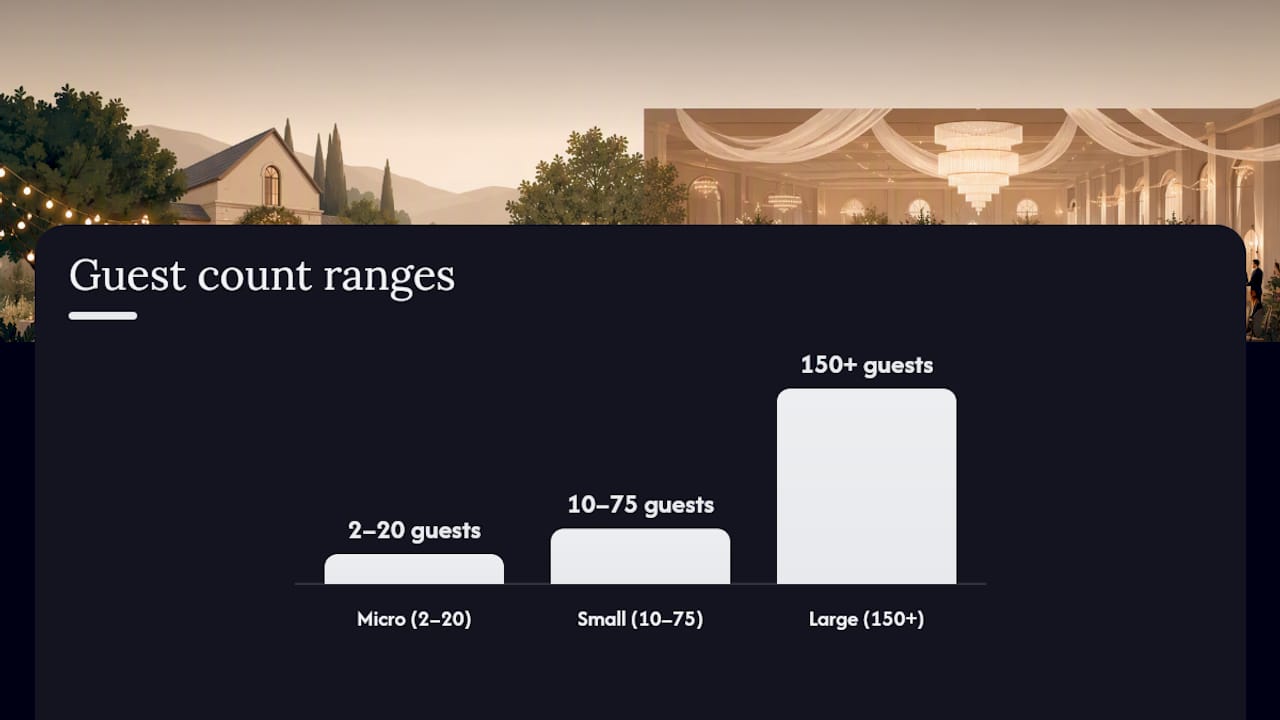
Match your venue size to your guest count first, then let atmosphere and budget refine the choice. A micro wedding (2 to 20 guests) suits intimacy, elopements and tight budgets. A small wedding venue (10 to 75 guests) balances personal connection with proper celebration. A medium venue (75 to 150 guests) gives room to move without losing warmth. A large venue (150 or more guests) suits couples who want a big guest list and a bigger production, though the trade-off is fewer venue choices and higher budget requirements.
- Micro (2 to 20): maximum intimacy, minimum cost, but limited “big day” spectacle
- Small (10 to 75): favours per-guest splurging and personalisation, fewer availability headaches
- Medium (75 to 150): the widest pool of available venues, moderate cost scaling
- Large (150+): dramatic entrances and big entertainment, but venue availability and budget both tighten
A quick data point: couples chasing 300 guests will find a much shorter shortlist than couples chasing 60, simply because fewer rooms can seat that many comfortably. Adelaide Wedding Venues lets you filter by guest count from the outset, which turns this whole decision from guesswork into a shortlist in minutes.
Key Takeaways
Venue size should be chosen from guest count and comfortable capacity first, with atmosphere and cost treated as secondary filters, not the starting point.
| Point | Details |
|---|---|
| Match size to guest count | Micro suits 2 to 20 guests, small suits 10 to 75, large typically means 150 or more. |
| Trust comfortable capacity, not maximum | Comfortable seated capacity runs about 80% of a venue’s stated maximum figure. |
| Understand the cost structure | Small venues often use flat fees; large venues often scale per guest with minimum spends. |
| Request a real floor plan | Ask for usable square footage, pillar locations and power access before booking. |
| Use Adelaide Wedding Venues to shortlist | Filter by guest count, amenities and location to cut hours off manual venue research. |
Small vs large venue: comparing the key decision dimensions
Once you know roughly how many guests you’re inviting, the size question comes down to seven practical dimensions. Small and large venues pull in opposite directions on almost all of them.
| Dimension | Small venue | Large venue |
|---|---|---|
| Guest-count range | Roughly 10 to 75 | 150+ |
| Cost structure | Often flat site fee, lower total spend | Frequently per-guest catering, higher total, sometimes minimum spends |
| In-house services | Variable, sometimes BYO vendors | Usually full in-house catering, staff, AV |
| Flexibility | High, easier to personalise layout | Lower, often locked into set floor plans |
| Guest experience | Intimate, conversational | High-energy, celebratory |
| Logistics | Simpler parking, fewer accessibility issues | More complex parking, accommodation blocks needed |
| Photo/acoustic quality | Candid, close-up shots | Staged drama, but sound can echo in big rooms |
A few trade-offs surprise couples who haven’t shopped venues before:
- Small venues often cost less overall but more per guest, since fixed costs spread across fewer people.
- Large venues are typically more expensive and have fewer available options, because fewer rooms in any city can seat 200-plus people well.
- A gorgeous small venue can still fail you on parking or accessibility, while a large ballroom can feel oddly flat acoustically if it’s under-booked.
The eight questions to ask before you book a venue
Feeling matters, but a good venue decision is made on numbers. Ask every venue these eight questions, in this order, before you sign anything.
- How do you calculate guest capacity? Ask whether the quoted number is standing-room maximum or comfortable seated capacity. They are rarely the same figure.
- What’s the comfortable seated capacity, not the fire-code maximum? Comfortable capacity typically runs about 80% of the venue’s stated maximum.
- What seating style are you planning? Round tables, banquet long tables and cocktail standing all need different amounts of floor space.
- Do you want a dance floor? If yes, that space comes out of your seated capacity, not on top of it.
- What are your AV and catering needs? In-house kitchens and sound systems save money; bringing your own vendors needs extra floor space and power access.
- Is parking and accessibility sorted? Ask directly rather than assuming, especially for guests with mobility needs.
- Is there a curfew or accommodation nearby? Late finishes and interstate guests both hinge on this.
- What’s actually included, and what costs extra? Cleaning, security, and overtime staffing are the usual hidden line items.
To convert a room’s floor area into a comfortable seated number, use the standard planning ratios: round-table dinners need about 12 to 15 square feet per person, while cocktail-style receptions need roughly 8 square feet per guest. Subtract space for dance floors, buffets and staging before you trust any number a venue quotes.
Send every shortlisted venue a short floor-plan request before your visit:
Adelaide Wedding Venues’ guide to venue capacity walks through exactly what to ask local venues about usable space, if you want a template tailored to South Australian rooms.
How venue size changes your wedding budget
Venue pricing works two ways: a flat site fee (you pay one number regardless of guest count) or per-guest pricing (catering, and sometimes the room itself, scales with headcount). Small venues lean toward flat fees. Large venues, especially those with in-house catering, lean toward per-guest structures with minimum spend requirements attached.
Costs that climb with guest count include catering, bar service, staffing, chair and linen hire, insurance, cleaning, security and any accommodation you’re covering for interstate guests. Costs that stay largely fixed regardless of size include the base site rental and some AV hire, which is one reason a smaller wedding can redirect savings into premium food or entertainment per guest.
Budgeting tips by size:
- Small weddings: put the savings from a smaller headcount into a better menu, photographer or band, since you’re paying for fewer plates anyway.
- Large weddings: negotiate package deals and ask venues about tiered pricing at 100, 150 and 200 guests, since minimums often step up at those thresholds.
- Any size: get every inclusion in writing.
Pro Tip: Ask specifically whether cleaning, security, overtime staffing and cake-cutting fees are included in your quote, or itemised separately. These four items cause more budget blowouts than any single “big” expense.
For a fuller local breakdown, Adelaide Wedding Venues’ budgeting checklist covers South Australian pricing patterns in more detail, and Wild Foodz’s guide to festive catering options is worth a look if catering is your biggest variable cost.
How layout and flow change guest experience by size
The number on a venue’s website rarely reflects what a room can actually hold once you add a dance floor, a buffet line and a DJ booth. Fixed features like pillars create dead zones that swallow usable space, and catering stations need dedicated linear clearance that most couples forget to budget for.
Space-per-person guidelines worth memorising: round tables need about 15 square feet per guest, banquet long tables about 12 square feet, and cocktail-style standing about 8 square feet, according to Pix’s venue capacity calculator. A dinner-and-dancing layout needs closer to 15 to 20 square feet per person once the dance floor is factored in.
Walk every shortlisted room with this checklist:
- Where does the dance floor go, and does it cut into seating?
- Is there a head table option, or does the layout suit long tables better?
- How much floor space does the buffet or bar line actually need?
- Can your photographer move freely, or are aisles too tight?
- Where are the pillars, and what do they block?
Large venues give you staged drama, sweeping wide shots and room for a grand entrance. Small venues favour candid, close-quarters photography where guests’ faces are actually in frame. Neither is better, but they photograph very differently, which is worth showing your photographer before you book.
When a micro wedding is the right call
A micro wedding (roughly 2 to 20 guests) suits couples prioritising cost, privacy, or a legal ceremony now with a bigger celebration later. A small wedding (10 to 75) still offers that intimacy while allowing a proper reception format. Both avoid the venue-availability squeeze that large weddings run into.
The risk with a small room is that it reads as empty rather than intentional. Scale your furniture down, use targeted lighting rather than trying to fill a big room with brightness, and invest in a good microphone so remote or hard-of-hearing guests don’t miss the vows.
Pro Tip: If you’re worried about hurt feelings from a short guest list, send a warm, early explanation to those not attending the ceremony, then invite them to a larger celebration later. Diplomacy upfront avoids awkwardness after the invitations go out.
Adelaide Wedding Venues’ guide to guest-list planning has more on managing this conversation gracefully.
Where to search for venues that match your guest count
Start your search with the filter that matters most: guest capacity, not style. Look for tools that let you filter by usable square footage, in-house catering availability, and AV inclusions, since these three factors decide whether a venue fits your actual wedding, not just your Pinterest board.
Build a simple shortlist with these columns for every venue you’re seriously considering:
- Venue name and location
- Comfortable seated capacity (not max)
- Available table layout options
- In-house services included
- Flat fee or per-guest pricing
- Parking and accessibility notes
- Link to a floor plan
Adelaide Wedding Venues’ search filters are built around exactly this workflow. Enter your rough guest count and preferred amenities, and the results narrow immediately to venues that can genuinely fit your wedding, rather than ones you’d have to rule out later on a site visit.
A planner’s perspective: common mistakes and quick heuristics
The biggest mistake couples make is trusting a venue’s “capacity” figure without asking whether it’s seated or standing. Always measure usable space yourself, and bring your photographer’s shot list to the walkthrough. Pillars, service corridors, power points and loading access are the four things almost everyone forgets to check.
Here’s the heuristic worth remembering: guest comfort beats absolute maximum capacity every time. A room that technically fits 180 people rarely feels good at 180. Book for the number that lets people actually move.
Let Adelaide Wedding Venues do the shortlisting for you
Filtering venues by hand across dozens of individual websites eats hours you’d rather spend on the parts of planning that are actually fun. Adelaide Wedding Venues solves that specific problem: search by guest count, amenities and location in one pass, and get floor plans and contact details without chasing down every venue’s separate enquiry form.
If your guest list is trending toward 150 or more, the curated large-wedding venue picks narrow the field to rooms that can genuinely handle that scale. If you’re still deciding between styles and sizes altogether, the complete venue-choosing guide walks through the decision from scratch. Either way, the next step is the same: filter by your real guest count today and see what actually comes up.
Sources
- Banquet hall capacity calculator: what to know before you book
- Pix
- Big or small – what is the right size wedding venue for you?
- Small wedding venues vs large ballrooms: guide | Le James
- Big vs small wedding pros and cons
FAQ
What guest count counts as a small wedding venue?
Small wedding venues typically suit 10 to 75 guests, favouring intimacy and higher per-guest spending over scale.
What guest count counts as a large wedding venue?
Large weddings are generally considered 150 guests or more, and venues that size tend to be scarcer and pricier.
Is it cheaper to book a small or large venue?
Small venues usually cost less in total, though large venues can offer lower per-guest rates through catering packages, so compare both total and per-guest figures before deciding.
How do I convert square footage into comfortable seating capacity?
Use roughly 15 square feet per person for round tables, 12 for banquet long tables, and 8 for cocktail standing, then subtract space for any dance floor or staging.
How can I quickly compare venues by size?
Adelaide Wedding Venues lets you filter by guest capacity, amenities and location in one search, which is faster than checking each venue’s site individually.
