
TL;DR:
- Preparing thoroughly, arriving early, and understanding venue lighting are essential for high-quality wedding photos. Using appropriate camera settings, avoiding direct flash, and adjusting white balance improve image consistency in various indoor conditions. Effective venue walkthroughs and clear communication prevent common mistakes and enhance the photographer’s ability to adapt creatively.
Venue photography tips are the techniques and practices that help photographers capture images that authentically represent a wedding location and the event within it. Getting these right separates a forgettable gallery from a portfolio piece that wins new clients. The core disciplines are preparation, lighting management, camera settings, and venue scouting. Each one compounds the others. A photographer who masters all four can walk into any Adelaide wedding venue and deliver consistent, high-quality results regardless of what the light or the floor plan throws at them.
What do you need before shooting a wedding venue?
Preparation is the single biggest predictor of a successful shoot. Photographers who arrive without a brief, without tested gear, and without knowledge of the space are already behind before the ceremony begins.
Gear essentials
The right kit covers every scenario a venue can present:
- Prime lenses: 35mm for environmental context, 85mm for portraits
- Zoom lens: 24–70mm f/2.8 for flexible framing in tight spaces
- External flash with a diffuser for bounce and fill work
- Backup batteries and at least two sets of memory cards
- A lightweight light stand if off-camera flash is part of the plan
The photography brief
Receive a detailed brief at least 7 days before the event. That brief should include the event schedule, key moments, VIP contacts, brand assets, and delivery expectations. Seven days gives you time to research the venue, prepare your shot list, and flag any gaps with the client before it is too late to fix them.
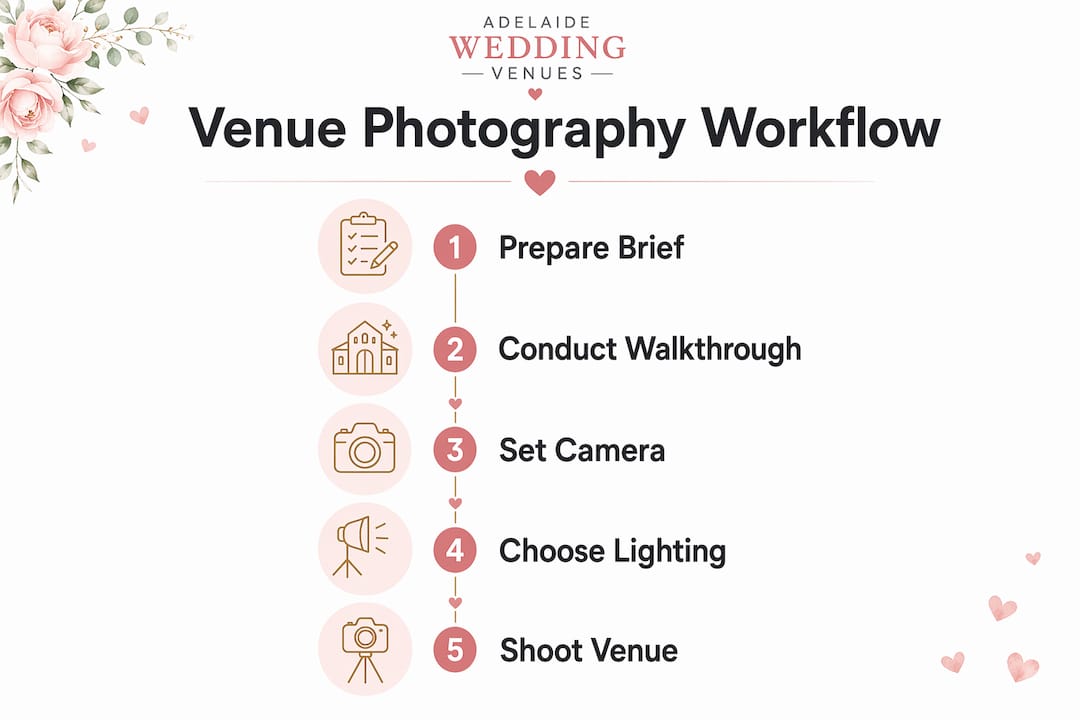
Venue walkthrough timing
Arriving 45–60 minutes early gives you time to test exposure and white balance, identify the worst lighting zones, and find the best portrait spots before guests arrive. That window is not optional. It is the difference between reacting to problems and anticipating them.
| Checklist item | Why it matters |
|---|---|
| Prime and zoom lenses packed | Covers wide, portrait, and detail shots |
| External flash and diffuser | Enables bounce and off-camera techniques |
| Backup batteries and cards | Prevents mid-shoot failures |
| Brief received 7 days prior | Confirms shot list and VIP requirements |
| Early arrival confirmed | Allows lighting tests and walkthrough |
Pro Tip: Confirm the venue’s lighting types and power sources before event day. Knowing whether the room uses tungsten, LED, or fluorescent fixtures lets you pre-set your white balance and avoid colour surprises mid-reception.
How do you set your camera for different venue lighting?
Camera settings for wedding venues are not a one-size-fits-all formula. They shift with every room, every hour, and every lighting rig the venue uses.
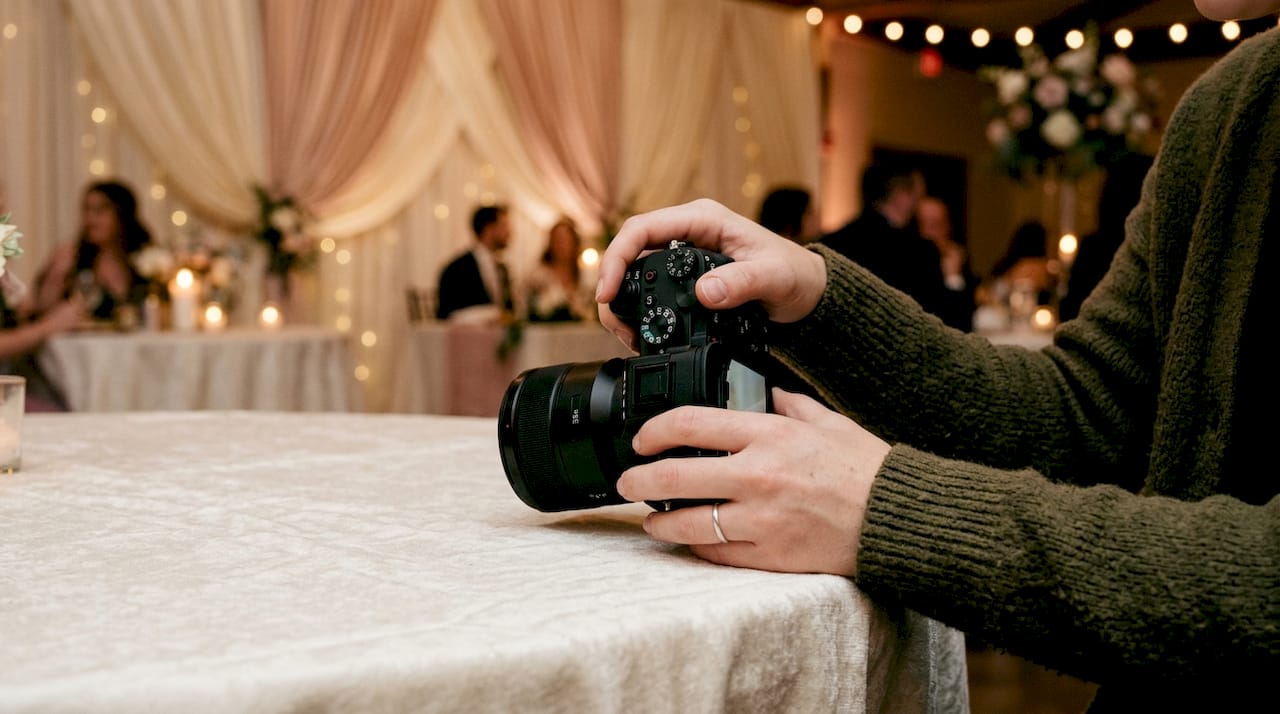
The starting point for shutter speed is 1/200s for static subjects and 1/500s for motion on the dance floor. Dropping below 1/200s on a moving subject produces motion blur that no amount of post-processing can fix. Aperture sits between f/2.0 and f/2.8 in low light. That range lets in enough light while keeping the subject sharp and the background pleasantly soft.
ISO starts at 1600 and climbs to 3200 or 6400 depending on the camera body and the available light. Modern full-frame sensors handle ISO 3200 cleanly. Shooting in Manual mode with Auto ISO as a safety net gives you control over depth of field and shutter speed while letting the camera compensate for sudden light changes.
Shoot RAW at every venue. RAW files preserve the full dynamic range of the sensor, which means you can recover highlights from a bright window or lift shadows in a dark corner during editing. JPEG files discard that data permanently.
Mixed colour temperatures are one of the most common challenges in indoor venue photography. A room might have warm tungsten downlights, cool LED uplights, and daylight spilling through windows all at once. Set a manual Kelvin value or create a custom white balance for each distinct lighting zone rather than relying on Auto White Balance to guess.
Pro Tip: Use the shutter drag technique at 1/60s to 1/100s combined with a fill flash. This balances the ambient light in the room with your flash exposure, producing images that feel lit rather than flashed.
What lighting techniques work best for venue and event photos?
Lighting technique is where average venue photography separates from work that genuinely stands out. The single most important rule is to avoid direct on-camera flash. Direct flash flattens faces, kills depth, and announces itself in every image.
Bounce flash is the practical alternative for most indoor venues. Angle the flash head toward a white ceiling or wall and the light wraps around the subject naturally. Off-camera flash opens up more creative options. Positioning a triggered strobe behind the dance floor creates rim lighting that separates subjects from the background and adds a cinematic quality to reception shots.
Stage washes and fairy lights are assets, not obstacles. Position yourself so these ambient sources backlight or side-light your subjects. The result is a warm, atmospheric image that feels true to the event rather than artificially lit.
Set flash TTL with negative EV compensation between -0.7 and -1.3 stops. This dials back the flash output so it fills shadows without overpowering the ambient glow of the venue. Images taken with uncorrected TTL flash often look like they were shot in a dark box with a torch pointed at the subject.
| Technique | Best use | Effect |
|---|---|---|
| Bounce flash | Indoor receptions | Soft, flattering light |
| Off-camera rim light | Dance floor | Subject separation, depth |
| Shutter drag plus fill flash | Ambient rooms | Balanced exposure |
| Natural ambient only | Fairy lights, stage wash | Cinematic, warm atmosphere |
Pro Tip: Stand opposite the venue’s strongest light source rather than beside it. This puts the light on your subject’s face and keeps distracting silhouettes out of your frame.
How do you conduct a venue walkthrough before the event?
A venue walkthrough is a structured pre-shoot assessment that identifies shooting opportunities and potential problems before guests arrive. Room lighting rarely looks the same on camera as it does to the naked eye. Walking the space with your camera in hand, taking test shots, is the only reliable way to know what you are dealing with.
Follow these steps on arrival:
- Walk every room and photograph key features with your camera at event settings.
- Test exposure and white balance in each distinct lighting zone.
- Identify the worst lighting areas and plan to avoid or compensate for them.
- Locate power outlets, note load-in access, and check internet access if live delivery is required.
- Confirm restricted areas with the venue coordinator before guests arrive.
- Mark your best portrait spots: near windows, under warm downlights, against clean backgrounds.
Photograph venue features with detailed captions during the walkthrough. Note the location of outlets, the direction of key light sources, and any fixtures that might cause lens flare. These notes are useful for planning future shoots at the same venue and for negotiating access with coordinators.
You can also use the walkthrough to align with the venue tour process that event planners follow. Understanding how the space is used from a planner’s perspective helps you anticipate where guests will gather and where the key moments will unfold.
Pro Tip: If an on-site walkthrough is not possible before the event, request recent photos and floor plan measurements from the venue. Use these to map your shooting positions and identify likely lighting challenges in advance.
What mistakes do wedding venue photographers most often make?
The most costly mistakes in venue photography are not technical. They are preparation failures that no amount of skill can fix on the day.
- Ignoring the brief. Not reading the brief carefully is a leading cause of missed shots and client disappointment. The brief is a contractual roadmap. Missing a VIP shot because you did not read the list is not a technical error. It is a professional one.
- Assuming the venue looks the same in photos. Low-light venue challenges come from uncontrolled, mixed lighting conditions, not darkness alone. A room that looks warm and inviting to the eye can produce muddy, colour-shifted images without the right settings.
- Using direct flash. Direct on-camera flash produces flat, harsh images that no client wants in their wedding gallery.
- Neglecting white balance. Leaving the camera on Auto White Balance in a mixed-light venue produces inconsistent colour across the gallery. Fix it in-camera, not in post.
- Arriving late. Skipping the walkthrough means shooting blind. You miss the best portrait spots, the worst lighting zones, and the restricted areas.
“Planning venue photography alongside event lighting design improves image quality and guest representation.” This principle applies equally to wedding photographers: coordinate with the venue and the event team before you pick up the camera.
Troubleshooting on the day is possible but costly. For motion blur, raise shutter speed to 1/500s and open the aperture. For lighting imbalance, dial in negative EV compensation on your flash. For colour casts, switch to a manual Kelvin setting matched to the dominant light source.
Key takeaways
Consistent, high-quality venue photography requires preparation, correct camera settings, and deliberate lighting technique working together from the moment you arrive.
| Point | Details |
|---|---|
| Brief before the shoot | Receive a full event brief at least 7 days out to confirm shot list and VIP requirements. |
| Arrive 45–60 minutes early | Use the extra time for lighting tests, white balance checks, and walkthrough notes. |
| Shoot RAW with manual white balance | RAW preserves dynamic range; manual Kelvin prevents colour casts in mixed-light venues. |
| Avoid direct flash | Use bounce or off-camera flash with TTL set to -0.7 to -1.3 EV for natural-looking results. |
| Read the brief completely | Missing a brief detail causes client dissatisfaction regardless of technical image quality. |
What I have learned after years of shooting Adelaide venues
The technical side of venue photography is learnable in a season. The communication side takes much longer.
The photographers who consistently produce the best work are not always the ones with the most expensive gear. They are the ones who have a conversation with the venue coordinator before the event, who ask where the light will be at 6pm, and who know which corners of the room the venue manager considers off-limits. That information is freely available. Most photographers just do not ask for it.
I have shot venues where the lighting rig looked extraordinary in person and produced unusable images at the settings I had planned. I have also shot venues that looked dim and uninspiring on arrival and delivered some of my strongest portfolio work because I took the time to find the angles where the ambient light was doing something interesting. The walkthrough is where those discoveries happen.
Videographers and photographers working the same event need to coordinate their flash use. A photographer dragging the shutter at 1/60s will pick up a videographer’s continuous light in the background. A quick conversation before the reception starts prevents that from becoming a problem in the edit suite.
The right photography style for a venue matters too. A heritage ballroom calls for a different approach than a beachside pavilion. Matching your technique to the venue’s character produces images that feel intentional rather than accidental.
Flexibility on event day is not a soft skill. It is a technical requirement. The couple who moves the first dance outside because the weather cleared, the venue coordinator who dims the lights earlier than planned, the unexpected fog machine at the reception. These are not problems. They are opportunities, if you have done the preparation to recognise them.
— Steven
How Adelaideweddingvenues helps photographers plan better shoots
Photographers who know a venue before they arrive shoot with more confidence and deliver better results. Adelaideweddingvenues maintains a detailed directory of wedding venues across Adelaide and South Australia, with listings that include venue type, capacity, and setting details that directly inform photographic planning.
For photographers building their portfolio, the Adelaide sunset photography venues page highlights locations known for exceptional natural light at golden hour. The ideal wedding venue guide covers venue characteristics from rustic barns to beachside settings, giving photographers a clear picture of what each space demands technically. Adelaideweddingvenues is built with photographer input, which means the venue information reflects what actually matters when you are planning a shoot, not just what looks good in a brochure.
FAQ
What shutter speed should I use for wedding venue photography?
Use at least 1/200s for static subjects and 1/500s for motion on the dance floor. Dropping below these speeds with moving subjects produces motion blur that cannot be corrected in post.
How early should I arrive at a wedding venue before shooting?
Arrive 45–60 minutes early to complete a full walkthrough, test your exposure settings, and identify the best shooting positions before guests arrive.
Should I shoot RAW or JPEG at wedding venues?
Shoot RAW at every venue. RAW files preserve the full dynamic range of your sensor, allowing you to recover highlights and lift shadows during editing without permanent data loss.
How do I handle mixed lighting at indoor wedding venues?
Set a manual Kelvin value or create a custom white balance for each distinct lighting zone. Auto White Balance produces inconsistent colour across a gallery when multiple light sources are present.
What is the most common mistake in wedding venue photography?
Not reading the client brief carefully is the leading cause of missed shots and client dissatisfaction. The brief confirms must-have shots, VIP contacts, and delivery expectations before the event begins.
