
TL;DR:
- A venue pricing strategy involves setting, adjusting, and communicating rates to maximize bookings and profit. It requires understanding costs, applying dynamic pricing, and ensuring transparent disclosure of all fees to build client trust. Regular quarterly reviews and clear tiered packages enhance revenue and customer satisfaction.
A venue pricing strategy is the structured method a venue owner uses to set, adjust, and communicate prices to maximise bookings and profitability. The national average cost for a wedding venue in Australia sits at approximately $13,200 in mid-2026, with costs ranging from around $4,500 in lower-cost states to over $28,000 in premium markets. That spread tells you one thing clearly: pricing is not one-size-fits-all. A well-built venue pricing strategy guide gives event planners and venue owners the tools to set rates that reflect real costs, respond to demand, and build lasting client trust.
What does a venue pricing strategy guide cover?
A venue pricing strategy brings together cost analysis, market research, pricing model selection, and transparent communication. Without all four elements working together, venues either leave money on the table or price themselves out of the market.
The foundation is understanding your costs. Every venue carries fixed costs such as rent, insurance, and staff wages, alongside variable costs like cleaning, catering, and AV equipment. Market research into competitor pricing and target audience purchasing power must happen before you set a single rate. Pricing based on intuition alone produces inconsistent results.
Three core pricing models apply to event venues:
- Time-driven pricing: Rates set by the hour or half-day, suited to smaller function rooms and corporate bookings.
- Spend-driven pricing: A minimum spend threshold that clients must reach across food, beverage, and hire fees combined. This model protects margins on high-demand dates.
- Experience-driven pricing: Packages priced by the type of event and level of service, from a basic room hire to a fully catered premium package.
Tiered packages structured as basic, mid-range, and premium give clients flexibility and allow venues to reach multiple budget segments at once. A couple planning a modest reception and a corporate client booking a gala dinner have very different expectations and very different budgets.
Pro Tip: Set your minimum spend thresholds by date desirability, not just by guest numbers. A Saturday in december commands a higher minimum than a Tuesday in july. Adelaideweddingvenues has a detailed breakdown of minimum spend requirements worth reading before you finalise your rate card.

How does dynamic pricing work for event venues?
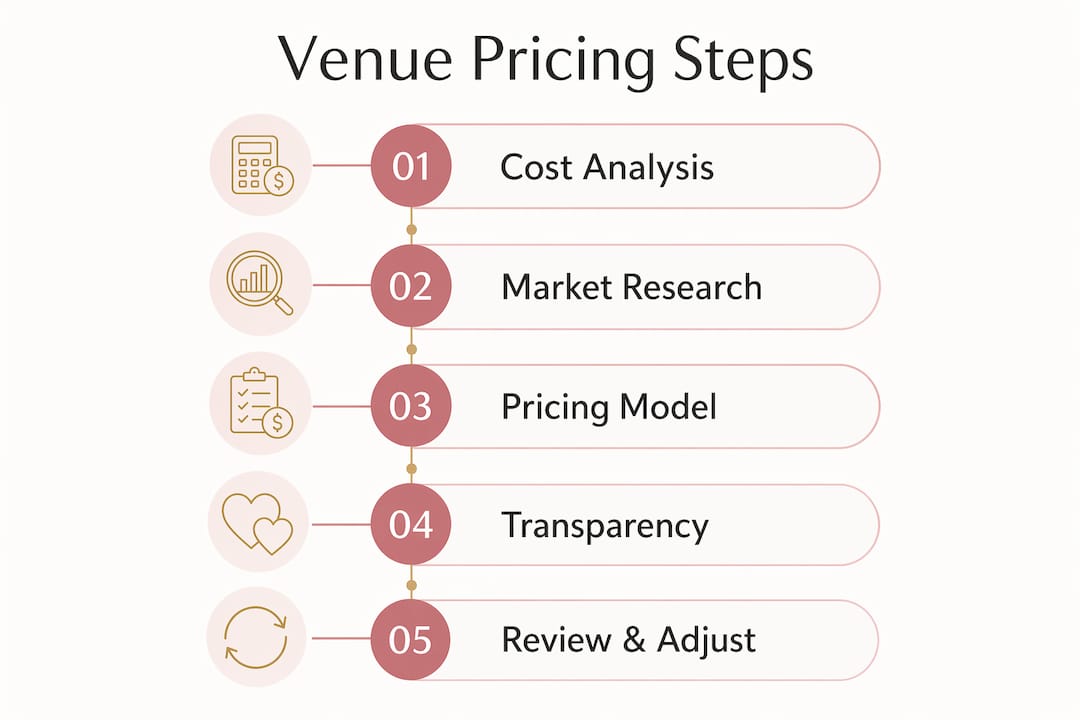
Dynamic pricing is the practice of adjusting your base rates up or down in response to demand, calendar events, and booking lead times. Pricing venues reactively rather than dynamically leads directly to lost revenue. Disciplined, data-led pricing shifts the process from gut-feel decisions to yield management grounded in real numbers.
Here is a practical framework for applying dynamic pricing across the calendar year:
-
Identify your premium dates. The top 10–15 dates per year, think New Year’s Eve, Valentine’s Day, and popular spring and autumn Saturdays, are your highest-value inventory. Scarcity-based pricing on these dates can sit 50–200% above your base rate, far beyond the standard 15–30% increase most venues apply.
-
Apply peak-period increases. For general peak demand periods such as the spring wedding season (september through november) and the december festive period, increase base hire fees by 15–30%. Apply the same logic to minimum spends.
-
Offer early-bird discounts for off-peak dates. Clients who book off-peak dates well in advance deserve a reward. A 15–20% discount for bookings made more than six months out fills your calendar during quieter periods without permanently reducing your rates.
-
Review pricing quarterly. Quarterly pricing reviews tied to local demand shifts, calendar events, and competitive positioning consistently outperform static annual pricing models. Set a calendar reminder for the start of each quarter and adjust accordingly.
The table below shows how a venue with a $3,000 base hire fee might structure dynamic pricing across demand tiers:
| Demand tier | Adjustment | Example hire fee |
|---|---|---|
| Off-peak (early-bird booking) | 15–20% discount | $2,400–$2,550 |
| Standard period | No adjustment | $3,000 |
| Peak period | 15–30% increase | $3,450–$3,900 |
| Premium/scarcity date | 50–200% increase | $4,500–$9,000 |
Pro Tip: Do not wait for a slow quarter to review your pricing. Build a simple spreadsheet that tracks enquiries, bookings, and conversion rates by date. Patterns emerge quickly and give you the data to justify rate changes with confidence.
Why does pricing transparency increase bookings?
Pricing transparency is the practice of listing all fees clearly before a client commits. Transparent disclosure of extras including overtime charges, cleaning fees, AV costs, and gratuities (typically 15–23%) increases booking conversion and client trust. Failing to list costs upfront leads to distrust and negative reviews, both of which are hard to recover from.
Common fees that venues forget to disclose include:
- Overtime charges per hour beyond the agreed finish time
- Cleaning and bump-out fees
- AV equipment hire and technician costs
- Security and crowd-control charges
- Corkage fees for client-supplied beverages
- Gratuities and service charges added to food and beverage bills
- Parking or valet fees passed on to clients
The unexpected expenses that couples and event planners encounter after signing a contract are one of the most common complaints in the industry. A venue that lists every cost upfront removes that friction entirely.
“Transparency increases booking confidence. Clear disclosure of all fees leads to higher conversion rates and better client relationships.”
Structure your pricing documents so that the base hire fee appears first, followed by a clear list of optional and mandatory add-ons. A well-formatted pricing sheet takes less than an hour to produce and pays for itself in reduced negotiation time and stronger client confidence.
How do you manage costs to protect venue profitability?
Profitability in venue management depends on pricing above your true cost base, not just above your obvious costs. Hidden costs within packages often erode profitability because small uncharged services accumulate across an event. A complimentary microphone setup, an extra hour of staff time, and a free room changeover each cost real money.
Startup capital to launch a venue ranges from $50,000 to $150,000 depending on location, real estate, and build-out requirements. That capital investment must be recovered through pricing, which means every package needs to account for depreciation, maintenance, and ongoing operational costs, not just the direct cost of each event.
The comparison below shows two approaches to package pricing for a 100-guest seated dinner:
| Pricing approach | What it includes | Risk |
|---|---|---|
| Base hire only | Room hire, tables, chairs | Underprices total cost; add-ons erode margin |
| All-inclusive minimum spend | Hire, catering, AV, staff, cleaning | Protects margin; client sees full value upfront |
The all-inclusive minimum spend model wins on both transparency and profitability. Clients understand exactly what they are paying for, and the venue recovers every cost within the one figure.
Cost-saving strategies at the operational level, such as bulk purchasing agreements with caterers and shared AV supplier contracts, reduce the cost base without reducing the client experience. Lower costs with stable pricing means stronger margins.
Pro Tip: Benchmark your rates against the local market at least twice a year. The real role of budget in venue selection shifts with economic conditions. What clients could afford in 2024 may differ from what they can afford in 2026, and your pricing needs to reflect that reality.
Key takeaways
Effective venue pricing combines accurate cost recovery, demand-responsive adjustments, and full fee transparency to protect profitability and build client trust.
| Point | Details |
|---|---|
| Know your true cost base | Include fixed costs, variable costs, and hidden add-ons before setting any rate. |
| Apply dynamic pricing by demand tier | Increase rates 15–30% for peak periods and up to 200% for premium scarcity dates. |
| Disclose all fees upfront | List overtime, cleaning, AV, and gratuity charges clearly to improve conversion rates. |
| Review pricing quarterly | Tie reviews to local events and calendar triggers rather than annual adjustments. |
| Use tiered packages | Basic, mid-range, and premium tiers reach more client segments and protect margins. |
Pricing models keep evolving: what I have learned
Venue owners often ask me which pricing model is the “right” one. My honest answer is that the right model is the one you will actually maintain and review. I have seen venues build beautifully structured tiered packages and then leave them untouched for two years while the market moved around them.
The most common mistake I observe is treating pricing as a set-and-forget task. Data-driven pricing reviews consistently outperform static models, yet most small venues still adjust prices once a year at best. Quarterly reviews feel like extra work until you see the revenue difference.
Transparency errors are the second most costly mistake. Venues that bury overtime fees or gratuity charges in the fine print save themselves an awkward conversation at the time of quoting, but they pay for it in negative reviews and lost repeat business. I have watched venues lose corporate clients permanently over a single unexpected invoice.
The venues that perform best over time are the ones that treat pricing as an ongoing conversation with the market. They watch local demand, track their own booking data, and adjust confidently. They also communicate pricing changes to returning clients before those clients see a new rate card. That small act of courtesy builds loyalty that no discount can buy.
If you are just starting out, read the negotiating with venues guide from Adelaideweddingvenues. It gives you a clear picture of how clients think about pricing, which is exactly the perspective you need when building your own rate structure.
— Steven
How Adelaideweddingvenues supports venue owners with pricing and exposure
Adelaideweddingvenues is South Australia’s specialist online directory for wedding and event venues, and it gives venue owners a direct channel to reach engaged couples and event planners actively searching for spaces. For a local overview, browse All Adelaide Wedding Venues.
Listing your venue on Adelaideweddingvenues puts your pricing, capacity, and inclusions in front of a qualified audience at no cost for a standard listing. The platform supports transparent pricing presentation, which aligns directly with the booking-conversion benefits of clear fee disclosure. Venue owners who want greater visibility can access featured listing options for paid promotion. Whether you manage a heritage estate or a contemporary function centre, choosing the ideal wedding venue starts with being found. Adelaideweddingvenues makes that first step straightforward for both venues and the clients searching for them.
FAQ
What is a venue pricing strategy?
A venue pricing strategy is the structured approach a venue uses to set, adjust, and communicate its rates to maximise bookings and profitability. It combines cost analysis, market research, pricing model selection, and transparent fee disclosure.
How much does a wedding venue cost in Australia?
The national average cost for a wedding venue in Australia is approximately $13,200 in mid-2026, with costs ranging from around $4,500 in lower-cost states to over $28,000 in premium markets.
What is dynamic pricing for event venues?
Dynamic pricing means adjusting base hire fees and minimum spends in response to demand, with peak-period increases of 15–30% and scarcity-based pricing on premium dates reaching 50–200% above the base rate.
Why should venues list all fees upfront?
Transparent disclosure of all fees, including overtime, cleaning, AV, and gratuities of 15–23%, increases booking conversion and reduces the risk of negative reviews caused by unexpected charges after signing.
How often should a venue review its pricing?
Venues should conduct pricing reviews quarterly, tying adjustments to local demand shifts, calendar events, and competitive positioning rather than relying on a single annual update.
