
TL;DR:
- Venue description optimization updates online profiles to help search algorithms and planners find venues faster and more accurately. Clear, factual attribute listings and customer language matching improve search relevance, visibility, and enquiry quality for venues. Regular, detailed updates across all platforms ensure venues stay competitive in AI-driven discovery and attract better-qualified bookings.
Venue description optimisation is the practice of structuring, wording, and updating your venue’s online profile so that both search algorithms and human planners can quickly extract the information they need to make a booking decision. Venue owners who treat their descriptions as living documents rather than set-and-forget copy see measurably better results. Structured data on your website and Google Business Profile signals how relevant your venue is to specific queries. Getting this right is no longer optional. AI-powered search tools now shortlist venues before a planner ever visits your website, which means your description is doing the selling before you even know someone is looking.
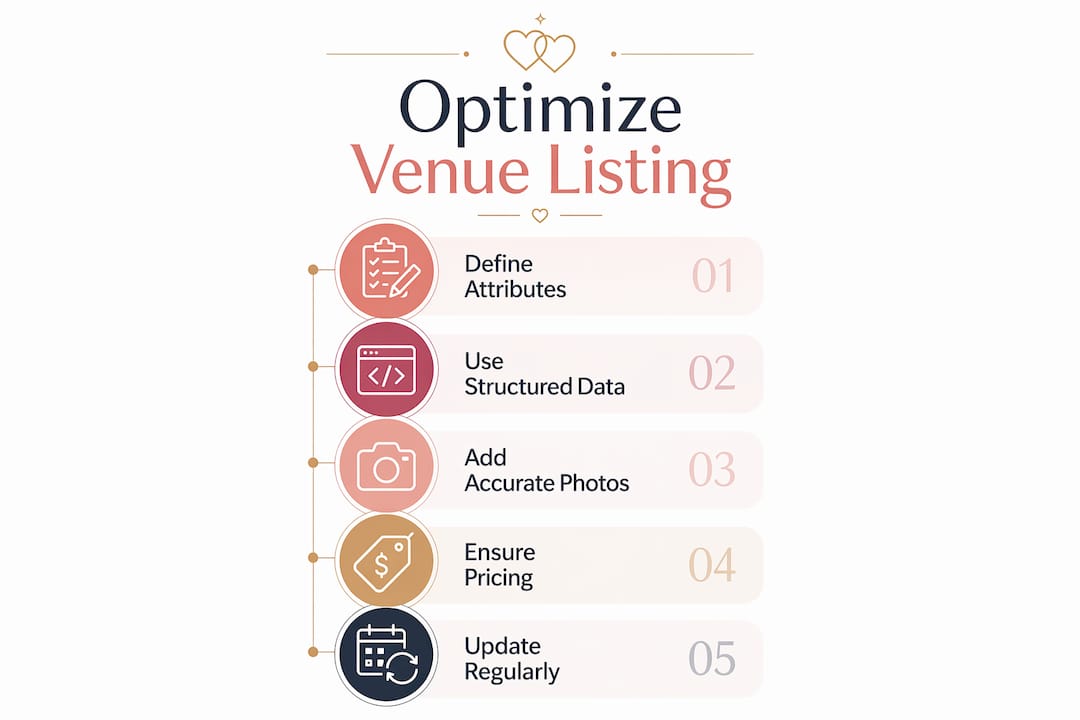
Why optimize venue descriptions: search visibility and AI ranking
A well-optimised venue description does two jobs at once. It tells search engines exactly what your venue offers, and it tells planners whether your space suits their event. These two audiences now overlap more than ever, because AI search tools read your description the same way a planner does.
Structured data earns 35% higher click-through rates compared to profiles without it. That figure reflects how much weight Google places on clearly declared attributes such as capacity, catering options, AV equipment, and accessibility features. A venue that lists “elegant function space” gains nothing from that phrase in an AI-driven search. A venue that lists “seated capacity of 120, in-house catering, wheelchair access, and built-in AV” gets matched to the right queries.
The shift from keyword-based local search to attribute-based conversational discovery changes the rules significantly. Google Ask Maps, for example, surfaces venues by specific factual attributes rather than by how many times a keyword appears. This means a venue description stuffed with “Adelaide wedding venue” repeated eight times will underperform against a description that clearly states layouts, inclusions, and event types supported.
Consistent, accurate profile data across your Google Business Profile, website, and directory listings prevents your venue from being deprioritised in AI search results. Inconsistencies, such as different capacities listed in different places, create doubt in the algorithm and reduce your chances of appearing in relevant searches. Treat every platform as one unified data record, not a separate marketing exercise.
Pro Tip: Add structured data schema markup to your venue website’s backend. Even a basic LocalBusiness schema that declares your event types, capacity, and location will give you a technical edge over venues relying on plain text alone.
What do event planners actually look for in a venue profile?
Nearly 50% of event planners say accurate online venue details and visuals are the primary factor in their decision to submit a Request for Proposal. That finding reframes the entire purpose of a venue description. It is not a branding exercise. It is a qualification tool that either earns or loses a planner’s time.

The most common mistake venue owners make is filling descriptions with vague adjectives. Phrases like “stunning views,” “versatile space,” and “unforgettable atmosphere” tell a planner nothing concrete. Planners prioritise specific data over marketing language, and a description built on adjectives signals that the venue may be hiding gaps in its offering.
The details planners look for include:
- Capacity by layout: Theatre, banquet, cocktail, and boardroom numbers listed separately
- Catering arrangements: In-house, preferred suppliers, or BYO, with a note on dietary accommodation
- AV and technical equipment: What is included, what requires an external hire
- Pricing range: A ballpark figure or starting rate, not a “contact us for pricing” dead end
- Accessibility: Lift access, parking, proximity to public transport
- Outdoor options: Whether the space has a wet-weather backup
Hiding pricing or forcing enquiries to reveal budget kills conversion. Planners working to a fixed budget will skip a venue that offers no financial transparency. Providing a price range, even a broad one, filters out mismatched enquiries and attracts planners who are genuinely ready to book.
Pro Tip: Think of your venue description as a pre-qualification form. Every detail you include removes a question a planner would otherwise need to ask, and every question you save them brings you one step closer to a confirmed booking.
How does customer language improve AI search relevance?
AI search tools do not just read your description. They compare it against what people are actually asking. When a planner types “venue for a 30-person team dinner with private dining” into a conversational search tool, the algorithm looks for venues whose profiles contain language that matches that scenario. A description written in generic marketing copy will not match. A description that uses real, scenario-based language will.
Google Ask Maps surfaces venues by factual attributes declared explicitly in profiles. This means the language in your customer reviews is a direct source of optimisation material. If five reviews mention “perfect for a small wedding ceremony,” that phrase belongs in your description. If guests consistently note “great natural light for photos,” that detail is a searchable attribute worth including.
Practical ways to mirror customer language in your venue profile:
- Read your most recent 20 reviews and note the specific phrases guests use to describe the experience
- Identify the event types mentioned most often and make sure each one appears in your description
- Use scenario-based sentences such as “suits intimate weddings of 40 to 80 guests” rather than “suitable for all events”
- Avoid repeating suburb or city names unnaturally. Google understands proximity automatically and penalises keyword stuffing
This approach builds authenticity alongside search relevance. Planners reading your profile feel they are getting an honest picture of the venue, not a sales pitch. That trust is what converts a profile view into an enquiry.
Practical steps to improve your venue listing today
A well-structured venue description follows a clear information hierarchy. Planners scan before they read, so the most critical details need to appear first. A layered profile moves from a quick summary at the top to detailed layouts and pricing further down, matching how planners actually process information.
Recommended description structure
- Opening summary (2–3 sentences): State what the venue is, its capacity range, and its primary event types. No adjectives without evidence.
- Layouts and spaces: List each configurable space with its capacity in at least two layouts.
- Inclusions and catering: Specify what is included in the hire fee and what is additional.
- Pricing range: Give a starting rate or a range. Planners need this to qualify the venue against their budget.
- Accessibility and logistics: Parking, public transport, lift access, and load-in details for suppliers.
Optimising a Google Business Profile description takes approximately 30 minutes and can influence profile engagement on the same day. That is a strong return on a modest time investment. The key is to update every platform at the same time so your information stays consistent across your website, directory listings, and Google profile.
The table below shows how a generic description compares to an optimised one across the factors planners and AI tools evaluate:
| Factor | Generic description | Optimised description |
|---|---|---|
| Capacity | “Suits small to large groups” | “Seated 80, cocktail 150, boardroom 20” |
| Pricing | “Contact us for a quote” | “Venue hire from $2,500, packages available” |
| Catering | “Catering available” | “In-house catering, dietary options on request” |
| AV | “Modern facilities” | “Built-in projector, PA system, lectern included” |
| Event types | “Suitable for all occasions” | “Weddings, corporate dinners, product launches” |
Keeping your venue details regularly updated is as important as the initial write-up. Stale information, such as an old pricing structure or a discontinued catering package, erodes planner confidence and can result in wasted enquiries on both sides.
Key takeaways
A venue description that declares specific attributes clearly outperforms vague marketing copy in both AI search rankings and planner conversion rates.
| Point | Details |
|---|---|
| Structured data drives clicks | Sites with structured data earn 35% higher click-through rates, making schema markup a priority. |
| Planners need facts, not adjectives | Nearly 50% of planners base RFP decisions on accurate details, so specificity wins enquiries. |
| Customer language improves AI matching | Phrases from real reviews align your profile with conversational search queries. |
| Pricing transparency filters leads | Providing a price range reduces mismatched enquiries and attracts serious planners. |
| Consistency across platforms matters | Matching data on your website, Google profile, and directories prevents AI deprioritisation. |
The detail most venue owners overlook
The venues I see losing bookings are not the ones with bad spaces. They are the ones with beautiful spaces and invisible profiles. A heritage ballroom with no listed capacity, a garden ceremony site with no wet-weather backup noted, a reception hall with “pricing on request” as its only financial signal. These gaps do not just frustrate planners. They actively push the venue down in AI-assisted shortlists.
AI-driven discovery values legibility above aesthetics. A venue that clearly communicates what it is, who it suits, and what experience it delivers will outrank a more visually impressive venue that leaves planners guessing. I have watched this play out repeatedly. The venues that invest 30 minutes in a structured, factual description consistently attract better-qualified enquiries than those relying on a single paragraph of marketing copy.
The mindset shift that matters most is this: stop writing your venue description for the brochure and start writing it for the algorithm and the planner simultaneously. Aligning your website content, reviews, and Google Business Profile creates cumulative confidence signals that AI ranking systems reward. Think of your description as a data specification document. Every attribute you declare is a filter that connects your venue to the right enquiry at the right moment.
The venues that will win bookings in 2026 are the ones that treat their online profile as seriously as their physical space. The good news is that the gap between a weak profile and a strong one can be closed in an afternoon.
— Steven
Adelaideweddingvenues: your next step for venue visibility
Adelaideweddingvenues is built specifically for venue owners and planners navigating the South Australian wedding market. The platform gives venues a structured, searchable profile that puts the right details in front of engaged couples and event coordinators actively looking to book.
Whether you are refining an existing listing or starting from scratch, the ideal venue selection guide on Adelaideweddingvenues walks through exactly what couples and planners look for when comparing spaces. For venue owners ready to sharpen their venue promotion strategies, the platform offers practical guidance alongside free listing options that put your venue in front of a qualified local audience.
FAQ
Why do venue descriptions affect search rankings?
Search algorithms, including Google Ask Maps, surface venues based on declared factual attributes such as capacity, catering, and event type. A description that explicitly states these details matches more relevant queries and earns higher visibility.
How long does it take to optimise a venue description?
Optimising a Google Business Profile description takes approximately 30 minutes and can influence profile engagement on the same day. Updating your website schema and directory listings adds a small amount of additional time.
What details should a venue description always include?
A venue description should always include capacity by layout, catering arrangements, AV inclusions, a pricing range, accessibility details, and the event types the space supports. These are the attributes planners use to qualify a venue before making an enquiry.
Does pricing transparency really improve booking quality?
Providing a price range reduces mismatched enquiries by filtering out planners whose budgets do not align with your rates. It also signals confidence and professionalism, which builds trust with serious planners.
How often should a venue update its online description?
Venue profiles should be reviewed and updated whenever pricing, inclusions, capacity configurations, or catering arrangements change. Consistent, accurate data across all platforms prevents AI search tools from deprioritising your listing.
