
TL;DR:
- AI-powered conversational search now dominates venue discovery in 2026, emphasizing detailed schema attributes over broad categories. Properly structured LocalBusiness, Event, and AggregateRating schemas significantly improve search visibility, click-through rates, and client engagement. Venues that publish seasonal content early and carefully manage reviews and Google Business Profiles gain a competitive edge in AI-driven local search.
SEO trends in 2026 for venues are defined by one fundamental shift: AI-powered conversational search has replaced keyword matching as the primary discovery mechanism. Google Ask Maps, powered by Gemini AI, now surfaces venues by specific attributes rather than broad category tags. Venues properly implementing structured data get 35% higher click-through rates than those relying on basic listings. LocalBusiness schema, Event schema, and AggregateRating schema are no longer optional extras. They are the foundation of competitive venue visibility in 2026.
How AI conversational search is reshaping venue SEO in 2026
The defining SEO shift in 2026 moves venues away from keyword-based search toward attribute-based conversational discovery. A couple searching for a wedding venue no longer types “Adelaide wedding venue.” They ask, “Which venues in Adelaide seat 150 guests, have in-house catering, and are wheelchair accessible?” Google Ask Maps and Gemini AI answer that query by reading your LocalBusiness schema, not your page title.
Simple category tags no longer carry enough weight. A venue tagged as “event space” tells an AI engine almost nothing. The same venue with schema declaring capacity, AV equipment, catering options, parking availability, and accessibility features becomes a precise match for attribute-rich queries. This distinction separates venues that appear in AI-generated recommendations from those that do not.
Google Ask Maps uses detailed attribute schema to match conversational local search queries. That means your Google Business Profile and your on-page schema must declare the same granular facts. Capacity figures, room configurations, catering arrangements, and accessibility details all need to be explicit, not implied.
The practical impact is significant. Venues that treat their online presence as a brochure will lose ground to venues that treat it as a data specification. The 2026 venue SEO strategies that perform best are built on specificity, not general descriptions.
Key attributes to declare in your LocalBusiness schema:
- Guest capacity (minimum and maximum)
- AV and technical equipment available
- Catering arrangements (in-house, external, or both)
- Accessibility features (ramp access, hearing loops, accessible bathrooms)
- Parking capacity and type
- Outdoor space availability
- Accommodation on site or nearby
Pro Tip: Write your schema attributes the same way a client would ask about them. If clients ask “do you have a bridal suite?”, your schema should explicitly declare it. Match the language of the query, not the language of your brochure.
Does structured data actually improve click-through rates for venues?
Structured data delivers measurable results for event spaces. Event schema on venue pages increases click-through rates by 15–40% in Google’s event rich results carousel. That range reflects the difference between minimal implementation and thorough implementation. Venues that include every required field sit at the top of that range.
Three schema types are critical for venues in 2026:
- LocalBusiness schema declares your venue’s physical attributes, contact details, opening hours, and service offerings. This is the foundation layer that AI engines read first.
- Event schema marks up individual events hosted at your venue. It must include event name, start date, end date, location, eventStatus, and availability. AI engines require eventStatus and availability fields to avoid recommending sold-out or cancelled events, which damages trust and ranking signals.
- AggregateRating schema pulls your review scores into search results as star ratings, increasing visual prominence and credibility at a glance.
Linking these schema types together is where most venues fall short. Using the @graph pattern with @id references connects your venue entity to each event it hosts. Linking venue entities and events via @id and @graph maximises AI visibility across both venue-specific and event-specific searches. A search for “outdoor wedding venues Adelaide” and a search for “wedding events this spring in Adelaide” can both surface your venue when the schema is correctly linked.
| Schema type | Primary benefit | Key fields required |
|---|---|---|
| LocalBusiness | Attribute matching in AI search | Capacity, amenities, accessibility, catering |
| Event | Rich results carousel visibility | eventStatus, availability, start/end date |
| AggregateRating | Star ratings in search results | ratingValue, reviewCount, bestRating |
One common mistake is deleting event pages after an event ends. Archiving event pages instead of deleting them preserves accumulated page authority and avoids broken links. Mark the page with an appropriate eventStatus and keep it indexed. The SEO value built over months does not disappear just because the event has passed.
Pro Tip: Run your schema through Google’s Rich Results Test after every update. A single syntax error can invalidate the entire markup block and remove your rich results overnight.
When should venues publish content to capture peak search demand?
Timing content publication is one of the most overlooked aspects of future SEO for event spaces. Publishing venue content 4–8 weeks before peak search demand gives Google time to index and rank the page before couples and corporate clients start searching in volume. Content published the week before a peak season rarely ranks in time to capture that traffic.
Many venues publish content randomly rather than aligning with search demand cycles. Google Search Console reveals exactly when your venue-related queries spike. Wedding venue searches in South Australia typically climb from late january through march and again from august through october. Corporate event searches peak in february and september. Publishing content that addresses those specific seasons, six to eight weeks ahead of the spike, is a straightforward way to capture qualified traffic.
Longer booking timelines and more comparison shopping define client behaviour in 2026. Couples now research venues for months before making contact. That means your content needs to address every stage of the decision process, not just the final booking step. Comparison guides, capacity explainers, and venue style breakdowns all serve clients who are still narrowing their options.
Content types that perform well for venue SEO in 2026:
- Seasonal guides (“Best Adelaide venues for spring weddings”)
- Capacity and configuration explainers
- Vendor partnership pages (caterers, photographers, florists)
- Accessibility and inclusion guides
- Real event case studies with photos and guest counts
Publishing consistently across these content types builds topical authority. Google recognises venues that cover their subject thoroughly and rewards them with broader ranking coverage across related queries.
How do reviews improve venue SEO and conversion rates?
Reviews are an underused SEO data source for venues. Requesting reviews 24–48 hours after an event produces significantly higher response rates than waiting a week. The experience is fresh, the emotion is positive, and the client is still engaged with your venue.
The review process itself matters. Each extra click in the review process reduces completion rates by approximately 30%. Send a direct link to your Google Business Profile review form. Do not ask clients to search for your venue, find the reviews tab, and then write a review. Every additional step loses a meaningful share of respondents.
Customer review phrases provide a direct match to natural language AI queries. When a client writes “the outdoor terrace was perfect for our cocktail hour,” that phrase tells you exactly how real clients describe your space. Map those phrases into your website copy, your schema attributes, and your Google Business Profile description. You are not copying reviews. You are learning the vocabulary your clients use and reflecting it back in your content.
Review strategy checklist for venue owners:
- Send a review request within 24–48 hours of each event
- Use a direct link to your Google Business Profile review form
- Respond to every review, positive or critical, within 48 hours
- Extract recurring phrases from reviews and add them to your site copy
- Flag specific attributes mentioned in reviews for schema inclusion
Pro Tip: Create a short post-event email template that thanks the client, includes one sentence asking for a review, and embeds the direct review link. Keep it under five sentences. Brevity improves click-through on the review link.
What makes a Google Business Profile work harder for venue visibility?
Your Google Business Profile is a data document, not a marketing brochure. Treating GBP as a data specification with granular venue attributes listed explicitly gives Ask Maps the raw material it needs to match your venue to conversational queries. Vague descriptions like “a beautiful space for all occasions” contribute nothing to attribute matching.

Fill every available field with specific facts. List your maximum seated capacity, your standing capacity, your AV specifications, your catering policy, and your accessibility features. If your venue has a commercial kitchen, say so. If you allow external caterers, state that clearly. These details are what AI-powered local search reads when deciding whether your venue matches a client’s query.
Mobile performance directly affects conversion rates from local search. Clients who find your venue through Ask Maps or Google Search are almost always on a mobile device. A slow-loading venue page or a contact form that does not work on mobile loses bookings that your SEO work already won. Monitor your mobile conversion path monthly, not just your rankings.
Google Business Profile optimisation checklist:
- List specific capacity figures (seated, standing, cocktail)
- Describe AV equipment by name where possible
- State catering policy explicitly
- List accessibility features in full
- Upload photos labelled with descriptive file names
- Post updates aligned with seasonal demand peaks
- Audit all attributes quarterly for accuracy
Pro Tip: Use the “from the business” description field in your GBP to include the exact phrases your clients use in reviews. This creates a direct linguistic match between how clients describe your venue and how Ask Maps reads your profile.
Key takeaways
Venue SEO in 2026 is won by venues that declare specific attributes in structured data, align content with seasonal demand, and extract client language from reviews to match AI-powered conversational queries.
| Point | Details |
|---|---|
| Structured data drives visibility | Venues with complete LocalBusiness and Event schema get significantly higher click-through rates in AI search results. |
| Attribute specificity beats category tags | Google Ask Maps matches venues by declared attributes, not broad category labels, so list every relevant detail explicitly. |
| Publish content 4–8 weeks early | Content indexed before peak search demand ranks in time to capture wedding and corporate event traffic at its highest volume. |
| Reviews are an SEO data source | Extract client phrases from reviews and integrate them into site copy and schema to match natural language queries. |
| GBP is a data document | Treat your Google Business Profile as a specification sheet, not a marketing description, to maximise AI search visibility. |
The SEO shift venues cannot afford to ignore
I have watched venue owners spend months perfecting their website design while their schema sits empty and their Google Business Profile reads like a tourism pamphlet. The gap between venues that understand 2026 SEO and those that do not is widening fast. The venues winning in AI search right now are not necessarily the most beautiful or the best staffed. They are the most precisely described online.
The mistake I see most often is treating SEO as a one-time task. Schema gets implemented once and never audited. Reviews accumulate without anyone reading them for vocabulary insights. Content gets published whenever someone has time, not when search demand is peaking. These are not small oversights. They are the difference between appearing in an AI-generated recommendation and being invisible to it.
The fundamentals have not changed. Accurate information, genuine client reviews, and content that answers real questions still underpin every ranking signal. What has changed is the layer on top. AI engines now read your venue’s data the way a meticulous researcher would, checking every attribute, cross-referencing your schema with your GBP, and deciding in milliseconds whether you match the query. Give them accurate, detailed, consistent data and they will recommend you. Give them vague marketing copy and they will recommend someone else.
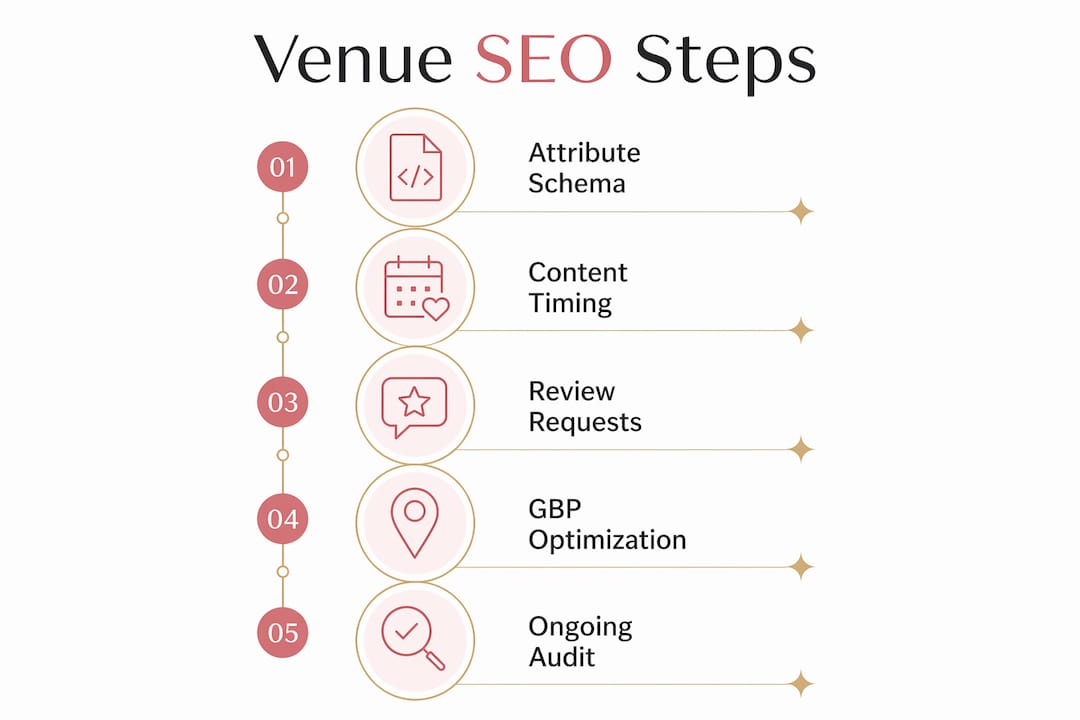
Start with your schema. Then audit your GBP. Then look at your review request process. These three steps, done thoroughly, will move the needle faster than any content campaign built on guesswork.
— Steven
How Adelaideweddingvenues supports venue owners and couples
Adelaideweddingvenues is South Australia’s dedicated wedding venue directory, built to connect couples with the right venue and to give venue owners meaningful online visibility. The platform offers free listings with options for featured placement, putting your venue in front of engaged couples who are actively comparing their options.
For venue owners thinking about how to position their space online, the ideal wedding venue guide on Adelaideweddingvenues outlines the features couples prioritise most. Understanding what clients are searching for is the first step toward describing your venue in the language that AI search and real clients both respond to. You can also list your venue online to increase your bookings and reach more couples across Adelaide and South Australia.
FAQ
What is the biggest SEO change for venues in 2026?
The shift from keyword-based search to attribute-based conversational discovery is the defining change. Google Ask Maps and Gemini AI now match venues to queries based on declared schema attributes like capacity, catering, and accessibility rather than general category tags.
How does Event schema help venue pages rank better?
Event schema with complete fields including eventStatus and availability increases click-through rates by 15–40% in Google’s event rich results carousel. Correct implementation also prevents AI engines from recommending cancelled or sold-out events, which protects your venue’s trust signals.
When is the best time to request a review from a client?
Request a review 24–48 hours after the event, when the experience is fresh and the client is still engaged. Send a direct link to your Google Business Profile review form, as each extra click in the process reduces completion rates by approximately 30%.
How should venues use Google Business Profile for SEO in 2026?
Treat your GBP as a data specification document. List specific capacity figures, AV equipment, catering policies, and accessibility features explicitly. Vague descriptions do not match attribute-based AI queries, so factual detail is what drives visibility in Ask Maps results.
How far in advance should venues publish seasonal content?
Publish venue content 4–8 weeks before your target seasonal peak. This gives Google sufficient time to index and rank the page before search demand reaches its highest point for wedding or corporate event queries in your region.
