
A vendor partnership in the wedding industry is a formal or informal collaboration between a venue and its preferred suppliers — photographers, caterers, florists, celebrants, musicians — or between a venue and a directory like Adelaideweddingvenues, built around mutual referrals, coordinated marketing, and better on-the-day delivery. The core benefit is straightforward: venues get reliable, brand-matched suppliers they can confidently recommend; suppliers get a steady referral stream; and couples get a pre-vetted team that already knows the space.
The most common forms of vendor partnership include:
- Preferred supplier lists shared with enquiring couples
- Cross-promotion via social media, styled shoots, and open-house events
- Featured directory listings that amplify reach beyond the venue’s own audience
- Referral arrangements where venues and suppliers actively recommend each other
Key takeaways
A curated vendor partnership programme, backed by written agreements, regular reviews, and a strong directory presence, is the most reliable way for South Australian venues to protect their reputation and grow bookings.
| Point | Details |
|---|---|
| Define the partnership clearly | A vendor partnership is a mutual referral and marketing arrangement between a venue and trusted suppliers or a directory. |
| Vet before you list | Check insurance, ABN, references, and operational fit before adding any supplier to your recommended list. |
| Use a tier system | Group partners into A-team, backup, style-specific, and trial tiers to manage expectations and protect couple experience. |
| Review annually | Schedule a formal annual review covering pricing, incidents, content delivery, and a renewal decision for each partner. |
| List on Adelaideweddingvenues | A featured listing on Adelaideweddingvenues amplifies your partnership programme to couples actively searching in South Australia. |
Why do vendor partnerships matter for South Australian venues?
Referrals are a core client acquisition channel: venues and suppliers that refer each other tap into each other’s audiences, often securing more bookings and smoother operations than those working in isolation. For a South Australian venue, that means a florist who already knows your load-in dock, a caterer familiar with your kitchen specs, and a photographer who has mapped every flattering corner of your space.
The operational advantages compound on the day itself. Tight long-term partnerships mean planner and venue teams can anticipate issues before they become problems, logistics run on shared timelines, and the guest experience benefits from a team that communicates without prompting.
Marketing benefits are equally tangible:
- Joint styled shoots produce content both parties can use across Instagram, Pinterest, and directory profiles
- Shared open-house events attract new couples at half the individual cost
- Cross-tagging on social posts extends organic reach to each partner’s audience
Stat: Online venue listings can significantly cut wedding search time — pairing a strong directory presence with a curated partner list amplifies that effect further.
How to build a partnership tier system for your venue
Modern partnership programmes replace static PDFs with curated tiers, collaborative marketing, and active engagement. A simple four-tier model works well for most South Australian venues:
- A-team partners — your most trusted, highest-performing suppliers across every style; first referral for every couple
- Backup partners — reliable alternatives for peak weekends or when A-team suppliers are booked
- Style-specific partners — suppliers who excel in a particular aesthetic (heritage, coastal, garden) or cultural tradition
- Trial partners — new suppliers completing a probationary period before full endorsement
Each tier carries different expectations. A-team partners typically commit to attending open-house events, supplying fresh content, and responding to couple enquiries promptly. Trial partners have lighter obligations while they prove their fit.
Pro Tip: Avoid assigning every supplier the same tier by default. A caterer who is perfect for a 200-person reception may not suit an intimate elopement. Tier by style and scale, not just reliability.

How do you build a vendor partnership programme step by step?
A structured three-month rollout prevents the common mistake of rushing to fill a list before relationships are genuinely formed.
- Month one — discover and map. List every service category your couples ask about. Identify gaps: do you have a reliable kosher caterer? A celebrant fluent in Mandarin? Map what you have against what you need.
- Month one — outreach. Research suppliers before contacting them: review their galleries, check their social presence, and attend industry events where possible. When you reach out, propose clear value — a styled shoot, a mention in your next newsletter — rather than a generic “join our list” request.
- Month two — trial. Low-risk trial steps include a joint styled shoot, a site visit, or shadowing a real event. For caterers, a tasting session is standard. Document how each supplier communicates under pressure.
- Month three — formalise. Move suppliers from trial to partner status once they have completed at least one event or shoot without issues. Issue a simple onboarding pack and a partnership agreement.
- Ongoing — promote. Add confirmed partners to your directory profile, feature them in social content, and invite them to your next open-house event to encourage active participation.
Checklist for a 90-day rollout:
- [ ] Service-gap audit complete
- [ ] Outreach emails sent with value offer
- [ ] Trial events or shoots scheduled
- [ ] Insurance and ABN verified for each candidate
- [ ] Partnership agreements signed
- [ ] Partners added to directory listing and social bio
Pro Tip: Suppliers who provide content — photos from your venue, styled-shoot assets, social tags — are far more likely to be recommended by venues long-term. Ask for it as part of the trial.
What should you check before adding a supplier to your list?
Vetting protects your reputation. A couple who books a supplier from your recommended list holds you partly responsible for that supplier’s performance.
Core checks:
- Current public liability insurance (a suitably high amount is standard in the Australian events industry)
- Valid ABN and GST registration where applicable
- Relevant licences: food handling for caterers, liquor licence for bar services, working-with-children check for suppliers regularly around minors
- Evidence of experience at comparable venues (similar size, style, access constraints)
- Two references from other venues or wedding planners, not just couples
Operational fit questions:
- Can they load in and pack down within your access windows?
- Do their staffing levels match your event sizes?
- Is their equipment compatible with your space (power requirements, noise limits)?
- How do they communicate on the day — do they use a run sheet, and will they share it?
Red flags that should disqualify or trigger probation:
- No current insurance or unwillingness to provide a certificate
- Inconsistent or outdated work samples
- Poor responsiveness during the vetting process itself
- Pay-to-play expectations — any supplier who implies that a fee guarantees placement is a reputational risk
What should a partnership agreement include?
A written agreement does not need to be lengthy, but it should cover the essentials clearly.
Suggested agreement outline:
- Scope — which services the supplier provides and which venue events they are endorsed for
- Referral expectations — how and when the venue will recommend the supplier, and vice versa
- Marketing commitments — minimum social posts per quarter, styled-shoot participation, open-house attendance
- Featured listing terms — if the supplier is promoted on a paid directory profile, state what that includes
- Trial period — duration and the criteria for moving to full partner status
- Termination — notice period (30 days is typical) and grounds for immediate removal
- Dispute process — a simple escalation path before either party exits
On exclusivity: most South Australian venues avoid strict exclusivity clauses. Locking in a single florist, for example, limits couple choice and can create friction if that supplier becomes unavailable. Tiered lists with an A-team recommendation achieve the same practical outcome without the legal constraint.
Pro Tip: Preferred supplier status must reflect demonstrated performance, not a fee. Couples trust your list because they trust you — the moment that list becomes pay-to-play, that trust erodes.
How does Adelaideweddingvenues fit into a partnership programme?
A directory extends a venue’s reach well beyond its own social following and email list. Directories are most effective when paired with curated partner tiers and quality-controlled featured listings rather than an open, unvetted list.
Adelaideweddingvenues offers South Australian venues:
- Searchable listings filtered by location, style, capacity, and budget
- Featured listing options that place a venue prominently in search results
- A platform maintained by photographers with direct knowledge of local venues
- Traffic from couples actively searching — not passive social scrolling
A featured listing on Adelaideweddingvenues works as a partnership tool in its own right: it signals to prospective suppliers that your venue is active, professionally presented, and attracting the right couples. Suppliers who see a well-maintained directory profile are more likely to approach you for a partnership than those who find a sparse or outdated one.
Pro Tip: Use your Adelaideweddingvenues profile to name your A-team partners and link to their work. Couples who find your venue through the directory will immediately see the team behind it, which shortens the decision process considerably.
Ready-to-use templates for venues and suppliers
Invitation email template
Subject: Partnership invitation — [Venue Name]
Hi [Supplier Name],
We’ve admired your work at [specific event or gallery reference] and think your style is a strong match for our couples. We’d love to explore a trial partnership — starting with a site visit and, if it feels right, a joint styled shoot in [month]. There’s no fee involved; we’re looking for suppliers we can genuinely recommend.
Would you be open to a 20-minute call this week?
Onboarding checklist
- [ ] Current public liability insurance certificate received
- [ ] ABN and GST status confirmed
- [ ] Venue operations sheet provided (access times, noise limits, parking, power points)
- [ ] Arrival and pack-down windows agreed in writing
- [ ] On-site contact and after-hours escalation path shared
- [ ] Preferred vendor badge or credit line agreed
- [ ] First content deliverable (photos, social tag) scheduled
Annual review form (key items)
- Has the supplier’s pricing changed materially since last review?
- Any on-the-day incidents or complaints from couples?
- Has the supplier provided content (photos, shoots, social posts) as agreed?
- References or feedback from couples who booked through the recommendation?
- Renewal decision: continue, move to backup tier, or remove?
Pro Tip: For cultural or style-specific partner groups — say, suppliers experienced with South Asian weddings or winery receptions — adapt the onboarding checklist to include relevant cultural protocols, dietary requirements, and any specialist licences.
How do you measure whether partnerships are working?
Tracking a handful of clear metrics prevents a partnership programme from drifting into a list nobody updates.
Recommended KPIs:
- Referral volume per partner per quarter
- Conversion rate: referrals received to bookings confirmed
- On-the-day incident rate (complaints, timeline failures, no-shows)
- Social engagement from joint content (reach, saves, enquiries generated)
- Couple satisfaction scores mentioning specific suppliers
A monthly referral log — a simple shared spreadsheet — is enough for most venues. The venue coordinator owns the log; each partner is responsible for reporting referrals they send. Annual reviews cover pricing changes, service updates, any repeat incidents, and a formal renewal decision.
Couple feedback is the most reliable early-warning system. A single negative comment about a supplier’s communication style, repeated across two or three post-wedding surveys, is worth acting on before it becomes a pattern.
Pro Tip: Schedule a brief 15-minute check-in with each A-team partner at the end of every quarter. Small, regular touchpoints catch issues far earlier than an annual review alone.
Cultural and regional factors in the Australian wedding market
South Australia’s wedding market reflects the state’s cultural diversity and its distinct regional geography. Adelaide’s growing South Asian, Chinese, and Vietnamese communities each bring specific supplier requirements: halal or vegetarian catering, tea ceremony specialists, multilingual celebrants, and photographers experienced with particular traditions. A partnership programme that ignores cultural fit will consistently fall short for a meaningful share of couples.
Regional geography matters too. Venues in the Barossa Valley, McLaren Vale, and the Adelaide Hills often work with a smaller pool of local suppliers willing to travel. Building partnerships with suppliers who are genuinely comfortable with regional access — including load-in on unsealed roads, limited power supply, and no nearby backup equipment hire — is a practical necessity, not a preference.
The Australian wedding calendar also concentrates heavily in spring (September to November) and autumn (March to May), which means A-team partners face simultaneous peak demand. Backup tier suppliers are not a fallback for poor performers; they are a deliberate capacity buffer for the busiest weekends.
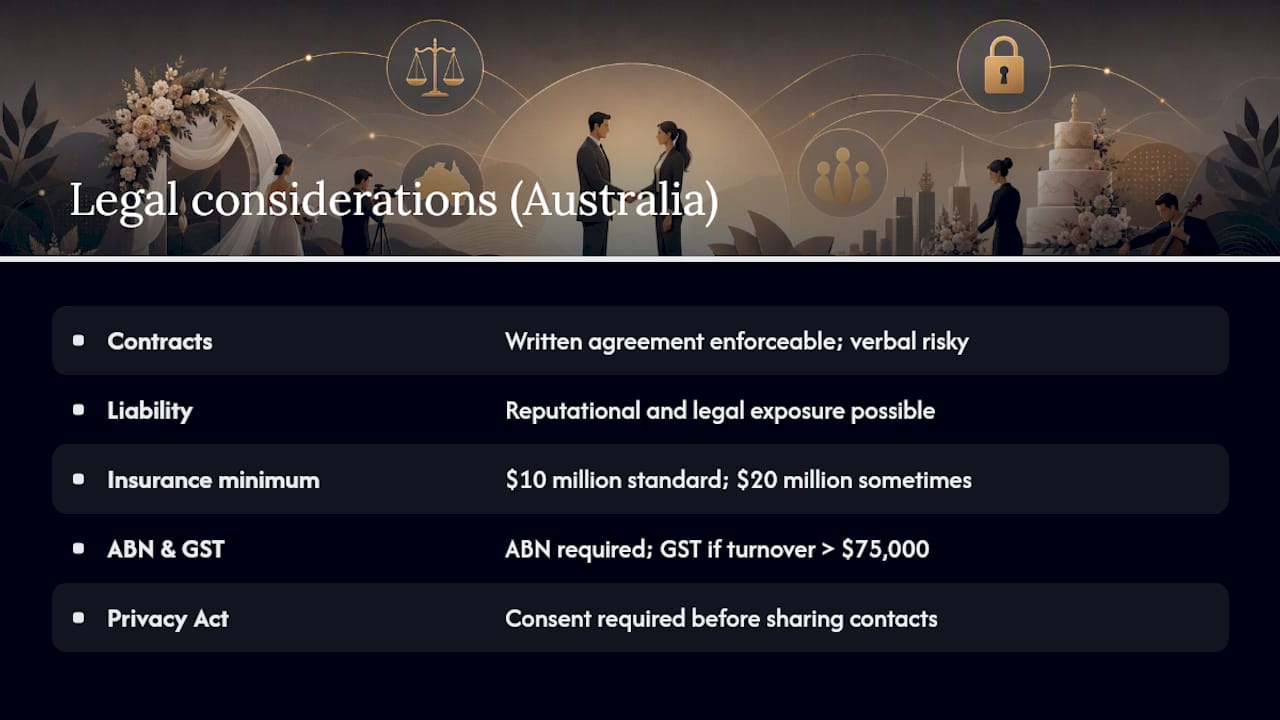
Legal considerations for vendor partnerships in Australia
Australian venues and suppliers entering partnership arrangements should be aware of several legal considerations, though this is general information and not a substitute for advice from a qualified legal professional.
Contracts: A written agreement, even a simple one, is enforceable under Australian contract law and protects both parties if expectations are not met. Verbal arrangements are difficult to enforce and create ambiguity around referral obligations and termination.
Liability: Venues that recommend suppliers may face reputational and, in some circumstances, legal exposure if a recommended supplier causes harm or fails to deliver. Requiring current public liability insurance from every partner is the primary protection. The standard minimum in the Australian events industry is $10 million, though some venues and councils require $20 million for certain event types.
ABN and GST: Any supplier operating as a business in Australia should hold a current ABN. If their annual turnover exceeds $75,000, GST registration is required under the A New Tax System (Goods and Services Tax) Act 1999. Venues paying referral fees or commissions to partners need to account for GST correctly.
Competition and Consumer Act 2010: Misleading or deceptive conduct in referrals — for example, implying a supplier is independently vetted when they have paid for placement — can expose venues to liability under the Australian Consumer Law. This is the legal dimension of the pay-to-play risk discussed earlier.
Privacy Act 1988: If venues share couple contact details with partners as part of a referral, they must comply with the Australian Privacy Principles. Couples should be informed that their details may be passed to recommended suppliers, ideally via a consent clause in the venue’s booking terms.
Which tools help you manage vendor partnerships locally?
Most South Australian venues do not need specialist software to run a partnership programme well. The right tool depends on the size of the programme and how many active partners you manage.
For small programmes (under 10 partners): A shared Google Sheet for the referral log, Google Drive for storing insurance certificates and agreements, and a simple Notion or Google Docs template for the annual review form cover everything needed.
For mid-size programmes (10–30 partners): A CRM such as HubSpot (free tier) or a purpose-built wedding business tool like Aisle Planner or Honeybook allows venues to track referral history, store supplier documents, and set review reminders. Both Aisle Planner and Honeybook are used by Australian wedding professionals and support local currency and date formats.
For directory management: Adelaideweddingvenues provides a venue profile optimisation checklist that guides venues through updating their listing to reflect current partners, featured images, and amenity details — keeping the directory profile aligned with the live partnership programme.
For catering partnerships specifically, resources like specialist event catering guides can help venues identify style-specific caterers worth approaching for a trial. For venues exploring venue booking partnership mechanics from a supplier’s perspective, practitioner-written guides offer a useful counterpoint to the venue-side view.
Why genuine partnerships outperform a list every time
The difference between a curated partnership programme and a PDF list handed to couples is not cosmetic. Industry professionals consistently report that partnerships work best when vendors treat each other as teammates, not referral sources. That mindset changes how suppliers behave on the day: they communicate proactively, they solve problems without waiting to be asked, and they protect each other’s reputation because they know their own depends on it.
A venue that has worked with the same photographer for three seasons does not need to brief them on where the light falls at 4 PM in the ceremony space. That knowledge is already there. The couple benefits from it without ever knowing it existed. That is what a real partnership produces — not a smoother process document, but a quieter, more confident day.
The venues that treat their supplier relationships as a living programme, with regular check-ins, honest annual reviews, and a genuine commitment to mutual success, consistently attract better suppliers over time. The best photographers, caterers, and florists in South Australia have choices about where they work. A well-run partnership programme is one of the clearest signals that a venue is worth their time.
Adelaideweddingvenues supports your partnership programme
South Australian venues building a partnership programme need more than a list. They need visibility with the couples who are actively searching right now.
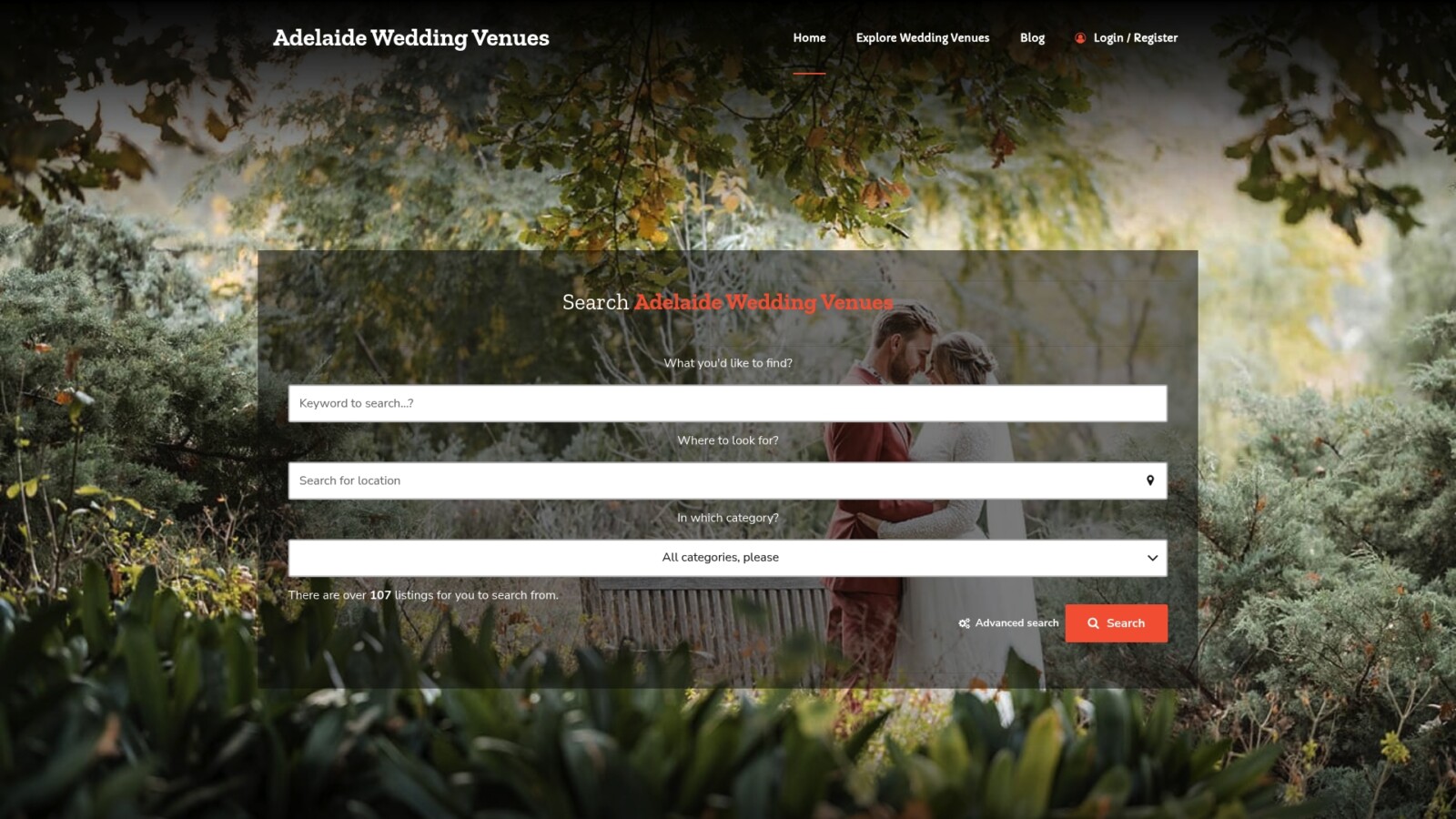
Adelaideweddingvenues is the dedicated directory for Adelaide and South Australia venues, maintained by wedding industry professionals with direct knowledge of local spaces. A standard listing is free and puts your venue in front of couples using location, style, and budget filters. A paid featured listing places you prominently in search results and gives your profile the space to showcase your partner team, your amenities, and your venue’s personality. When your listing reflects a well-curated partner programme, it signals quality to both couples and prospective suppliers. Start with a free venue listing or review the venue profile optimisation checklist to make your current listing work harder for your partnership programme.
Sources
- Why you need a wedding vendor list — BriteBiz
- How to get on a wedding venue’s preferred supplier list — Brighton Savoy
- The modern vendor partnership approach — Snowmad Digital
- Venue recommended suppliers and why pay-to-play is risky — NikNat Entertainment
FAQ
What is a vendor partnership in the wedding industry?
A vendor partnership is a formal or informal arrangement between a wedding venue and preferred suppliers — or between a venue and a directory — built around mutual referrals, shared marketing, and coordinated on-the-day delivery.
How do you establish a vendor partnership with a venue?
Research the venue thoroughly, build rapport through social engagement and industry events, then approach with a clear value offer such as a styled shoot or content contribution rather than a generic request to join the list.
What should a vendor partnership agreement cover?
A solid agreement covers scope, referral expectations, marketing commitments, trial period terms, notice period for termination, and a simple dispute process — all in plain language both parties can act on.
Why should venues avoid pay-to-play supplier arrangements?
Couples trust a venue’s recommended list because they trust the venue’s judgement. Accepting fees for placement undermines that trust and can expose venues to liability under the Australian Consumer Law for misleading conduct.
How does Adelaideweddingvenues support vendor partnerships?
Adelaideweddingvenues provides a searchable directory where South Australian venues can list their profile and showcase their partner team, with featured listing options that increase visibility among couples actively searching by location, style, and budget.
