
A clear budget allocation takes five steps: calculate your net take-home pay, list every expense, assign dollars to needs, wants and savings, protect your savings allocation first, then review monthly. That process works whether you earn $3,000 or $10,000 a month, and you can start it today using the free MoneySmart Budget Planner.
Your five-step allocation at a glance:
- Step 1: Find your net take-home pay on your last payslip (after tax, Medicare levy and HECS/HELP).
- Step 2: List every expense — fixed (rent, loan repayments), variable (groceries, petrol) and irregular (car rego, annual insurance).
- Step 3: Normalise all figures to the same period (monthly is easiest) and subtract total expenses from income.
- Step 4: Assign the remaining money to needs, wants and savings using a percentage framework such as 50/30/20.
- Step 5: Set a monthly review date and automate your savings transfer on payday.
The 50/30/20 rule splits net income into 50% needs, 30% wants and 20% savings. On a net monthly income of around $4,000, typical allocations would be approximately half for needs, just under one-third for wants, and the remainder toward savings. Australians saved a lower-than-recommended percentage of disposable income in early 2026, well below the 20% target, so adapting the framework to your actual situation matters more than hitting a textbook number.
Do this right now: pull out your last payslip, open the MoneySmart Budget Planner, and enter your net income. Everything else follows from that one number.
Key takeaways
A consistent five-step budget allocation process, built on net take-home pay and automated savings transfers, is the most reliable path to financial control for Australian households.
| Point | Details |
|---|---|
| Start with net pay | Always use take-home pay from your payslip, never gross salary, as your budget baseline. |
| Use the 50/30/20 rule as a starting point | Split net income into 50% needs, 30% wants and 20% savings; adjust to 60/20/20 or 70/10/20 if housing costs are high. |
| Protect savings first | Automate a savings transfer on payday before any discretionary spending to avoid saving nothing at month end. |
| Normalise frequencies | Convert all income and expenses to the same period (monthly) using the formulas in Step 3 to avoid calculation errors. |
| Review monthly | Update your budget whenever pay, bills or goals change; a budget that is never reviewed quickly becomes inaccurate. |
How to do a step by step budget allocation: the full five-step process
Step 1: Calculate your net take-home pay
Your budget must be based on net pay, not gross salary. Net pay is what lands in your bank account after income tax, Medicare levy, and any compulsory HECS/HELP repayment. Check your payslip rather than estimating.
If your income varies — casual shifts, freelance work, commission — use the lowest reliable monthly amount you have received over the past three to six months. That baseline protects you from overspending in a good month and being short in a lean one.
Documents to gather:
- Last two payslips (or three months of bank statements for variable income)
- Most recent tax return or payment summary
- Any Centrelink or government payment notices
Step 2: List every expense
Write down every outgoing, sorted into three types:
- Fixed: rent or mortgage repayment, loan repayments, insurance premiums, phone plan, streaming subscriptions
- Variable: groceries, petrol, utilities, dining out, clothing
- Irregular: car registration, annual insurance renewal, school fees, medical costs, holiday savings
Bank statements from the past two to three months are the most reliable source.
Step 3: Normalise frequencies and compare
Bills arrive weekly, fortnightly, monthly, quarterly and annually. To compare them fairly, convert everything to the same period. Monthly is the most practical for most Australians.
Conversion formulas:
- Weekly to monthly: multiply by 52 ÷ 12 (approximately 4.33)
- Fortnightly to monthly: multiply by 26 ÷ 12 (approximately 2.17)
- Annual to monthly: divide by 12
- Annual to fortnightly: divide by 26
The MoneySmart Managing Your Money workbook uses these same conversion rules and includes printable worksheets you can fill in by hand.
Once everything is monthly, subtract total expenses from net monthly income. A positive result means you have money to allocate further. A negative result means expenses exceed income and cuts are needed before anything else.
Step 4: Assign money to buckets — worked example
With a $4,000 net monthly income and the 50/30/20 framework:
| Bucket | Percentage | Monthly amount (AU$) |
|---|---|---|
| Needs | 50% | $2,000 |
| Wants | 30% | $1,200 |
| Savings and debt repayment | 20% | $800 |
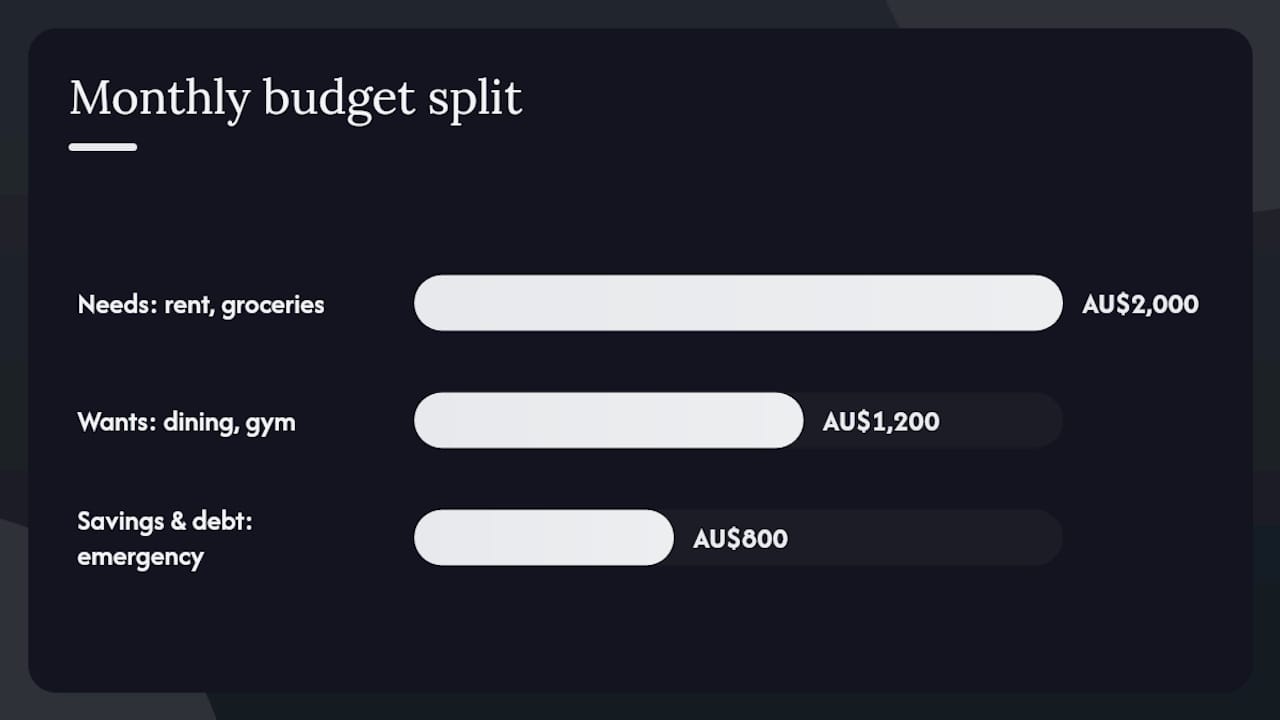
Needs ($2,000): rent or mortgage interest, groceries, utilities, minimum loan repayments, transport to work, phone plan, HECS/HELP (treated as a needs pressure on take-home pay).
Wants ($1,200): dining out, streaming, gym, clothing beyond basics, hobbies.
Savings and debt ($800): emergency fund contributions, extra mortgage principal, superannuation top-up, sinking funds for irregular bills.
Note on mortgage: the interest portion of a repayment is a need; the principal portion is effectively forced savings and can sit in the savings bucket.

Step 5: Set goals, automate and verify
Set at least one specific savings goal — an emergency fund of three months’ expenses is a sound first target. Schedule an automatic transfer to your savings account on the same day your pay arrives. Spend the first month tracking actual spending against your plan, then adjust any category that was consistently over or under.
Pro Tip: If your income is variable, build a one-month buffer in your transaction account equal to your lowest monthly expenses. Draw from the buffer in lean months and replenish it in strong ones, rather than changing your allocations every pay cycle.
How do you classify expenses into needs, wants and savings?
Getting the classification right is what makes percentage frameworks meaningful. A misclassified expense inflates one bucket and starves another.
Needs are non-negotiable costs required to live and work:
- Rent or mortgage repayments (interest portion)
- Groceries (reasonable weekly shop, not premium extras)
- Utilities: electricity, gas, water
- Basic phone plan and internet
- Public transport or fuel for commuting
- Minimum repayments on all debts
- Health insurance and Medicare gap payments
- HECS/HELP repayments (these reduce take-home pay automatically, so they are already a needs pressure)
- Compulsory superannuation (deducted before take-home pay; treat as baseline retirement saving, separate from your discretionary savings target)
Wants are lifestyle choices you could reduce without immediate hardship:
- Dining out and takeaway
- Streaming services (Netflix, Spotify, Disney+)
- Gym membership (unless medically necessary)
- Clothing beyond basics
- Entertainment, hobbies, travel
Savings and debt repayment includes:
- Emergency fund contributions
- Extra debt repayments above the minimum
- Sinking funds for irregular bills
- Investment contributions
- Mortgage principal repayment
Borderline items — the practical test: ask yourself, “Would I genuinely suffer a material consequence if I cut this for three months?” If yes, it is a need. If the honest answer is no, it is a want. A mid-range phone plan with data is a need for most workers; upgrading to the premium unlimited plan is a want.
Buy Now Pay Later (BNPL): treat BNPL repayments as debt, not spending. They belong in the needs bucket under minimum debt repayments, regardless of what you originally purchased.
Sinking funds: the formula
A sinking fund converts an irregular annual bill into a predictable fortnightly or monthly contribution.
Formula: Annual cost ÷ number of pay periods per year = contribution per pay period
Example: car registration costs $800 per year. Paid fortnightly: $800 ÷ 26 = $30.77 per fortnight. Set that amount aside in a named savings account and the bill never surprises you. The MoneySmart workbook includes a full sinking fund worksheet covering registration, insurance, school fees and medical costs.
Which allocation framework suits your situation?
The 50/30/20 rule is a useful starting point, not a fixed law. ANZ notes that it should be adapted to individual circumstances, particularly when housing costs are high.
Three practical variants
Sample amounts based on $4,000 net monthly income.
That is the non-negotiable column. When housing pressure rises, the wants bucket absorbs the cut, not savings.
Decision rules:
- If needs exceed 50% of net income after honest classification, move to 60/20/20.
- If needs exceed 60%, move to 70/10/20 and treat it as a temporary position while working to reduce fixed costs.
- If needs exceed 70%, the priority shifts to increasing income or reducing fixed costs before any other allocation change.
Protecting savings first: transfer savings on payday before spending anything. Treating savings as a bill you pay yourself prevents the common pattern of spending first and saving whatever remains, which is usually nothing.
Direct extra repayments from the savings bucket until the balance is cleared, then redirect that amount to an emergency fund or investment.
Pro Tip: Zero-based budgeting (ZBB) assigns every dollar a category so that income minus all allocations equals zero. It works well alongside a percentage framework on tight budgets: use the percentage split to set category targets, then use ZBB to assign every remaining dollar within each category. Prosperity Associates explains the full ZBB process for Australian households.
How to implement your budget using accounts and automation
Setting up the right account structure turns a budget plan into an automatic system. The goal is to make the right financial behaviour the path of least resistance.
Recommended account setup for Australians
- Transaction account (bills): your pay lands here. Scheduled transfers go out on payday to all other accounts. Keep only enough to cover fixed bills for the month.
- Spending account: your wants allocation transfers here on payday. When it is empty, spending stops. No overdraft facility.
- High-interest savings account: your savings allocation transfers here on payday. Use a separate institution or a locked account to reduce the temptation to dip in.
- Sinking fund account(s): one account (or sub-account) per major irregular bill. Label each with the bill name and target amount.
Automation checklist
- Schedule a transfer to your savings account for payday morning, before any discretionary spending.
- Schedule a transfer to your spending account for the same day.
- Set up direct debits for all fixed bills (rent, utilities, insurance) aligned to the day after payday.
- Schedule minimum debt repayments as direct debits so they never miss.
- Set BNPL repayment dates to align with payday to avoid missed payments.
- Review scheduled transfers once per quarter to confirm amounts still match your plan.
CommBank’s bucketing guidance recommends using account nicknames (e.g. “Car Rego Fund”, “Holiday 2027”) to make the purpose of each account visible at a glance, which reduces accidental spending of earmarked money.
Pro Tip: Name your savings accounts after the goal, not the account type. “Emergency Fund — $5,000 target” is harder to raid than “Savings Account 2.” Most Australian banks allow custom account nicknames at no cost.
How do you track spending and review your budget monthly?
A budget that is never reviewed quickly becomes inaccurate. Life changes — pay rises, rate increases, new bills — and the budget needs to reflect those changes to stay useful.
Two tracking methods
Weekly check-in (5 minutes): open your banking app and compare actual spending in each category against your planned allocation for the week. Flag any category that is trending over. This catches problems early, before the month is gone.
Monthly review (20–30 minutes): a more thorough check covering all categories, savings progress and upcoming irregular bills.
A budget only works if you treat it as a living document. Update it whenever your pay, bills or goals change — not just at the start of the year. The most common reason budgets fail is not overspending; it is failing to update the plan when life moves on.
Monthly review checklist
Track these five indicators each month:
- Actual vs planned spend in each category (needs, wants, savings)
- Savings rate: amount saved ÷ net income × 100
- Buffer balance: is the transaction account buffer holding steady or eroding?
- Debt balance: is the total reducing at the planned rate?
- Bill surprises: any unexpected costs that need a sinking fund added?
MoneySmart recommends reviewing and updating your budget whenever income, expenses or goals change, not just on a fixed schedule. Major life events — a pay rise, a new loan, moving house — each warrant an immediate review.
If your income is variable, switch to the lowest reliable monthly income as your baseline whenever you notice three consecutive months below your current baseline. Adjust allocations downward and treat any above-baseline income as a bonus directed first to the buffer, then to savings.
Quick wins to free up money for reallocation
Finding extra money to allocate to savings or debt does not always require major lifestyle changes. Several high-impact switches take under an hour and produce ongoing savings.
High-impact switches:
- Energy provider: comparison sites such as the Australian Government’s Energy Made Easy show available plans; switching can reduce annual electricity costs for many households.
- Phone plan: the prepaid and SIM-only market in Australia is competitive; many plans offer comparable data at significantly lower monthly costs than postpaid contracts.
- Insurance: home, contents and car insurance premiums vary widely between providers. An annual comparison at renewal can identify savings without reducing cover.
- Streaming subscriptions: audit all active subscriptions. Cancelling two unused services at $15–$20 per month each frees $30–$40 per month, or $360–$480 per year.
- Grocery shopping: meal planning and a written list consistently reduce impulse purchases. Many supermarket apps offer personalised specials and price tracking.
Realism check: keep a small wants allowance in the budget. Removing every discretionary item makes the budget unsustainable and increases the likelihood of abandoning it entirely. A modest dining-out or entertainment budget is not a failure; it is a feature that keeps the plan working long term.
For further switching and savings tools, the MoneySmart budgeting hub includes calculators and links to comparison resources across energy, insurance and banking.
Which budget tools work best in Australia?
The right tool depends on how you prefer to work and how much detail you want to track.
| Tool | Best use case | Automation support |
|---|---|---|
| MoneySmart Budget Planner | First-time budgeters; frequency normalisation; Excel export | Autosave; exportable to spreadsheet |
| MoneySmart Managing Your Money workbook | Printable worksheets; sinking fund calculations; offline use | None (printable PDF) |
| Bank app budget/goals features (e.g. CommBank, ANZ, NAB) | Real-time spending tracking; category alerts; goal tracking | Automatic transaction categorisation |
| Google Sheets or Excel (custom template) | Full customisation; partner sharing via cloud; multi-pay-cycle tracking | Manual; can add formulas for automation |
The MoneySmart Budget Planner supports weekly, fortnightly, monthly, quarterly and annual frequency settings, lets you add custom income and expense items, and exports results to Excel. That export is worth saving to Google Drive or OneDrive so both partners in a household can access and update it.
For couples planning a major event like a wedding, the same budgeting principles apply to the event budget. Adelaideweddingvenues offers a wedding budgeting guide for Adelaide couples that translates these allocation steps into venue and event costs.
Common budgeting mistakes and how to avoid them
Most budget failures trace back to a small number of predictable errors. Knowing them in advance makes them easy to sidestep.
Common pitfalls:
- Using gross income instead of net pay. Tax, Medicare and HECS/HELP reduce take-home pay significantly. A $90,000 gross salary does not produce $7,500 per month in take-home pay. Always start from the payslip figure.
- Mismatched pay frequencies. Comparing a fortnightly income against monthly bills without converting creates a false surplus. Normalise everything to one period before comparing.
- Ignoring HECS/HELP. Compulsory repayments reduce take-home pay and must be treated as a needs pressure, not an afterthought.
- Not automating savings. Saving whatever is left at month end usually means saving nothing. Automate the transfer on payday.
- Forgetting irregular expenses. Annual bills feel invisible until they arrive. Sinking funds solve this; the formula is straightforward (annual cost ÷ pay periods per year).
- Setting an unrealistic wants allocation. A wants budget of zero is not sustainable. Build in a realistic amount and treat it as planned spending, not guilt.
- Never reviewing the budget. A budget set in January and never updated is wrong by March. Review monthly and update after any significant life change.
Pro Tip: When margins are very tight, combine the 50/30/20 percentage framework with zero-based budgeting. Use the percentages to set category targets, then assign every dollar within each category to a specific purpose. This hybrid approach prevents unallocated dollars from disappearing into vague spending.
ANZ’s 50/30/20 guidance reinforces that the framework is a flexible starting point. Adapting it to your actual income and costs is not a compromise; it is the correct application of the method.
Why a simple, repeated process beats a perfect spreadsheet
There is a temptation to delay starting a budget until you have the perfect template, the right app, or a tidy month to begin with. That moment rarely arrives.
The evidence points clearly in one direction: a simple process repeated consistently outperforms a complex one used once. The five-step framework covered here works not because it is sophisticated, but because it is repeatable. Net income, listed expenses, assigned buckets, protected savings, monthly review. That cycle, run every month, compounds over time in ways that a single elaborate spreadsheet never will.
When savings are automated and protected before spending begins, the rate climbs without requiring willpower.
For couples working toward a specific financial goal, such as a wedding, the same principles apply directly. Adelaideweddingvenues provides planning resources that help couples translate a household budget into a realistic venue and event allocation. The venue choice and budget guide is a practical companion for anyone allocating savings toward a major life event.
Start with the BLUF checklist at the top of this article. Open the MoneySmart Budget Planner. Enter one number: your net monthly income. Everything else is just subtraction and decisions.
Sources
A short list of trusted resources for calculators, planners and deeper reading:
Whichever tool you use, protect your savings allocation and set a recurring monthly review date. Those two habits do more for long-term financial health than any particular app or template.
FAQ
What are the five steps of the budgeting process?
The five steps are: calculate net take-home pay, list all expenses (fixed, variable and irregular), normalise frequencies and compare income to expenses, assign money to needs/wants/savings buckets, then set goals and review monthly. MoneySmart outlines this process and provides a free planner to guide each step.
How do you allocate a budget using the 50/30/20 rule?
What is the 70/20/10 rule for money?
It is one of several percentage frameworks; the 50/30/20 rule separates needs from wants more explicitly and is the more commonly recommended starting point in Australia.
What are the seven steps in a full budget process?
A more detailed process expands the five-step framework to include: (1) set financial goals, (2) calculate net income, (3) list all expenses, (4) normalise frequencies, (5) assign to categories, (6) automate transfers, and (7) track and review monthly. Steps 6 and 7 are the ones most people skip, and they are the ones that determine whether the budget actually works.
How often should you review your budget?
Review your budget monthly as a minimum, and immediately after any significant change to income, expenses or financial goals. MoneySmart recommends treating the budget as a living document rather than a one-time exercise.
