
TL;DR:
- Understanding venue selection terminology helps couples negotiate contracts confidently and avoid surprises. It is essential to clarify terms like exclusivity, capacity, and bump-in times before signing agreements. Learning this vocabulary ensures better decision-making and smoother event planning.
Venue selection terminology refers to the specialised language and key concepts used when choosing and contracting event spaces. Knowing this vocabulary is the difference between signing a contract confidently and discovering costly surprises on the day. Couples and event planners who understand terms like exclusive use, bump-in, force majeure, and capacity make better decisions at every stage of the venue selection process. Adelaideweddingvenues has compiled this guide to give you a clear, practical foundation before you visit a single venue or read a single contract.
What is venue selection terminology and why does it matter?
Venue selection terminology is the shared vocabulary of the events industry, covering everything from venue styles and exclusivity types to contract clauses and logistical criteria. Without it, couples often misread agreements, overestimate what “exclusive use” includes, or underestimate the financial risk of an undefined cancellation policy. The industry standard for venue hire in Australia is the Venue Hire Agreement, a binding contract that covers event space boundaries, permitted hours, guest capacity, and cancellation policies. Knowing what each term means before you negotiate puts you in a far stronger position.
What are the main types of venue styles?
Venue style defines the atmosphere and operational character of a space. It is distinct from exclusivity, which relates to legal and physical access rights. Confusing the two leads to mismatched expectations. A coastal venue may feel open and relaxed, but it could still host multiple events simultaneously. An estate venue may feel grand and private, but shared accommodation on the property may remain open to other guests.

Understanding style versus exclusivity helps couples set realistic expectations for both planning and guest experience. Venue style also influences whether a space suits a one-day celebration or a multi-day retreat format. The table below outlines the most common venue styles and their typical event suitability.
| Venue style | Atmosphere | Best suited for | Key logistical note |
|---|---|---|---|
| Estate | Formal, grand | Large weddings, galas | High setup complexity |
| Garden | Relaxed, natural | Daytime ceremonies | Weather contingency needed |
| Coastal | Open, breezy | Relaxed celebrations | Noise curfews common |
| Bushland retreat | Rustic, intimate | Multi-day events | Remote access considerations |
| All-in-one | Practical, contained | Full-service weddings | Supplier restrictions may apply |
| Hybrid (indoor/outdoor) | Flexible | Varied guest profiles | Floor plan flexibility critical |
Pro Tip: Narrow your venue style preference before you start enquiring. Contacting venues without a style shortlist wastes time and makes it harder to compare options objectively.
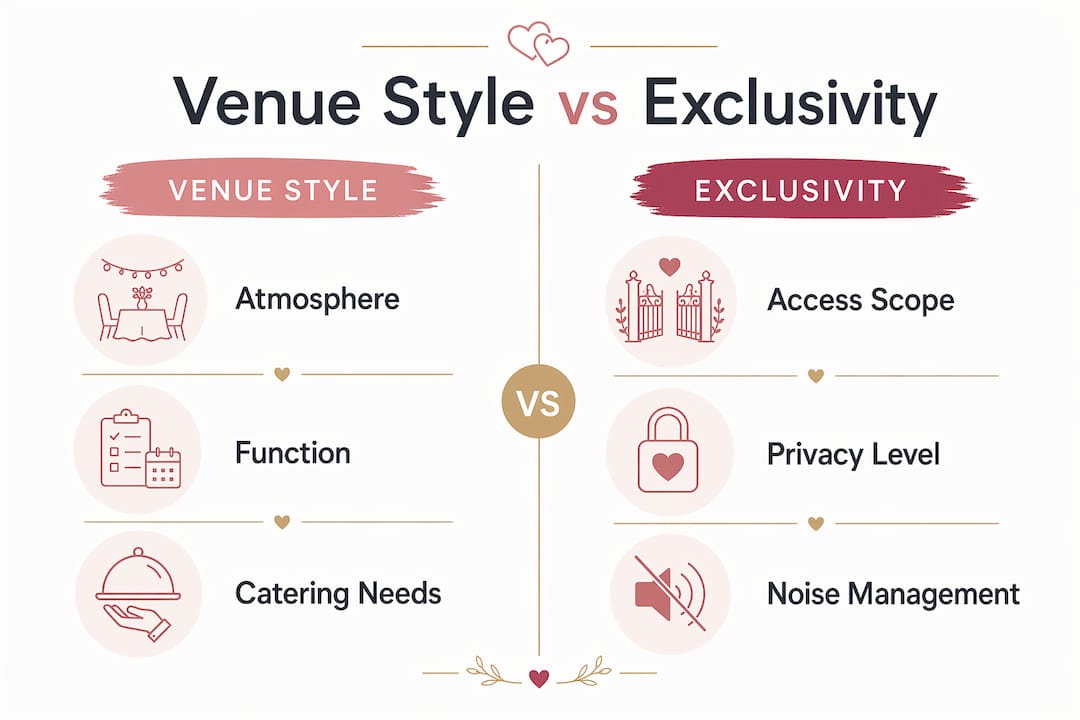
Venue style also shapes catering requirements. A bushland retreat, for example, may require event catering planning well in advance due to limited local supplier access, whereas an all-in-one venue typically provides in-house catering as part of the hire package.
What does “exclusive use” mean for your event?
Exclusive use is one of the most misunderstood terms in venue selection. Exclusive use varies widely and often covers only specific event spaces, not the entire venue or its accommodation. A venue can legitimately market itself as “exclusive use” while still hosting other guests in shared areas. Couples who do not clarify the scope in writing often feel surprised on the day.
There are four distinct types of exclusivity to understand:
- Full private hire. The entire property, including accommodation, gardens, and event spaces, is reserved solely for your event and guests.
- Event-only exclusivity. Only the ceremony and reception spaces are exclusive. Other guests may still access accommodation or common areas.
- Partial exclusivity. Certain zones are exclusive while others remain open. This is common at winery venues with public cellar doors.
- Shared-site exclusivity. Your event runs alongside another event, but in a separate, defined area of the property.
Exclusivity scope directly affects guest privacy, atmosphere, and noise management. A shared-site arrangement at a large property may work perfectly for some couples and feel intrusive for others. The right question to ask is not “Do you offer exclusive use?” but “What exactly does your exclusive use include, and what remains accessible to others?”
Pro Tip: Always request a written description of exclusivity scope before signing. Verbal assurances from venue staff are not enforceable in a contract dispute.
Which contract terms should you understand before signing?
A Venue Hire Agreement is a binding contract covering event space boundaries, permitted hours, guest capacity, and cancellation policies. Australian legal guidance defines this document as the foundation of your relationship with the venue. Reading it without understanding the terminology is a genuine financial risk.
The following clauses appear in most Australian venue hire agreements and carry the most weight:
- Booking details. Confirms the date, event space, permitted hours, and maximum guest capacity. Any deviation from these details may incur additional fees.
- Payment schedule. Outlines deposit amounts, instalment due dates, and final payment deadlines. Missing a payment date can void your booking.
- Cancellation and rescheduling fees. Specifies what you forfeit if you cancel or move the date. These fees often escalate the closer you are to the event date.
- Bump-in and bump-out times. Bump-in and bump-out define the periods allocated for setup and pack-down. Undefined periods risk unexpected rush fees or conflicts with other bookings.
- Use-of-venue rules. Covers noise restrictions, alcohol service requirements, approved caterers, and security obligations. Breaching these rules can result in bond forfeiture.
- Bond and damage obligations. A refundable security deposit held against cleaning costs, damage, or rule breaches. Confirm the release timeline in writing.
- Public liability insurance. Public liability insurance is typically mandatory for venue hirers, with minimum coverage amounts specified. Venues generally require a certificate of currency before your event proceeds.
- Force majeure clause. This clause addresses events outside either party’s control. Force majeure clauses should explicitly cover government-mandated lockdowns and natural disasters, with clear refund or credit policies. Basic contracts often fail to define this adequately, which creates real financial risk.
Read every clause before you sign. If a term is unclear, ask the venue to explain it in writing. A short delay at the contract stage is far less costly than a dispute after the event.
What logistical terms help you compare venues objectively?
Logistical venue evaluation terms like capacity, accessibility, parking, floor plan, and noise curfew are the practical criteria that determine whether a venue actually works for your event. These terms are distinct from style or exclusivity. They measure function, not feeling.
The table below shows the most common evaluation criteria and their direct impact on event planning.
| Evaluation term | Definition | Impact on event |
|---|---|---|
| Seated capacity | Maximum guests for a sit-down format | Determines guest list ceiling |
| Cocktail capacity | Maximum guests for a standing format | Often higher than seated; affects layout |
| Floor plan | Spatial layout of the venue | Governs furniture placement and guest flow |
| Noise curfew | Time by which amplified sound must cease | Affects ceremony and reception timing |
| Bump-in window | Allocated setup period before the event | Determines how early suppliers can arrive |
| Parking | On-site or nearby spaces for guests | Affects accessibility for elderly or mobility-impaired guests |
| Supplier rules | Approved or restricted vendor lists | Limits or expands your catering and styling choices |
| Weather contingency | Backup plan for outdoor elements | Critical for garden, coastal, and bushland venues |
Capacity figures deserve particular attention. Venues often list both seated and cocktail capacities, and the difference can be significant. A space listed at 200 cocktail guests may seat only 120 for a formal dinner. Always confirm which format your event requires before comparing numbers.
Guest flow is another term worth understanding. It describes how guests move through a space from arrival to ceremony to reception. Poor guest flow creates bottlenecks, delays, and a disjointed experience. Ask venues to walk you through the intended guest journey during your site inspection.
RSVP count is the confirmed guest number you provide to the venue, usually required four to six weeks before the event. This figure locks in catering quantities, seating arrangements, and staffing levels. Venues use it to finalise operational logistics, so accuracy matters.
Key takeaways
Mastering venue selection terminology is the single most effective way to avoid costly surprises, negotiate with confidence, and choose a venue that genuinely fits your event.
| Point | Details |
|---|---|
| Style versus exclusivity | These are separate concepts. Style describes atmosphere; exclusivity defines legal access rights. |
| Exclusive use scope | Always confirm in writing exactly which areas are included in any exclusivity arrangement. |
| Contract clause literacy | Understand bump-in/out times, force majeure, and public liability before signing any agreement. |
| Capacity formats | Seated and cocktail capacities differ significantly. Confirm which format applies to your event. |
| Logistical criteria | Noise curfews, supplier rules, and weather contingencies are as important as aesthetics when comparing venues. |
Why terminology is the first thing I tell every couple to learn
Couples almost always arrive at their first venue inspection focused entirely on aesthetics. The gardens look beautiful, the light is perfect, and they are ready to sign. Then the contract arrives and the questions start. What does “event-only exclusivity” actually mean? Is the bump-in window long enough for the florist and the band? What happens if a bushfire closes the road on the day?
I have seen couples lose deposits because they did not understand cancellation fee structures. I have seen receptions cut short because nobody checked the noise curfew before booking a live band. These are not rare outcomes. They are predictable consequences of signing a contract without understanding the language.
The good news is that terminology is learnable. Spending two hours reading a standard Venue Hire Agreement before your first inspection changes everything. You ask better questions. You spot gaps in the contract. You negotiate from a position of knowledge rather than goodwill. Style and atmosphere matter enormously, but they are the easy part. The terms are where the real decisions happen.
My strongest advice is to treat venue selection vocabulary the same way you treat a budget. Build your knowledge before you start spending your time on inspections. The couples who do this consistently have smoother planning experiences and fewer surprises on the day.
— Steven
How Adelaideweddingvenues helps you find the right venue
Adelaideweddingvenues is a specialist directory for wedding venues across Adelaide and South Australia, built by wedding industry professionals who understand both the aesthetic and contractual side of venue selection.
The platform gives couples access to detailed venue listings that include style categories, capacity figures, and location filters, so the terminology you have learned here translates directly into a faster, more focused search. Whether you are comparing a coastal ceremony space with a bushland retreat or weighing up exclusivity options across the Adelaide Hills, the directory makes the differences clear. Start with the ideal wedding venue guide to apply your knowledge to real South Australian options, or browse the full Adelaide venue directory to find spaces that match your style, capacity, and budget requirements.
FAQ
What is venue selection terminology?
Venue selection terminology is the specialised vocabulary used when evaluating and contracting event spaces. It covers terms like exclusive use, bump-in/out, force majeure, capacity, and noise curfew.
What does “exclusive use” actually include?
Exclusive use can mean full private hire, event-only exclusivity, partial exclusivity, or shared-site exclusivity. Always confirm the exact scope in writing before signing.
What is a bump-in time in a venue contract?
Bump-in time is the allocated period before your event when suppliers can access the venue for setup. Undefined bump-in windows risk extra fees or conflicts with other bookings.
Why does force majeure matter in a venue hire agreement?
A force majeure clause protects both parties when events outside their control, such as government lockdowns or natural disasters, prevent the event from proceeding. Without clear terms, deposits may not be refundable.
What is the difference between seated and cocktail capacity?
Seated capacity is the maximum number of guests for a formal dinner format. Cocktail capacity covers a standing event and is typically higher. Confirm which applies to your event before comparing venues.
