
TL;DR:
- A thorough venue site visit checklist transforms an emotional walkthrough into an assessment of logistics, costs, accessibility, and technical readiness. Preparing with guest estimates, a checklist, and capturing detailed notes ensures confident decision-making and negotiation leverage. Testing space features and clarifying contract details at each visit prevents costly surprises and guarantees a seamless event experience.
Walking into a beautiful venue and falling in love with it on the spot is easy. Signing a contract only to discover hidden costs, poor acoustics, or no accessible parking is a much harder lesson. A thorough venue site visit checklist, known professionally as a site inspection guide, turns each tour from an emotional walkthrough into a structured event space assessment. This article covers everything engaged couples and event planners need to evaluate before committing: logistics, costs, accessibility, technical readiness, and guest experience. Prepare well, and venue selection becomes confident, not stressful.
Key takeaways
| Point | Details |
|---|---|
| Prepare before you arrive | Bring a guest list range, budget limits, and a checklist template to keep every tour focused. |
| Assess the physical space thoroughly | Test acoustics, power capacity, wi-fi, and back-of-house access before signing anything. |
| Uncover all costs upfront | Request a full fee breakdown including service charges, cleaning fees, and overtime rates at every visit. |
| Score venues using consistent criteria | Use a standardised rating system and photos to compare venues objectively after multiple tours. |
| Treat the visit as a negotiation tool | Notes and photos give you leverage to discuss terms, request inclusions, or push back on pricing. |
Your venue site visit checklist starts before you arrive
Most couples and planners arrive at a venue tour unprepared, which means they spend the visit admiring the décor instead of gathering the information they actually need. The professional term for what you are undertaking is a site inspection, and clear event objectives before the visit allow you to tailor your scrutiny to the features that matter most to your specific event style.
Before your first tour, gather the following:
- A confirmed or estimated guest count range (for example, 80 to 120 guests)
- Your total venue budget, including a ceiling figure you will not exceed
- A rough event flow or timeline (ceremony, cocktail hour, reception, finish time)
- A printed or digital checklist template with space for notes in each category
- Your phone or camera for photos, plus a measuring tape for tight spaces
Scheduling matters more than most people realise. If your event will run on a Saturday evening, try to schedule venue tours on a Saturday or at least during the time of day your event will start. Natural lighting shifts dramatically between midday and 6pm, and traffic patterns around the venue at that hour will mirror your guests’ arrival experience.
Pro Tip: When touring multiple venues in one day, limit yourself to three visits maximum. More than that and your impressions start blending together, making it harder to recall specific details accurately.
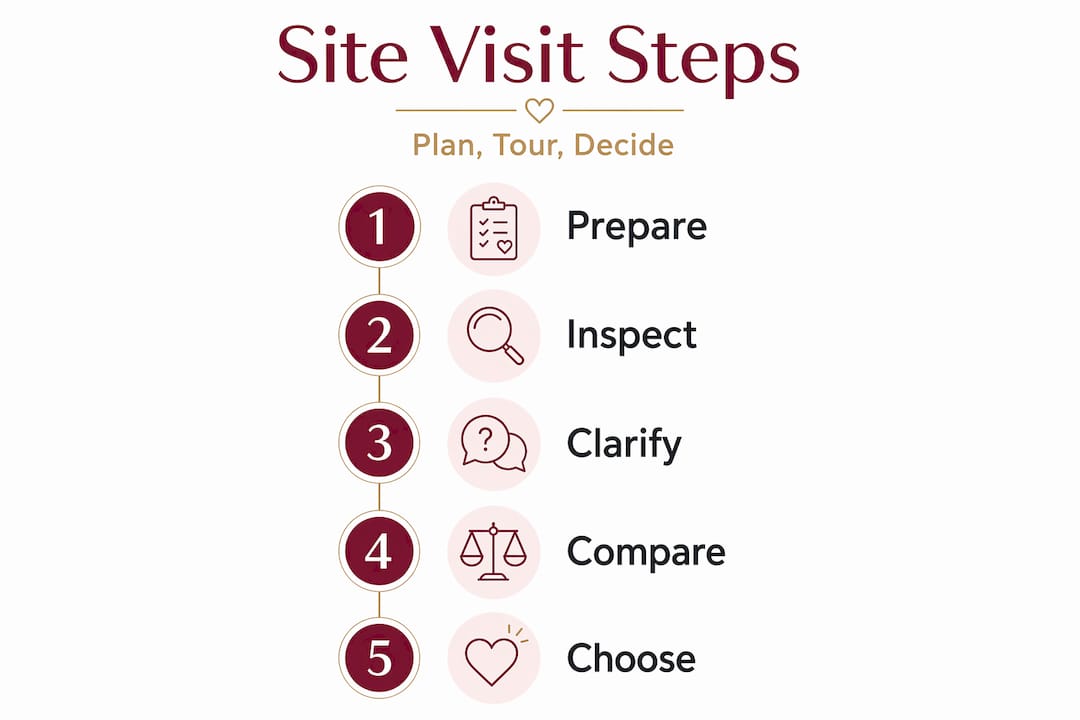
If you are touring with a partner or client, assign roles. One person asks questions while the other photographs and takes notes. This simple split keeps the visit organised and doubles the information you collect.
Evaluating the physical space and technical infrastructure
This is where most couples miss critical details. A beautiful ballroom means very little if the power supply cannot support your audiovisual requirements or if guests with mobility needs cannot access the ceremony space. Accessibility features including ramps, lifts, and parking significantly affect guest comfort and safety, and they must be verified in person, not assumed from photos.
Work through these checks during every venue walkthrough:
- Entrances and exits. Walk the guest arrival path from the carpark to the ceremony space. Note any stairs, narrow doorways, or uneven surfaces.
- Accessibility compliance. Confirm the presence of ramps, lifts, accessible restrooms, and clear signage throughout. ADA-equivalent compliance and realistic guest flow should be verified for every space you plan to use.
- Power and circuits. Ask to see the distribution board or speak with the venue’s technical manager. Circuit and outlet locations are frequently underestimated for events with live bands, lighting rigs, or photo booths.
- Wi-fi and mobile coverage. Test both in the actual event rooms, not just the lobby. Older buildings and underground spaces routinely have dead zones that can disrupt entertainment systems or payment terminals.
- Acoustics and noise interference. Clap once loudly in the ceremony space. Listen for echo. Ask about neighbouring function rooms or external noise sources such as roads or kitchen extraction units.
- Back-of-house access. Walking the dock-to-room path and confirming vendor loading windows is critical, particularly for large weddings with florists, caterers, and AV crews all arriving simultaneously.
| Area to inspect | What to check | Red flags |
|---|---|---|
| Ceremony and reception spaces | Ceiling height, rigging points, lighting controls | No dimmer switches, low ceilings |
| Restrooms | Quantity relative to guest count, cleanliness | Fewer than one per 30 guests |
| Power infrastructure | Outlet locations, circuit capacity | Single phase only, limited outlets |
| Wi-fi and connectivity | Signal strength in event rooms | Dead zones, shared bandwidth |
| Vendor access | Loading dock, lift size, time windows | No after-hours access, tight corridors |
Pro Tip: Bring a phone charger and plug it into an outlet in the reception space. If the circuit trips or the charge is slow, the venue may have insufficient power capacity for event equipment.
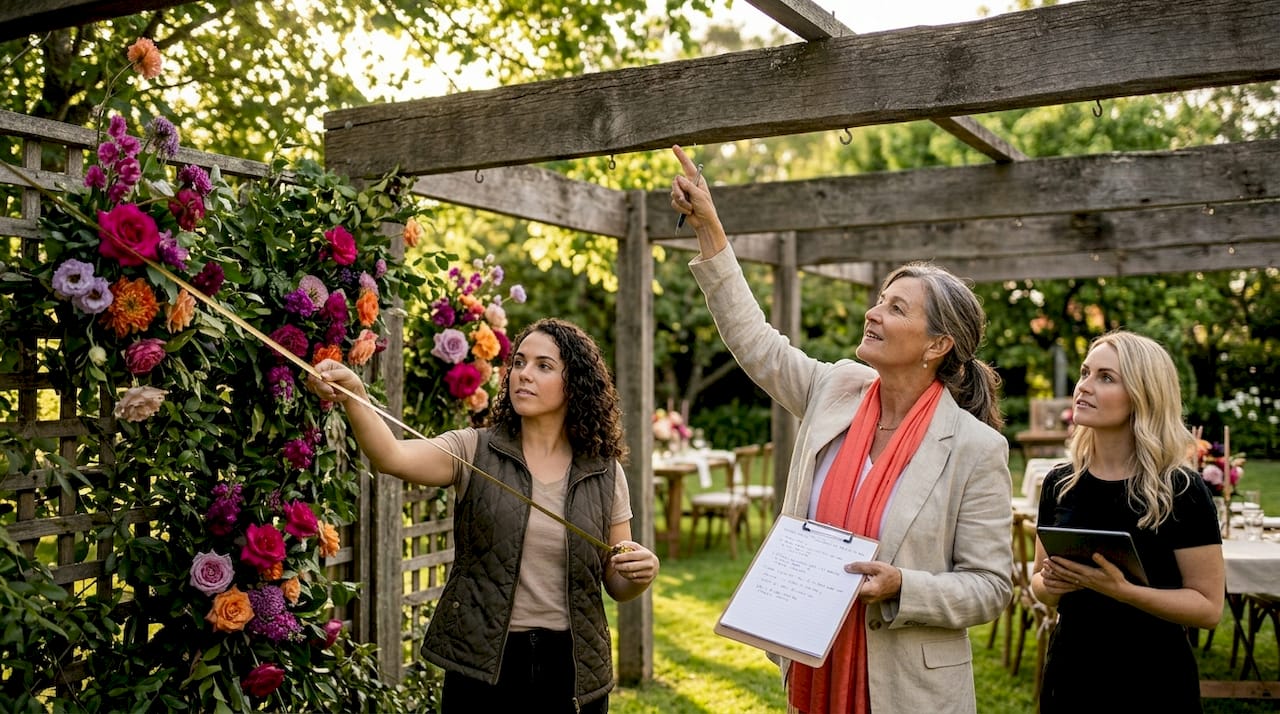
Ceiling height and rigging points are details that catch planners off guard long after the venue is booked. If you are planning hanging installations or projection screens, measure and confirm these details on-site.
Financial and contract details to clarify on your visit
The physical space is only half of the evaluation. A professional site inspection is critical before signing and gives you consistent comparison and negotiation leverage across every venue you visit. Many couples discover significant cost gaps only after receiving a contract.
Ask the venue coordinator to walk through every line of their pricing:
- Base hire fee. Confirm exactly what hours this covers and which spaces are included.
- Service charges and staffing. Some venues add a compulsory service fee on top of quoted rates.
- Cleaning fees. These are frequently not mentioned upfront but appear in the contract.
- Overtime rates. Know the per-hour charge if your event runs long, and clarify cancellation and postponement terms in detail.
- Deposit schedule. When are payments due, and what is the refund policy at each stage?
The distinction between what is included and what costs extra is equally important. A venue that quotes a lower hire fee but charges separately for tables, chairs, linen, AV equipment, and a venue manager can end up costing considerably more than a higher-quoted all-inclusive option.
| Included at most venues | Usually charged separately |
|---|---|
| Basic tables and chairs | Linen and chair covers |
| Venue manager on the day | Dedicated event coordinator |
| Standard lighting | Uplighting or custom AV rigs |
| Basic PA system | Band or DJ power supply |
| On-site parking | Valet or overflow parking |
Vendor exclusivity is another area worth probing. Some venues require you to use their in-house caterer or a preferred supplier list, which limits your choices and can increase costs. For more detail on costs that couples commonly miss, the Adelaideweddingvenues article on unexpected venue expenses is worth reading before any tour.
Pro Tip: Photograph the venue’s pricing sheet or fee schedule during your visit. If verbal quotes differ from what appears in the contract later, your photos provide documented evidence for the negotiation.
Guest experience and event day logistics
You can have a technically perfect space that still delivers a poor experience for guests if the operational details are not right. Catering operations and staffing arrangements directly affect event flow and timeline, and these details must be assessed during your walkthrough rather than assumed later.
Key areas to review with the venue team:
- Catering policy. Can you bring an external caterer, or is the kitchen exclusive to their team? Ask about food service pace and whether a tasting is included.
- Bar arrangements. Is the bar staffed by the venue, or do you supply your own? Confirm licence terms, last drinks timing, and any corkage fees.
- Restroom quantity. For a seated event of 100 guests, you need at minimum three to four stalls. Walk to the restrooms yourself rather than asking a coordinator to describe them.
- Amenities. Check whether a green room or bridal suite is available, where coats and bags can be stored, and whether pram or wheelchair storage is provided.
- Setup and teardown windows. Venues enforce strict access windows, and exceeding them results in overtime charges. Get the exact times in writing during your visit.
- Noise restrictions and decoration limits. Ask specifically about cut-off times for amplified music and whether open flames, confetti, or hanging decorations from walls are permitted.
Statistic to keep in mind: Multiple professional checklists flag that unclear setup windows are among the most common sources of unexpected charges after weddings. Confirm start and finish access times for every vendor, not just the couple.
For events where guests may be travelling some distance, wedding transport considerations are worth discussing with the venue team as well. Some venues have agreements with transport providers or can advise on nearby drop-off areas.
Making the final decision with your site visit notes
A thorough site inspection guide only pays off if you use the data you have collected. Effective note-taking with photos and area-specific comments transforms a chaotic tour into documented, comparable information that supports clearer decisions and more confident negotiations.
Follow this process after each visit:
- Organise photos by area. Create folders labelled by space: ceremony room, reception hall, prep rooms, restrooms, exterior, and back of house.
- Complete your scoring sheet. Rate each venue on five to eight criteria that matter most to your event, using a consistent one-to-five scale. This removes the problem of recency bias, where the last venue toured feels like the best one simply because it is freshest in memory.
- Identify non-negotiable gaps. If a venue failed on accessibility or power capacity, that is not a “maybe.” Flag those as disqualifiers before comparing pricing.
- Prepare your negotiation points. Notes and photos give you specific, documented grounds to request inclusions, price adjustments, or extended access windows.
- Involve key stakeholders. Share your notes, photos, and scores with your partner, wedding planner, or key vendor before committing. A fresh perspective on your data often surfaces something you missed during the tour.
Pro Tip: Use a simple spreadsheet with venues as columns and criteria as rows. Add your scores and a photo link for each. Showing this to a venue coordinator during a follow-up conversation signals professionalism and often improves their willingness to negotiate.
The essential questions to ask your Adelaide wedding venue resource from Adelaideweddingvenues is a helpful companion to your scoring sheet, ensuring nothing falls through the gaps during follow-up conversations.
What I have learned from watching couples navigate venue visits
I have seen many couples walk into a venue and make a decision based almost entirely on how the space made them feel. The emotion is real and understandable. But the venues that have delivered the smoothest events are always the ones where the couple or planner arrived with a plan and asked hard questions.
The biggest mistakes I observe are: not testing anything technical, skipping the back-of-house walk, and failing to ask about overtime and cancellation policies before the relationship is warm. By the time you are in love with a venue, negotiating feels uncomfortable.
What I have learned is that the site visit is not just an evaluation. It is the only moment where you have genuine leverage before signing. The venue needs your booking. Use that dynamic. Ask about inclusions. Reference what a competing venue offered. Document everything.
I also think the soft factors matter more than people admit. How did the coordinator respond when you asked a difficult question? Did they know the answers without hesitation? Site visits evaluate both the space and the staff, and service quality influences the event outcome as much as the physical room does.
Trust the process. A checklist does not remove the joy from choosing your venue. It protects it.
— Steven
Find your perfect Adelaide wedding venue with confidence
Adelaideweddingvenues makes it straightforward to move from checklist to confirmed booking. The directory lists venues across Adelaide and South Australia covering every style, from garden ceremonies to grand ballrooms. Use the search filters to match venues to your guest count, budget, and location preferences. When you find strong candidates, you will have everything you need from this guide to walk in prepared and ask the right questions.
Explore the ideal Adelaide wedding venues guide to discover options from rustic barns to beachside settings. Or browse the choosing the perfect venue resource for in-depth selection advice. The right venue is out there. Now you have the tools to find it with clarity and confidence.
Frequently asked questions
What should I bring to a venue site visit?
Bring a printed or digital checklist, your estimated guest count, budget range, a camera or phone for photos, and a measuring tape. Arriving with these materials means you collect useful data rather than general impressions.
How do I compare multiple venues objectively?
Use a consistent scoring sheet that rates each venue on the same set of criteria, such as capacity, accessibility, technical infrastructure, cost transparency, and staff responsiveness. Adding photos by area makes post-tour comparisons much clearer.
What financial details should I clarify during a venue visit?
Ask for a full breakdown of all fees including base hire, service charges, cleaning, overtime rates, and deposit schedules. Clarifying hidden costs like cancellation penalties during the visit prevents costly surprises in the contract phase.
Why is testing wi-fi important during a venue walkthrough?
Wi-fi must be tested in the actual event rooms because older buildings and basement spaces often have dead zones that do not show up in lobby tests, and these can disrupt payment systems, entertainment equipment, or live-streaming setups.
When is the best time to schedule a venue tour?
Schedule your tour at the same time of day your event will run, and ideally on the same day of the week. This lets you observe natural lighting conditions, traffic patterns, and how busy the surrounding area actually is during your event window.
