
TL;DR:
- Thorough understanding of key contract clauses helps couples negotiate effectively and avoid surprises.
- Preparation, including research and question formulation, increases negotiation power and secures better terms.
- Focus on value-adds and flexible arrangements rather than just seeking price reductions for optimal results.
Venue contracts can feel overwhelming, especially when you are already managing dozens of other wedding decisions. Hidden costs, vague cancellation clauses, and inflexible terms are common concerns for engaged couples across South Australia. The good news is that negotiation is absolutely possible, and approaching it with preparation gives you real control over how your wedding day is structured and what you actually pay for. This guide walks you through every practical step, from understanding what should appear in your contract, to preparing your questions, executing smart negotiation tactics, and reviewing the final document with confidence.
Key Takeaways
| Point | Details |
|---|---|
| Use a contract checklist | A detailed clause-by-clause checklist prevents hidden risks and supports strong negotiation. |
| Prepare before negotiating | Research, clarify key questions, and know your guest and venue priorities to improve your outcomes. |
| Negotiate concessions, not just price | If price is locked, focus on securing value-added extras and better contract terms. |
| Get everything in writing | Ensure contract amendments and negotiated concessions are documented before signing. |
Understanding the essentials of venue contracts
Before you sit down with a venue coordinator, it helps to understand what a thorough venue contract actually looks like. Many couples sign documents without fully reading them, only to discover surprise fees or restrictive conditions months later. Knowing the key components of a venue hire agreement protects you from that outcome and puts you in a much stronger position when negotiating.
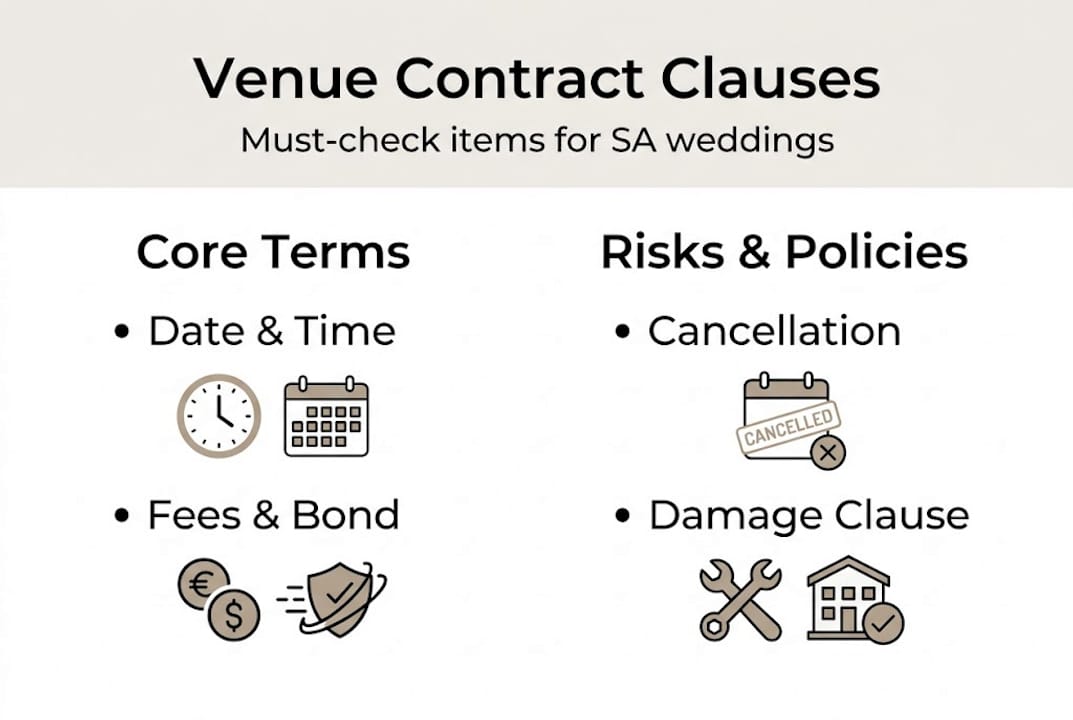
A well-structured venue contract should cover a clear set of clauses that address every aspect of your event. According to Sprintlaw’s venue hire agreement template for Australian couples, the key clauses for any venue hire agreement include parties and purpose, dates, times and access, capacity and house rules, fees, bond and payment schedules, cancellations, refunds and rescheduling, damage, cleaning and condition, insurance, liability and indemnities, compliance, noise and neighbours, force majeure, and disputes. Understanding each of these clauses before your first meeting gives you a structured checklist to work through, rather than reacting to whatever the venue presents.
Here is a summary of the most critical clauses and what to look for in each:
| Clause | What to check |
|---|---|
| Fees and bond | Total cost, bond amount, due dates, refund timeline |
| Cancellation and refunds | Notice periods, refund entitlements, rescheduling conditions |
| Insurance and liability | Who holds public liability, what is covered |
| Force majeure | What counts as an unforeseen event and what happens next |
| Dispute resolution | How disagreements are handled and which jurisdiction applies |
The clauses listed above are the ones that most frequently cause problems for couples who sign without reading carefully. For instance, a cancellation clause that requires 12 months notice for a full refund can be financially devastating if circumstances change. Similarly, a bond clause that does not specify a return timeline could leave you waiting weeks after your wedding.
South Australia has its own consumer protection considerations, particularly around public liability insurance requirements for events. Some venues require you to hold your own event insurance in addition to what the venue carries. This is worth clarifying in writing before you sign anything.
Essential questions to ask about every clause:
- Is there a minimum spend threshold and how is it calculated?
- What constitutes a breach of the house rules?
- Are there any additional compliance requirements under South Australian law?
- What noise restrictions apply and are they legally mandated or venue policy?
For couples who want a broader understanding of this topic, navigating venue contracts offers further detail on how to approach the process. You can also find localised advice in this Adelaide venue contract guide that covers common situations specific to the South Australian market.
Pro Tip: Print out the contract and go through it clause by clause with a highlighter before your negotiation meeting. Mark anything unclear, anything missing, and anything you want to change. This makes the negotiation conversation much more focused and productive.
Preparing to negotiate: What couples should know before approaching venues
Now that couples understand the contract essentials, the next step is preparing to negotiate with venues. Arriving at a negotiation without preparation is one of the most common mistakes couples make. Venues deal with contracts every week, and their coordinators are experienced at fielding requests. Your best advantage is thorough preparation.
Start by researching the venue thoroughly. Understand their peak seasons, their typical booking volume, and their usual inclusions. In South Australia, the peak wedding season generally runs from October through to April, with popular venues in the Adelaide Hills, Barossa Valley, and McLaren Vale often booked 12 to 18 months in advance. Approaching a venue during their quieter months, or booking a mid-week date, gives you meaningfully more negotiating power.
Key research steps before your venue meeting:
- Compare at least three venues to understand typical pricing and inclusions in your category
- Read recent reviews to identify common complaints or gaps in service
- Ask your photographer or wedding planner if they have insights about the venue’s flexibility
- Confirm the venue’s capacity relative to your guest list to ensure there is no padding in minimum spend requirements
- Check whether the venue has any restrictions on external suppliers, such as preferred caterers or beverage minimums
Preparing the right questions is equally important. Knowing what to ask demonstrates seriousness and signals to the coordinator that you are a detail-focused couple who will read the contract carefully. This often encourages more transparent conversations. You can find a strong starting point for your questions in our guide on questions for your venue.
Questions to have ready before your negotiation:
- What is included in the venue hire fee, and what is charged separately?
- What is the cancellation policy, and what notice is required for a partial or full refund?
- Is there flexibility around access times for setup and pack-down?
- Are there any mandatory supplier requirements, and can we bring our own?
- What is the bond amount and how quickly is it returned after the event?
- Can any of the extras, such as furniture, audio-visual equipment, or catering packages, be included in the base rate?
- What happens in the event of an unforeseen circumstance on either side?
These questions also tie directly back to the clause-by-clause checklist approach for venue hire agreements, which outlines exactly the categories your questions should cover. Pairing your preparation with a solid venue checklist ensures no detail is overlooked before your wedding day.
Pro Tip: Bring a written list of your must-haves and nice-to-haves to the meeting. Share it with the coordinator early in the conversation. This sets a collaborative tone and helps the venue identify where they can add value without cutting price.
Step-by-step negotiation: Tactics to achieve the best deal
Once couples are prepared, the negotiation process itself is where the outcomes are defined. Many people expect to walk in and negotiate a lower price, but that is rarely how venue negotiations work in practice. Understanding what venues are actually flexible on changes your entire strategy.
As Brighton Savoy notes in their guidance on venue negotiation, venues may not lower their pricing but can often offer value-adds such as extras included at no additional cost. This is a critically important mindset shift. When the rate is fixed, your negotiation should shift to securing inclusions, concessions, or contract flexibility that effectively reduces your overall spend.
Comparison: Price negotiation vs. value negotiation
| Negotiation type | Example ask | Likelihood of success |
|---|---|---|
| Price reduction | “Can you lower the hire fee by $500?” | Low at popular venues in peak season |
| Inclusion negotiation | “Can you include the audio-visual package?” | Moderate to high |
| Access time extension | “Can setup begin two hours earlier?” | Often flexible |
| Minimum spend adjustment | “Can we lower the food and beverage minimum?” | Low in peak season, higher off-peak |
| Cancellation terms | “Can we extend the full refund notice period?” | Moderate |
Here is a step-by-step approach to the negotiation conversation itself:
- Establish rapport first. Build a genuine connection with the coordinator before discussing numbers. Ask about their experience with weddings similar to yours. Venues are more willing to accommodate couples they connect with.
- Lead with your confirmed details. State your guest count, preferred date, and budget range confidently. Uncertainty signals you are still shopping around, which reduces your leverage.
- Present your must-have list. Reference the list you prepared. Ask which items can be bundled into the package at no extra cost.
- Ask about off-peak incentives. Many South Australian venues offer better terms for Sunday events, mid-week bookings, or dates in the quieter June to August window.
- Negotiate minimum spends explicitly. If the venue has a food and beverage minimum, ask whether that figure can be adjusted based on your confirmed guest numbers or whether menu selection can be used to meet it efficiently.
- Request flexibility on access times. Setup and pack-down windows are frequently negotiable, especially if the venue has no other event on the same day.
- Get every agreed concession documented. Before leaving, confirm that all verbal agreements will be reflected in the written contract.
For more detailed tactics on securing favourable terms, our guide on venue deal tips and negotiation strategies offer practical frameworks specific to the South Australian market.
Pro Tip: Always negotiate on more than one item at a time. Asking for a single discount puts the venue in a position to simply say no. Asking for a package of adjustments, such as longer access, an included bar package, and softer cancellation terms, creates room for the venue to give ground on at least one or two points.
Verifying, amending, and finalising your venue contract
After negotiation, attention shifts to carefully reviewing the contract and ensuring every detail reflects the agreed terms. This stage is where many couples relax when they should be most attentive.
Request an updated draft of the contract that incorporates every concession and amendment discussed. Do not sign the original document with verbal assurances that changes will be made. Insist on seeing the revised version before putting pen to paper. If a venue is unwilling to update the contract to reflect your agreements, that is a significant red flag.
Key items to verify in the final contract draft:
- All agreed inclusions are listed specifically, not referenced vaguely as “extras as discussed”
- The bond amount and return timeline are clearly stated
- Cancellation terms match what was verbally agreed, including notice periods and refund percentages
- Access times for setup and pack-down are explicitly noted with start and end times
- Any noise restrictions are clearly defined, including what time music must cease
- The force majeure clause explains what qualifies and what remedies are available to both parties
- The dispute resolution clause specifies how disagreements will be handled and which state’s laws apply
The clause checklist covering parties, dates, fees, cancellations, insurance, compliance, noise, force majeure, and disputes is your verification tool at this stage. Work through it methodically once you receive the revised draft.
Always treat the contract review stage as its own negotiation. If the revised draft contains terms you did not agree to, or omits terms you did, address them immediately in writing before signing anything.
It is also worth considering an independent legal review if the contract is lengthy or if any clause is genuinely unclear to you. You can compare All Adelaide Wedding Venues while finalising your venue choice. Many solicitors in South Australia offer fixed-fee document reviews, and the cost is minor compared to the financial risk of signing a contract you do not fully understand.
Our guide on venue capacity details is also worth consulting at this stage to confirm that the capacity specified in the final contract accurately reflects your confirmed guest numbers and the layout you have planned.
A fresh perspective: Why couples shouldn’t just chase discounts
Here is something worth saying plainly: the couples who walk into venue negotiations expecting a straightforward price cut are usually disappointed, and sometimes they miss far better opportunities because of that focus.
As Brighton Savoy’s guidance makes clear, some venues have very little pricing flexibility depending on demand, season, and internal commitments. Fixating on a rate reduction can actually damage the relationship with the coordinator and close off conversations that might have led to genuinely valuable concessions.
The real wins in venue negotiation are found in the venue factors that couples often undervalue: extended access windows that reduce your hire costs, inclusive packages that eliminate supplier invoices, and flexible cancellation terms that protect you if circumstances change.
South Australia’s wedding venue market is also shaped by strong seasonal demand, particularly in wine regions and coastal areas. Expecting a discount at a Barossa Valley estate in November is unrealistic. Approaching the same venue for a July Sunday booking opens an entirely different conversation. Strategy matters more than persistence.
Explore Adelaide’s venue solutions for your wedding
Having mastered venue contract negotiation, couples can now explore solutions and options for their dream wedding across South Australia.
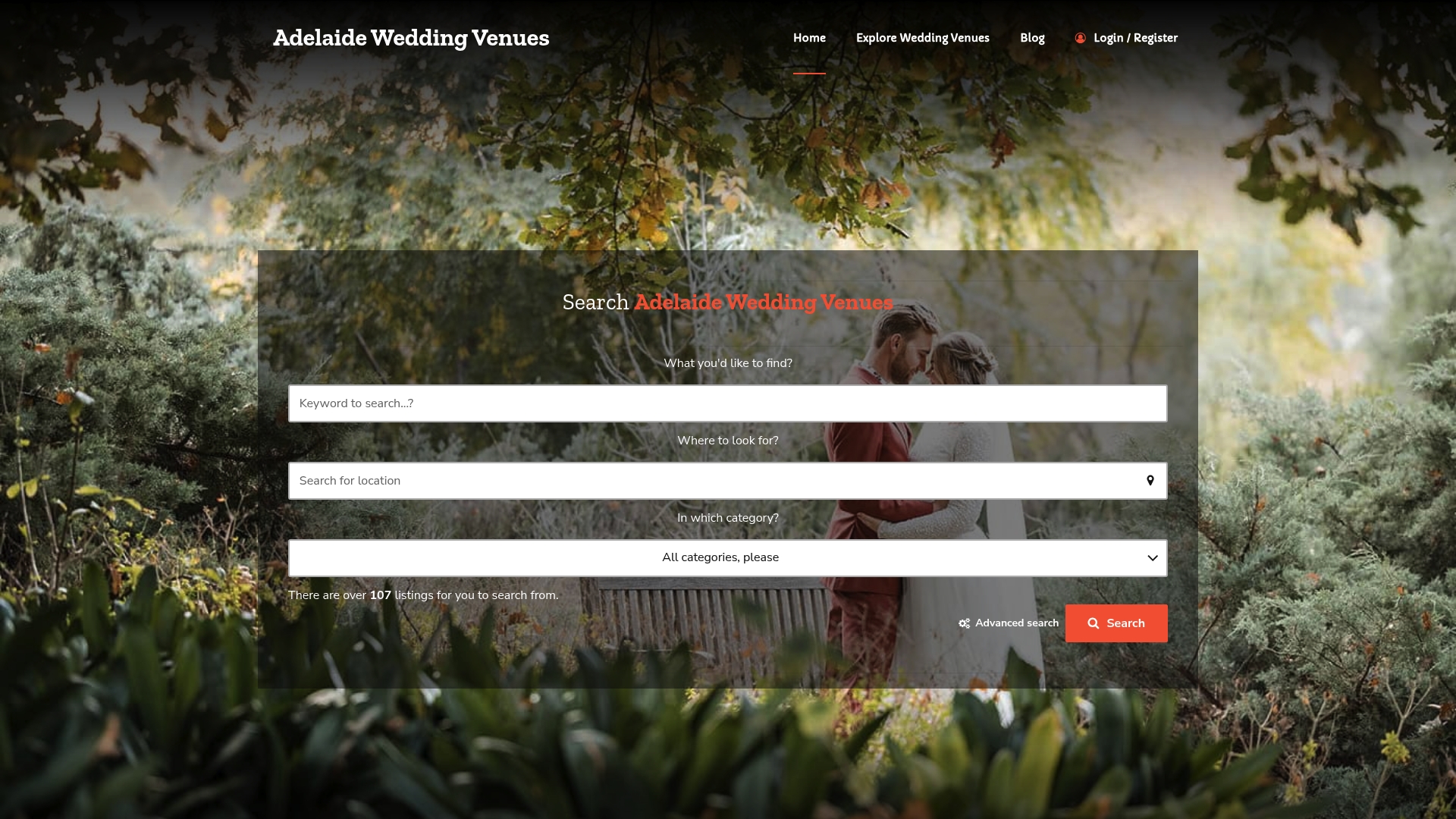
Adelaide Wedding Venues provides a curated, searchable directory of venues across Adelaide and South Australia, making it straightforward to compare options by location, capacity, style, and budget. Whether you are looking for a venue known for flexible contract terms or one that offers strong all-inclusive packages, the directory helps you find and compare your options before you begin any negotiation. Start your search today and choose your ideal venue with confidence. You can also follow the wedding location decision process to narrow your shortlist using a structured approach tailored to the South Australian market.
Frequently asked questions
Is it possible to negotiate the price of a wedding venue in South Australia?
Venues usually have fixed rate structures, but some can offer added value or minor concessions depending on demand and timing. As the Brighton Savoy negotiation guidance notes, pricing flexibility varies significantly by season and internal commitments, so couples should focus on total value rather than rate reductions alone.
What clauses should couples focus on when reviewing venue contracts?
Key clauses include purpose, dates, fees, cancellations, damage, insurance, compliance, noise policies, and dispute resolution. The Sprintlaw venue hire checklist provides a complete clause-by-clause reference that covers every category relevant to Australian venue agreements.
How can couples maximise negotiation outcomes if price is fixed?
Focus on securing extras, concessions, and flexible terms to lower overall cost and improve value. Brighton Savoy’s advice specifically recommends asking for value-added services when price reductions are unavailable, such as having additional inclusions bundled into the base package.
What are common mistakes couples make when negotiating venue contracts?
Overlooking cancellation policies, unlisted extras, or failing to get amendments in writing are frequent pitfalls. The Sprintlaw clause checklist highlights exactly these categories as areas where couples most commonly encounter problems when they have not reviewed their contracts carefully before signing.
