
TL;DR:
- Understanding the step-by-step venue registration process ensures timely approvals, legal compliance, and successful event hosting. Proper preparation of documents, early communication with authorities, and maintaining accurate digital listings are essential for smooth registration and ongoing management. Regular updates and proactive management after approval help venue owners maximize bookings and stay compliant over time.
Whether you are an engaged couple searching for your perfect Adelaide setting, a venue coordinator taking on new events, or an event organiser building a client’s dream day, understanding the step by step venue registration process is non-negotiable. Get it wrong and you face delays, fines, or a venue that simply cannot legally host your event. Get it right and the whole process moves with confidence. This guide walks you through every stage, from gathering documents before you begin to maintaining compliance long after approval lands in your inbox.
Key takeaways
| Point | Details |
|---|---|
| Prepare documents first | Gather insurance certificates, fire safety reports, and building plans before submitting any application. |
| Allow plenty of lead time | Physical venue licensing can take 6 to 8 weeks or longer, so start early. |
| Digital listings need quality content | Clear descriptions, professional images, and accurate pricing improve visibility and booking conversions. |
| Test everything before going live | QA testing of digital registration forms prevents costly errors during live events. |
| Compliance does not end at approval | Ongoing inspections, renewals, and platform updates are part of responsible venue management. |
What you need before starting venue registration
This is the stage most people skip, and it is exactly why so many applications get delayed. Before you fill in a single form, you need to know what you are working with and what regulators or platforms will ask of you.
Legal and safety documents
Required documentation typically includes fire safety reports, insurance certificates, building plans, and compliance certificates. In South Australia, you will also need to confirm the venue meets capacity limits and accessibility requirements under the relevant building codes. If the venue intends to serve alcohol, note that liquor licence applications must be submitted at least four weeks before construction or fit-out is complete, with mandatory site inspections required.
For couples selecting a venue rather than registering one, understanding what approvals your venue already holds is equally important. You can check what questions to ask by reviewing key venue questions before signing anything.
Digital platform prerequisites
If you plan to list your venue on an online booking directory, platforms will ask for more than paperwork. You will need high-quality photographs of the space, a well-written description covering amenities and capacity, clear pricing structures, and details about your deposit and cancellation policies.
Here is a summary of what to prepare across both registration types:
| Requirement | Physical venue registration | Digital platform listing |
|---|---|---|
| Insurance certificate | Required | Recommended |
| Fire safety report | Required | Not always required |
| Building plans | Required | Not required |
| High-quality photos | Not required | Required |
| Pricing and deposit details | Sometimes required | Always required |
| Venue description | Not required | Required |
| Capacity confirmation | Required | Required |
Pro Tip: Prepare a digital folder containing all documents before you begin. Uploading or emailing incomplete files is the single biggest cause of back-and-forth delays in venue registration applications.
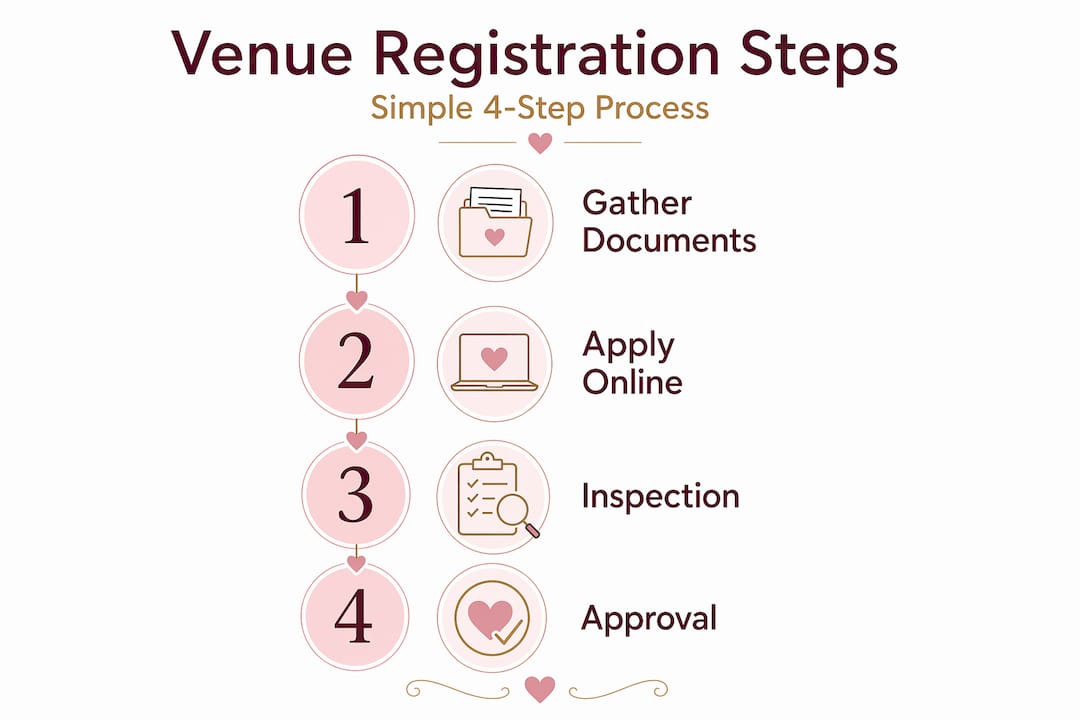
Registering a physical venue: step by step
This is the core of the venue registration guide for coordinators working directly with local councils or regulatory bodies. The process is methodical, and understanding each step reduces surprises considerably.
The registration steps
-
Confirm venue suitability. Before applying, verify the property is zoned appropriately for events. In South Australia, you can review venue legalities to understand zoning and licence types relevant to your event.
-
Obtain and complete the application form. Contact your local council or the relevant authority. For wedding venue licences, the form will ask for the premises address, proposed event types, maximum capacity, and details about on-site facilities.
-
Compile your supporting documents. Attach all required certificates and plans as outlined in the prerequisites section above. Missing even one document is enough to pause your application.
-
Submit and pay the application fee. Fees and timelines vary by jurisdiction. As a reference point, a venue licence for marriages in the UK costs approximately £950 for a three-year term, with processing taking at least six to eight weeks. Australian council fees differ but the timeframes are broadly comparable, so plan accordingly.
-
Prepare for a pre-inspection or site meeting. Regulators often visit the site before approving a licence. Have the venue in good order, with clear emergency exit signage and access routes visible.
-
Respond promptly to any requests for additional information. Regulators may come back with questions. A slow response extends your wait time significantly.
-
Receive your approval notice and display it as required. Most licences must be displayed on the premises.
What to watch for
- Missing deadlines for liquor licence applications
- Underestimating the time needed for fire safety assessments
- Failing to confirm maximum capacity in writing before submitting
- Not accounting for accessibility compliance, particularly for guests with mobility needs
Pro Tip: Book your pre-inspection meeting as soon as you submit your application. Some councils have waiting lists for inspections, and booking early can save weeks off your overall timeline.
Listing your venue on digital booking platforms
A strong online listing is not just convenient. A venue’s online presence is often the key factor in visibility and bookings. This matters especially for wedding venues competing in a crowded market.
How to register and build your listing
Start by creating a verified account on the platform of your choice. You will typically need a business email address, an ABN if you are in Australia, and basic contact details. Verification usually involves a confirmation email or, on some platforms, a phone call.
Once your account is active, input your venue details with care. Write a description that covers the style of the space, what is included, and what makes it different. Attach multiple photos showing the main event space, outdoor areas, catering facilities, and any bridal suites. Set your pricing structure clearly, including minimum spend, deposit requirements, and cancellation terms.

On the payment side, note that digital platforms require deposits ranging from 5 to 40 per cent upfront, with escrow systems holding up to 60 per cent of payments until services are confirmed. Understanding these terms before you list protects both you and your clients.
Here is a quick comparison of typical deposit and escrow terms across platform types:
| Platform type | Typical deposit range | Escrow held until |
|---|---|---|
| Specialist wedding directories | 10 to 25% | Event completion |
| General event booking platforms | 5 to 40% | Service confirmation |
| Direct booking via website | Negotiable | At venue’s discretion |
Once live, manage your availability calendar regularly and respond to enquiries within 24 hours. Online venue listings cut wedding search time by up to 40 per cent for couples, which means your listing needs to be accurate and up to date to capture that interest.
Tips to lift your listing’s visibility:
- Use specific keywords in your description that couples actually search for
- Include pricing ranges rather than “contact for pricing,” as transparency builds trust
- Ask satisfied clients for reviews promptly after their event
- Add event-type landing pages with specific photos and packages, as event-specific pages increase booking conversions meaningfully
Troubleshooting common registration problems
Even well-prepared applicants hit obstacles. Knowing what to expect makes these moments far less stressful.
If your application is rejected or returned with a request for more information, read the feedback carefully and respond to every point specifically. Regulators appreciate thoroughness. A vague or partial response is likely to generate a second round of queries.
For digital platform registrations, QA testing must cover guest limits, payment failures, and conditional logic before you go live. Testing your listing as a user, not just as the account holder, reveals problems that are invisible from the admin side.
Common mistakes to avoid:
- Submitting incomplete documentation with the plan to follow up later
- Missing renewal deadlines and unknowingly operating without a current licence
- Publishing a digital listing before it has been reviewed for accuracy
- Ignoring accessibility requirements in the physical registration process
Pro Tip: Have someone unfamiliar with your venue attempt to complete your digital registration or enquiry form. Fresh eyes spot broken links, confusing fields, and missing information that you have stopped noticing.
“The biggest usability mistake in digital registration is feature creep. Keep forms to the essentials and your registrants will complete them.”
When you are genuinely unsure about legal compliance, particularly around South Australian venue regulations, seek professional advice from a solicitor or a venue compliance consultant. The cost of advice is always lower than the cost of a rejected application or a fine.
After approval: what comes next
Receiving your approval is a milestone, not a finish line. The steps for venue registration do not stop the moment you receive your licence or your listing goes live.
For physical venues, your registration typically carries a validity period. Renewal requirements vary, but most councils expect you to reapply before the licence expires and to maintain all compliance certificates in the interim. Keep a calendar reminder set at least three months before any renewal deadline.
For digital listings, maintenance is ongoing. Key tasks include:
- Updating your availability calendar after every confirmed booking
- Refreshing photos seasonally or after venue refurbishments
- Responding to every review, positive or critical
- Updating pricing annually to reflect current costs
- Checking that all contact details and booking links remain functional
Once your venue is registered and listed, prepare it thoroughly for incoming enquiries. Review wedding venue contracts to confirm your terms are clear and fair, and build a standard enquiry response that covers the key details couples need quickly.
My honest take on venue registration
I have seen more venue registration processes than I can count, and the pattern is almost always the same. Venues and coordinators who treat the preparatory work as a nuisance tend to pay for it later, whether through delays, licence conditions they were not expecting, or digital listings that quietly underperform because nobody updated them after the first month.
The part that surprises people most is the hidden costs. Move-in and move-out rates, rehearsal fees, and set-up charges can add significantly to a venue’s total cost. These are often available at up to 60 per cent of the standard rental rate if you negotiate upfront, but most organisers do not even ask because nobody told them to. Read every contract line, and ask about everything that is not explicitly included.
My other strong opinion: do not underestimate how much early communication matters. Calling a council officer before you submit your application, or emailing a platform’s support team to confirm your listing requirements, saves time every time. Regulators and platform managers are not adversaries. They want venues to succeed. Treating the process as a dialogue rather than a transaction changes the experience entirely.
The venue registration checklist approach works best when you treat it as a living document, not a one-time task. Update it, revisit it before each renewal, and share it with anyone new to your team.
— Steven
Find your Adelaide venue and register with confidence
Ready to put this venue registration guide into practice? Adelaideweddingvenues is the place to start, whether you are a couple selecting your perfect South Australian setting or a venue coordinator looking to get your space in front of thousands of engaged couples across Adelaide and beyond.
Browse the full directory to discover venues suited to your style, guest list, and budget. You can also explore All Adelaide Wedding Venues to compare options by style, guest list and budget. If you are still weighing up your options, the guide on choosing your ideal wedding venue covers everything from rustic barns to beachside settings with practical advice built for the South Australian market. For couples who want a more curated starting point, the perfect venue selection guide at Adelaideweddingvenues walks you through the decision step by step.
FAQ
How long does venue registration take?
Physical venue licence applications typically take six to eight weeks from submission to approval, though this varies by council and the completeness of your documentation. Digital platform listings can go live within days once your account is verified and all details are submitted.
What documents are needed for venue registration?
Required documentation typically includes fire safety reports, insurance certificates, building plans, and compliance certificates, along with completed application forms. Digital platforms also require high-quality photos, a venue description, and clear pricing details.
How do I register my venue on an online booking platform?
Create a verified account using a business email address and ABN, then input your venue details including description, photos, capacity, and pricing. Once submitted for review, most platforms publish your listing within a few business days.
What is escrow and why does it matter for venue bookings?
Escrow systems hold a portion of payment, sometimes up to 60 per cent, until services are confirmed, protecting both the venue and the client. Understanding escrow terms before listing your venue helps you manage cash flow expectations accurately.
How do I keep my venue registration current after approval?
Track your licence renewal dates, maintain all compliance certificates, and update your digital listings regularly with accurate availability, pricing, and photos. Setting a calendar reminder three months before any renewal deadline is a practical way to stay on top of requirements.
