
TL;DR:
- Choosing a wedding venue is primarily a financial decision that shapes your entire budget and planning process. Venue and catering costs typically consume 40 to 60 percent of your total wedding expenses, with hidden fees potentially inflating costs by up to 40 percent; understanding and planning for these costs is essential. By setting a realistic venue budget early, fixing two of three variables (budget, guest count, venue), and choosing off-peak times or venues with inclusive amenities, couples can achieve better value and reduce stress during planning.
Choosing a wedding venue feels like a creative decision, but it is fundamentally a financial one. The role of budget in venue choice is far more complex than most couples expect. Budget is not a secondary concern to sort out after falling in love with a location. It is the first filter that shapes every venue decision you make, from the number of guests you invite to the style of space you can realistically afford. Understanding this early changes everything about how you plan, and it can save you thousands of dollars and a great deal of stress.
Key takeaways
| Point | Details |
|---|---|
| Venue costs dominate your budget | Venue and catering typically consume 40 to 60 per cent of total wedding spend, so plan accordingly. |
| Hidden fees inflate real costs | Service charges and overtime fees can push base venue costs up by 20 to 40 per cent above quoted prices. |
| Use budget as a decision filter | Treat your budget as a non-negotiable guide for every venue and vendor decision, not a rough estimate. |
| Off-peak dates reduce costs significantly | Booking Friday evenings or Sunday brunches can unlock discounts of 20 to 40 per cent on venue hire. |
| Contingency funds prevent budget crises | Setting aside 10 to 20 per cent of your total budget covers unexpected venue-related expenses comfortably. |
How venue costs shape your overall wedding budget
Most couples are genuinely surprised when they see how much of their wedding budget disappears into venue and catering costs alone. Venue and catering expenses typically consume 40 to 60 per cent of the total wedding budget, making them the single largest line item by a significant margin.
To put that in perspective, consider these approximate budget allocations across a typical wedding spend:
| Wedding element | Approximate share of total budget |
|---|---|
| Venue hire and catering | 40 to 60 per cent |
| Photography and videography | 10 to 15 per cent |
| Flowers and décor | 8 to 12 per cent |
| Music and entertainment | 5 to 10 per cent |
| Attire and beauty | 5 to 8 per cent |
| Remaining vendors and miscellaneous | 10 to 20 per cent |
The national average venue cost sits at approximately $8,573, with upper-quartile couples spending around $12,900. These figures serve as useful benchmarks when you begin your search, but they vary considerably based on location, guest count, and the type of venue you choose.
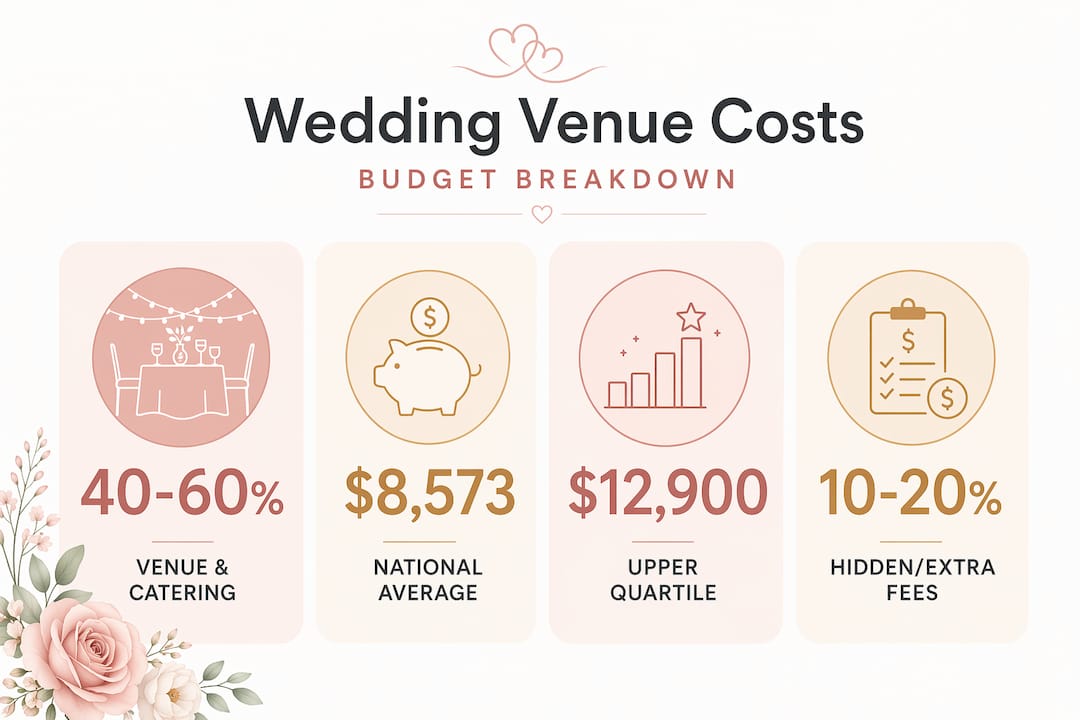
Why does this matter so much? Because if you commit to a venue before establishing a firm budget, you risk locking in a cost that throws every other category off balance. The impact of budget on venue selection is not abstract. It directly determines which venues are accessible to you and which are not, before you even step foot inside one.
Pro Tip: Before touring any venues, write down your total wedding budget and calculate 50 per cent of it. That number is your realistic venue and catering ceiling.
The budget, guest count, and venue trade-off
Here is something most wedding advice skips over. Budget, guest count, and venue choice are interdependent. You can only fix two of the three. When couples try to lock in all three, the planning process becomes frustrating and financially unworkable.

Understanding budget as a decision filter means recognising that every choice you make about the venue should be checked against your financial reality. This is not about settling. It is about making deliberate trade-offs that reflect your actual priorities.
Here is how the three-variable model works in practice:
- Fix budget and guest count. Your venue options are determined by what venues can accommodate your guests within your per-head spend. This is the most financially disciplined approach and the one most planners recommend.
- Fix budget and venue. Your guest count becomes the variable. If you love a boutique venue that costs $6,000 for up to 80 guests, inviting 140 people simply does not fit.
- Fix guest count and venue. Your budget must stretch to meet the reality of both. This often leads to overspending or cutting from other meaningful categories like photography or catering quality.
Calculated cost per attendee gives you a far clearer comparison between venues than headline rental fees. A venue charging $10,000 for 100 guests costs $100 per head. A venue charging $7,500 for 60 guests costs $125 per head. The cheaper-looking option may actually cost more per person.
Pro Tip: Always divide total venue costs by your expected guest count before comparing venues. The per-head figure is the number that truly matters for financial planning.
Hidden costs that inflate your venue bill
The quoted hire fee is rarely the full story. One of the most common ways couples find themselves over budget is by not accounting for the fees that accumulate on top of the base rate. Service charges, gratuities, and overtime fees can increase total venue costs by 20 to 40 per cent above the original quote.
Common hidden venue costs to watch for include:
- Service charges and mandatory gratuities. Many venues apply a fixed percentage on top of catering costs. This can add hundreds or thousands to your final invoice.
- Overtime fees. Events that run past the contracted finish time are often charged at a premium per-hour rate. A one-hour extension can cost $500 or more.
- Equipment and infrastructure. Blank-slate venues require you to hire flooring, lighting rigs, power generators, and furniture that fully fitted venues include in their base rate.
- Preferred vendor restrictions. Some venues require you to use their approved caterers or bar services, which removes your ability to negotiate pricing with external suppliers.
- Cleaning fees and bond payments. These are often listed in the fine print and range from a few hundred dollars to over a thousand.
- Public liability insurance. Certain venues require couples to take out their own event insurance, which is an additional cost many do not budget for.
Careful review of venue rental agreements for hidden fees and obligations, including overtime fees and vendor limitations, is the most reliable way to avoid mid-planning budget surprises.
For a thorough breakdown of what surprises to expect, Adelaideweddingvenues has a detailed article on unexpected venue expenses that covers the specific charges South Australian couples encounter most often.
Pro Tip: Ask every venue for a full cost schedule, not just the hire fee. Request a sample invoice from a past event to see exactly what charges appear.
Practical strategies to stretch your venue budget
Knowing where your money goes is only part of the solution. The other part is making smarter decisions that give you more value for the dollars you spend. Several practical approaches can reduce how budget constraints affect venue selection without compromising the quality of your event.
Choose the right day and time
Off-peak bookings like Friday evenings or Sunday brunches routinely attract venue rental discounts of 20 to 40 per cent compared to Saturday rates. For many couples, a Friday evening wedding is logistically straightforward for guests and significantly cheaper for them.
Prioritise venues with built-in amenities
Venues that include tables, chairs, linens, audio-visual equipment, and kitchen facilities in the hire fee save you considerably on external hire costs. A venue that charges $8,000 all-inclusive can cost less in total than an industrial space charging $5,000 that requires $5,000 worth of hired infrastructure.
Focus décor spending on high-impact areas
Concentrating décor spend on focal points such as the ceremony backdrop, bridal table, and entrance creates a visually impressive result without decorating every corner of the venue. Visualisation tools that show how styling will look in the space before you commit can prevent costly over-ordering on rentals and florals.
Use structured venue comparison processes
Event planners who use structured request-for-proposal processes reduce time and costs by 10 to 30 per cent. Couples can apply the same principle by comparing three to five venues against a fixed set of criteria that includes all-in cost, capacity, inclusions, and flexibility.
For inspiration on current pricing and popular venue styles in South Australia, the 2026 venue trend guide from Adelaideweddingvenues is a practical reference point.
Building a venue budget that actually works
A realistic venue budget is not a rough number. It is a calculated figure based on your total spend, your priorities, and a built-in buffer for the unexpected. Here is a straightforward framework to build one:
- Set your total wedding budget. Be honest about what you can spend without financial stress after the wedding.
- Calculate your venue and catering ceiling. Allocate 45 to 50 per cent of your total budget to this category as your starting point.
- Divide by guest count. Use your per-head figure to shortlist venues that can deliver your desired experience within that number.
- Add a contingency buffer. A contingency reserve of 10 to 20 per cent of your total venue budget should be set aside before you sign any contract.
- Validate with a comparison exercise. Compare at least three venues using total all-in cost, not headline hire fees. Include estimated hidden fees in each comparison.
Consider two quick budgeting scenarios:
| Scenario | Total budget | Venue ceiling (50%) | Guest count | Per-head budget |
|---|---|---|---|---|
| Scenario A | $30,000 | $15,000 | 80 guests | $187.50 |
| Scenario B | $50,000 | $25,000 | 120 guests | $208.33 |
The per-head figures tell you immediately which venues are viable. A venue quoting $220 per head for full catering and hire falls within Scenario B but not Scenario A. That clarity prevents you from touring venues that were never financially realistic.
Treating your budget as an evolving guide rather than a fixed ceiling also helps. As you gather real quotes and compare venues, you may realise that adjusting your guest list by 10 people opens up a significantly better venue category. That kind of flexibility is worth exploring early.
Pro Tip: Use the budgeting checklist from Adelaideweddingvenues to track all venue-related costs in one place before you commit to any bookings.
My perspective on getting the budget conversation right
I have seen countless couples approach venue selection the wrong way around. They tour venues, fall in love with a space, and then try to make the budget work afterwards. That approach is almost always the source of the stress and regret that follows.
In my experience, the couples who have the most enjoyable planning process are the ones who do the financial work first. Not the romantic work. The financial work. Once they know their real ceiling, their guest count, and their non-negotiables, venue selection becomes a focused and genuinely exciting exercise rather than an anxious one.
What I find most telling is how often the underestimation of hidden costs is the culprit. A couple signs a contract for a venue they believe fits their budget, only to receive a supplementary invoice for service charges, overtime, and equipment they did not anticipate. I would say this pattern accounts for the majority of budget blowouts I observe.
The good news is that treating your budget as a creative planning tool, rather than a constraint, genuinely changes the experience. When you know what you can spend, you make better decisions faster. You waste less time on venues that were never right for you. And you arrive at your wedding with financial peace rather than post-event debt.
— Steven
Find your budget-friendly venue with Adelaideweddingvenues
Adelaideweddingvenues is a comprehensive venue directory built specifically for South Australian couples and event planners. Browse All Adelaide Wedding Venues to compare options as you refine your budget. The platform lets you filter venues by budget, capacity, location, and style, so you can immediately see which options align with your financial plan rather than discovering mismatches after a site visit. Every listing is curated with input from wedding industry professionals who understand what couples actually need to know.
Whether you are looking for an intimate garden ceremony on a modest budget or a grand ballroom celebration, you can explore venues by style and budget and compare real options across Adelaide and South Australia. Start your search with your budget front and centre at Adelaideweddingvenues and find a venue that fits both your vision and your finances.
FAQ
What percentage of a wedding budget should go to the venue?
Venue and catering costs typically account for 40 to 60 per cent of the total wedding budget. Allocating around 45 to 50 per cent as your starting ceiling gives you a realistic and financially safe guide.
How do hidden fees affect venue budget planning?
Service charges, gratuities, and overtime fees can add 20 to 40 per cent on top of the base hire quote. Always request a full cost schedule and a sample invoice before signing any venue contract.
Can off-peak bookings really reduce venue costs significantly?
Yes. Choosing off-peak event dates such as Friday evenings or Sunday sessions typically delivers venue hire discounts of 20 to 40 per cent compared to peak Saturday rates.
How much contingency should couples budget for venue costs?
Setting aside a contingency reserve of 10 to 20 per cent of your total venue budget is strongly recommended to absorb unexpected fees, overtime charges, or last-minute hire requirements without disrupting your overall financial plan.
Is per-head cost a better metric than total venue hire fee?
Calculating cost per attendee gives you a far more accurate comparison between venues. A venue evaluated by cost per guest reveals true value in a way that headline hire fees often obscure, particularly when venues vary significantly in capacity.
