
TL;DR:
- Venue flexibility enhances guest engagement by allowing seamless configuration changes that support various event phases. It provides essential weather contingency plans, size adaptability, and operational benefits that streamline event management. Prioritizing flexible venues during site visits ensures better negotiation and reduces risks, making it a crucial factor often overlooked.
Most couples and event planners spend months focused on aesthetics, catering, and cost when selecting a venue. But understanding why venue flexibility is important can be the difference between a day that flows beautifully and one derailed by a sudden downpour, a last-minute change in guest numbers, or a layout that simply does not work. Venue adaptability is one of the most practical, high-impact factors you can evaluate during your search, yet it remains one of the most overlooked. This guide walks through exactly what flexible venues offer and how that flexibility protects your event from start to finish.
Key takeaways
| Point | Details |
|---|---|
| Engagement depends on adaptability | Adaptable layouts directly support the guest interaction that 63% of planners now prioritise above all other metrics. |
| Weather contingency saves events | Venues with defined indoor backup options and contractual weather clauses reduce last-minute chaos significantly. |
| Size flexibility prevents discomfort | Matching space to guest count using configurable layouts keeps events feeling warm, not cavernous or cramped. |
| Flexibility cuts time and cost | Structured venue sourcing with flexibility built in can save planners 10 to 30 per cent in time and costs. |
| Ask the right questions early | Evaluating flexibility during site visits, not after signing, gives couples and planners the most negotiating room. |
Why venue flexibility is important for guest engagement
When attendee engagement outstrips price and availability as the top criterion for venue selection, the physical space becomes a tool for connection, not just a backdrop. A room that cannot change its configuration locks your event into a single mode. A room that can shift from a ceremony to a reception, or from a formal dinner to a relaxed cocktail setting, actively supports the different phases of guest experience.
Think about how a wedding day actually unfolds. Guests arrive for a ceremony that calls for stillness and focus. Within hours, those same people need space to mingle, dance, and celebrate. A venue that handles both without shuffling guests between properties or leaving half the room empty makes that transition feel natural rather than logistical.
The connection between layout and engagement is well supported. 63% of event planners in 2026 name attendee engagement as their primary success measure, and flexibility is recognised as one of the key physical features that supports it. Movable furniture, adaptable lighting rigs, and modular staging all allow a venue to match the energy of each event moment.
- Retractable walls let organisers open a space for a reception after closing it for a ceremony
- Adjustable lighting transforms the mood between formal and festive without a venue change
- Modular staging allows speeches, performances, and dancing to share the same floor
- Flexible seating arrangements accommodate different group sizes and social dynamics
Pro Tip: When touring a venue, ask the coordinator how long a full layout reconfiguration takes and whether venue staff manage it. If the answer is vague or places the burden on you, that is a signal to probe further.
Weather resilience and why flexibility matters outdoors
Outdoor weddings in South Australia are stunning, but the weather does not always cooperate. Understanding the importance of venue flexibility for outdoor settings is not pessimistic planning. It is responsible planning.
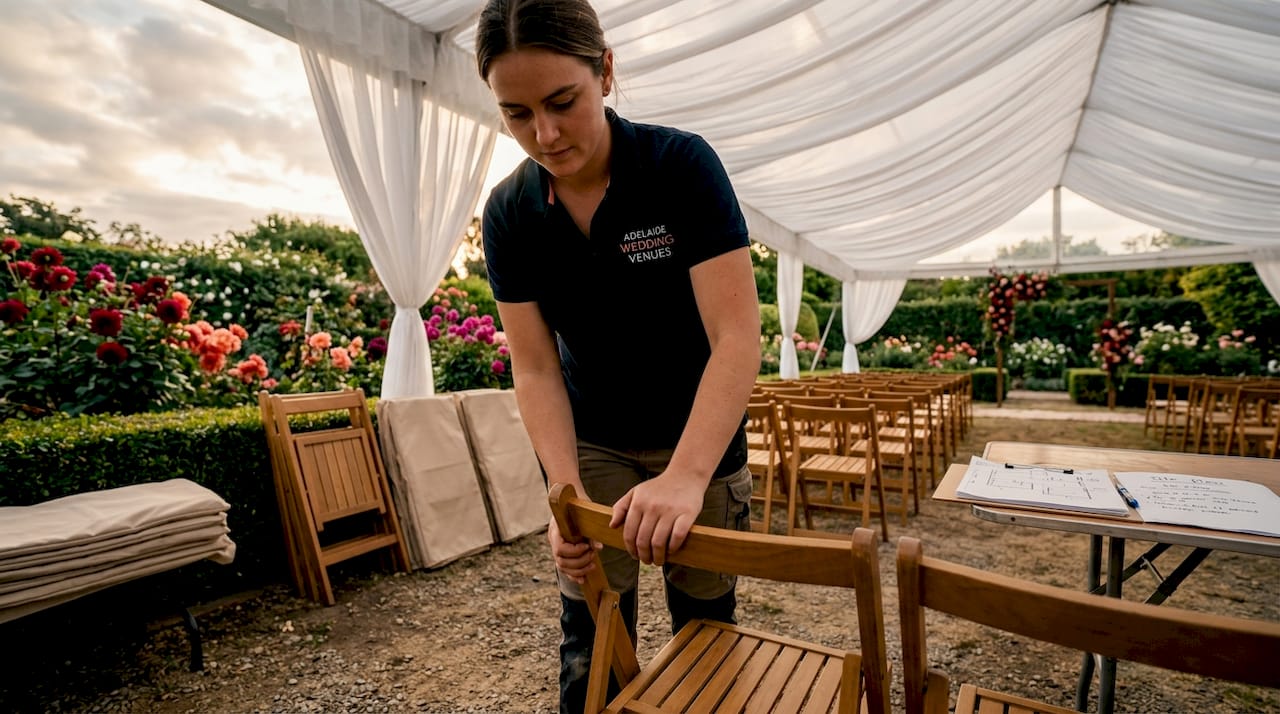
The best-prepared venues set a defined decision point rather than waiting until the morning of the event. One well-documented example from a wedding venue involves relocation triggered at 11 AM if the rain forecast reaches 50 per cent or higher, with staff handling all chair logistics so neither the couple nor their guests are affected. That kind of protocol transforms uncertainty into a manageable process.
Contractual weather contingency clauses are equally important. These clauses define what constitutes a weather trigger, who makes the call, and what the backup space is. Without them, couples can find themselves negotiating under pressure on the morning of their wedding. With them, everyone knows their role before the day begins.
Practical weather resilience planning at a flexible venue should include:
- A confirmed indoor backup space with enough capacity for the full guest list
- A clearly defined forecast threshold that triggers the move (such as 50 per cent chance of rain by a set time)
- Staff assigned to execute the transition without input from the couple
- A guest communication plan, whether by SMS, signage, or a designated point of contact
- Real-time forecast integration written into the venue’s operational playbook
Pro Tip: Ask specifically whether the backup indoor space can hold your full seated guest list, not just a reduced version. Some venues offer a backup that works only for cocktail-style standing arrangements, which is not the same thing.
Matching venue size to your guest count
One of the most underappreciated benefits of flexible venues is their ability to scale. A venue that accommodates 300 guests does not automatically work well for 80. Without the ability to section off or reconfigure the space, smaller gatherings can feel lost in an oversized room, which affects atmosphere, acoustics, and the sense of warmth that couples want their guests to feel.
Industry guidance recommends 10 to 15 square feet per guest as a comfortable baseline for events combining dining and interaction. That figure shifts depending on whether dancing, a band stage, or a photo booth is included. A flexible venue lets you adapt the footprint to the actual programme rather than forcing the programme around a fixed floor plan.
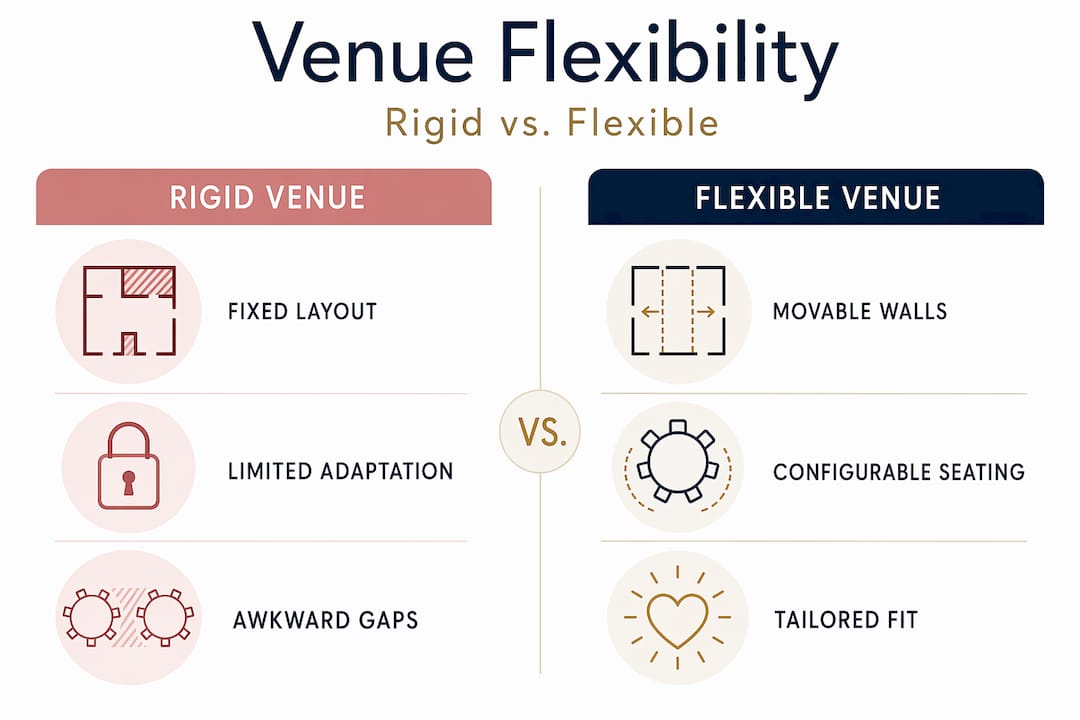
The table below compares rigid versus flexible venue configurations across common wedding scenarios:
| Scenario | Rigid venue | Flexible venue |
|---|---|---|
| Guest count drops by 30 | Empty sections feel awkward | Walls retract or close to rightsize the space |
| Ceremony and reception in one location | Guests wait while staff reconfigure | Barn doors or partitions manage the transition quickly |
| Last-minute addition of a photo booth | No space available | Modular layout absorbs additions with minor adjustment |
| Intimate elopement in a large ballroom | Space feels cold and disconnected | Partitioned section creates an intimate setting within the larger venue |
Venues with movable walls, configurable seating, and multi-functional rooms give couples and planners the freedom to tailor the environment to the event, not the other way around. This is equally valuable for corporate functions, milestone birthdays, and mixed-use events where the needs of the programme shift throughout the day.
Operational benefits for planners and couples
Beyond the guest experience, the reasons for venue flexibility extend directly into how smoothly an event runs behind the scenes. For planners managing multiple functions or tight timelines, a flexible venue is an operational asset.
Here is how flexibility supports smoother event delivery from a planning perspective:
- Reduced sourcing time and cost. Structured flexibility evaluation during venue sourcing can save planners 10 to 30 per cent in time and costs, according to 2026 data from over 1,600 event professionals.
- Seamless transitions between event phases. Venues that use physical features such as barn doors for flow between ceremony and reception spaces eliminate the need to move guests between properties, cutting a common source of delays.
- Fewer day-of decisions. Pre-planned contingency protocols mean planners and couples are not improvising under pressure. The decisions are already made; they just need to be enacted.
- Lower risk of cost blowouts. When a venue can accommodate changes in guest count, layout, or schedule internally, there are fewer reasons to hire external suppliers or add last-minute services.
- Staff support reduces your load. Venues with trained teams who manage layout flips and contingency transitions mean coordinators can focus on the couple and guests rather than furniture logistics.
Pro Tip: Before signing a contract, ask the venue coordinator to walk you through exactly how they handle a same-day layout change, from who gives the instruction to how long it takes. If there is no clear answer, build the protocol into your contract.
How to evaluate venue flexibility before you book
Knowing why venue flexibility matters is only useful if you know how to assess it during the selection process. The time to ask hard questions is during the site visit and contract review, not on the day of your event.
Popular venues book quickly, so early site visits give you the most choice and the most room to negotiate. Use that time well.
Treat venue flexibility as both a physical infrastructure feature and a contractual one. Here is a practical checklist of questions and considerations to bring to every site visit:
- Does the venue have confirmed indoor and outdoor ceremony options? Can both accommodate your full guest list?
- What is the defined trigger and timeline for moving from outdoor to indoor? Who communicates this to guests?
- Are there movable walls, retractable partitions, or configurable room dividers? How quickly can they be deployed?
- Can the lighting and AV systems be adjusted for different event phases without a separate technician booking?
- Does the contract include a weather contingency clause with clear triggers? If not, can one be added?
- Are there any restrictions on décor, external suppliers, or catering that would limit how you use the space?
- What staff are on-site during the event and what tasks are they authorised to manage independently?
Reviewing these points early gives you a genuine picture of how the venue performs under pressure. A venue that answers all of these questions with confidence and clarity is a venue that has thought through its flexibility as a deliberate feature, not an afterthought.
My take on why flexibility is the most underestimated factor
I’ve reviewed and worked with dozens of venues across South Australia over the years, and the single pattern I see most often is couples who prioritised how a venue looked in photos over how it actually functioned on the day. Style matters. But style without flexibility is a gamble.
I’ve seen events where a change in weather or a shift in guest numbers created a cascade of problems that a more adaptable venue would have absorbed without anyone noticing. I’ve also seen couples walk into their reception feeling completely at ease because their venue had a protocol for every contingency, and their coordinator had rehearsed it. That emotional relief is real, and it is not a small thing on one of the most significant days of your life.
What I’ve learned is that flexibility is not optional in modern event planning. It is infrastructure. The couples who prioritise it from the beginning of their search do not just avoid problems. They free themselves up to actually be present on the day. My strongest advice: build your venue shortlist around flexibility first. Everything else is much easier to work around.
— Steven
Find your perfect flexible venue with Adelaideweddingvenues
Adelaideweddingvenues makes it straightforward to find venues across South Australia that offer the adaptability your event deserves. Explore All Adelaide Wedding Venues to compare options by venue type, location and capacity. Whether you are drawn to rustic barns, beachside settings, elegant ballrooms, or garden spaces with built-in indoor backup options, the directory is organised so you can filter by venue type, location, and capacity.
Start by exploring the guide to choosing your ideal venue, which covers the full range of venue styles available in Adelaide with practical guidance on what to look for. From there, you can browse the full Adelaide venues directory to compare options side by side. For a deeper look at what features to prioritise, the perfect venue guide is a strong next step. Planning your best event starts with finding a venue that works for every scenario your day might bring.
FAQ
Why does venue flexibility matter more than venue style?
Style sets the atmosphere, but flexibility determines how well a venue handles the unexpected. A beautiful space that cannot adapt to weather changes, guest count shifts, or layout needs creates risk that style alone cannot resolve.
What does a weather contingency clause actually include?
A weather contingency clause defines the forecast threshold that triggers a move to the indoor space, the decision timeline, and who is responsible for communicating the change to guests. It removes ambiguity and protects all parties.
How much space per guest is recommended for a comfortable event?
10 to 15 square feet per guest is the standard guideline for events that combine seated dining with some movement and interaction. This figure increases when a dance floor, stage, or activity areas are included.
When should couples ask about venue flexibility?
The best time is during the initial site visit, before any contract is signed. Early site visits provide the most flexibility and the most opportunity to negotiate contingency provisions into the agreement.
Can flexible venues save money on event planning?
Yes. Venues with built-in adaptability reduce the need for external suppliers to manage layout changes or last-minute contingencies. Data from 2026 shows that structured flexibility evaluation can save planners up to 30 per cent in sourcing time and associated costs.
