
TL;DR:
- Step-by-step event planning follows a structured, phase-based approach to ensure timely task completion from goal setting to post-event wrap-up. Effective coordination, risk management, and a locked run-of-show timeline are essential for stress-free, successful events in Adelaide and beyond.
Step by step event planning is a structured, phase-based approach to organising any event, from intimate weddings to large corporate functions, that ensures every task is completed in the right order and at the right time. Professional event managers call this process “event lifecycle management,” and it covers everything from setting your initial goals to post-event follow-up. Structured planning timelines reduce last-minute failures and double bookings by ensuring all phases are covered from three or more months prior through to wrap-up. The tools that make this work include vendor coordination spreadsheets, run-of-show timelines, and insurance checklists. Whether you are an engaged couple planning your wedding or a corporate planner organising a conference, this guide gives you a practical, phased roadmap you can use immediately.
What are the main phases in step by step event planning?

Every well-run event follows a predictable sequence of phases. Understanding these phases is the foundation of any solid event planning guide, because it tells you what to do and when to do it.
Phase 1: Foundation setting (3+ months before)
This is where you define your event’s purpose, guest count, budget, and non-negotiables. For weddings, this means setting your vision and booking your venue first, since venues in Adelaide and South Australia book out 12 to 18 months in advance for peak season Saturdays. For corporate events, this phase includes stakeholder alignment and budget approval.
Phase 2: Vendor selection and contracting (2 to 3 months before)
Secure your key suppliers during this window. Wedding photographers book 12 to 14 months ahead, DJs and bands 9 to 12 months ahead. Missing these lead times, particularly for popular spring and summer Saturdays, often means settling for your second or third choice. Corporate planners should lock in AV suppliers, catering, and transport at this stage.
Phase 3: Logistics and communications (4 to 6 weeks before)
Build your vendor coordination matrix, draft your run-of-show timeline, and confirm all contracts. Send your first draft timeline to all vendors and request confirmation of arrival times and requirements.
Phase 4: Final confirmations (1 to 2 weeks before)
Submit final headcounts to caterers, confirm ceremony details with your officiant, and lock your run-of-show timeline seven days out. Prepare vendor payments in sealed, labelled envelopes so there is no confusion on the day.
Phase 5: Event day execution
Follow your run-of-show minute by minute. Assign a point-of-contact for each vendor group so you are not fielding every question yourself.
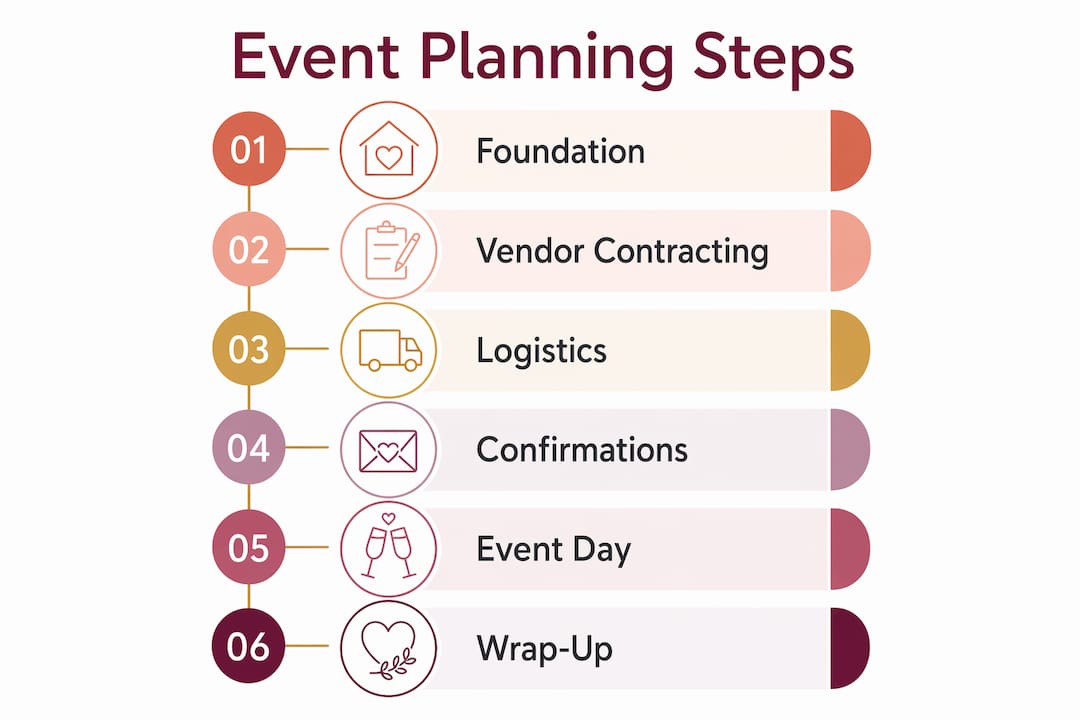
Phase 6: Post-event wrap-up
Send thank-you notes, collect feedback, settle final invoices, and document what worked and what did not for future events.
The table below summarises the key milestones across each phase.
| Phase | Timeframe | Key milestone |
|---|---|---|
| Foundation setting | 3+ months before | Venue booked, budget confirmed |
| Vendor contracting | 2 to 3 months before | All major suppliers signed |
| Logistics and comms | 4 to 6 weeks before | Vendor matrix and draft timeline shared |
| Final confirmations | 1 to 2 weeks before | Run-of-show locked, payments prepared |
| Post-event | Within 1 week after | Invoices settled, feedback collected |
Following structured phases improves overall event satisfaction significantly by reducing ad hoc decision-making and clarifying critical deadlines. That improvement comes directly from removing the guesswork that causes most event-day problems.
How to manage and coordinate vendors effectively
Vendor management is 30% planning and 70% communication. Consistent communication checkpoints with vendors improve adherence to timelines on event day and reduce no-shows and timing errors. The practical tool that makes this work is the vendor coordination matrix.
A vendor coordination matrix is a single spreadsheet that lists every supplier, their contact details, contracted arrival time, setup duration, departure time, and any special requirements. Every vendor receives access to this document, and it becomes the single source of truth for the entire event. When a florist and a photographer both need access to the ceremony space at the same time, the matrix reveals the conflict before it becomes a crisis.
Here is how to build and use your vendor coordination matrix effectively:
- Start building it six weeks before the event. At this point you have all vendors confirmed and can begin mapping their tasks against the event timeline.
- Share a draft three to four weeks out. Ask each vendor to review their allocated time slots and flag any conflicts or requirements you may have missed.
- Send a revised draft two weeks before. Incorporate vendor feedback and add buffer times between overlapping tasks.
- Lock the final version seven to ten days prior. After this point, only minor tweaks should be made. Building a vendor-first master timeline accessed digitally by all vendors reduces on-the-day conflicts among competing supplier tasks.
- Confirm arrival times 48 hours before. A brief message or phone call to each vendor confirming their arrival time prevents the most common day-of delays.
For weddings, stagger your vendor arrival sequence logically: venue setup crew first, then florists, then AV and lighting, then hair and makeup, then photographers and videographers. Corporate events follow a similar logic but often require AV and staging crews to arrive the day before for technical rehearsals.
Pro Tip: Create a shared Google Sheet or Airtable base for your vendor matrix and grant view access to all suppliers. This eliminates the version-control problems that come with emailing updated PDFs and means every vendor always has the current information.
What risk management and legal checks should event planners include?
Risk management is not an afterthought in Australian event planning. Risk documentation and insurance are integral parts of planning, particularly for corporate events subject to venue and council requirements. Treating them as optional extras is one of the most common and costly mistakes planners make.
The non-negotiables for Australian events include:
- Public Liability Insurance. Corporate events typically require Public Liability Insurance of $20 million or more. Venues and councils will ask for your certificate of currency before confirming your booking. Obtain this before budget approval, not after.
- Supplier certificates of currency. Every vendor working at your event, including caterers, AV crews, and florists, should provide their own Public Liability certificate. Keep copies on file.
- Site safety walkthrough. Conduct a physical walkthrough of the venue at least two weeks before the event. Check emergency exits, crowd flow paths, and any potential hazards such as uneven surfaces or low lighting in transition areas.
- Emergency plan. Document your emergency procedures, including evacuation routes, the location of first aid kits, and the contact details of the venue’s emergency warden. Share this with your event team.
- Food and alcohol service compliance. Caterers must hold a current food safety supervisor certificate. If alcohol is being served, confirm your venue or caterer holds the appropriate Responsible Service of Alcohol accreditation under South Australian liquor licensing laws.
“An Australian event risk checklist emphasises practical emergency plans, crowd flow control, food and beverage safety, and site safety walkthroughs as must-haves for events of all sizes.”
For weddings, the venue typically holds its own Public Liability Insurance, but you remain responsible for any suppliers you bring in independently. Always clarify with your venue manager exactly where their liability ends and yours begins. This conversation is best had during your venue site visit, not on the day of the event.
How do you create a run-of-show timeline for event day?
A run of show is a minute-by-minute operational document that tells every person involved in your event exactly what is happening, when it is happening, who is responsible, and what needs to be completed before each task can begin. It is the difference between a team that moves with confidence and a team that is constantly asking questions.
A detailed run-of-show timeline should include the following columns as a minimum:
| Column | Purpose |
|---|---|
| Start time | When the task or segment begins |
| End time | When it must be completed |
| Duration | Total time allocated |
| Owner | The person or vendor responsible |
| Dependencies | What must be done before this task starts |
| Status | Confirmed, in progress, or completed |
Run-of-show timelines often miss the dependency and status columns, which causes coordination failures because teams lack clarity on task readiness before event day. Adding these two columns alone will prevent the majority of on-the-day scrambles.
Build your run of show in three drafts. The first draft, created four to six weeks out, maps the broad sequence of the day. The second draft, two weeks before, adds specific times, owners, and dependencies based on your confirmed vendor matrix. The final version is locked seven days before the event. Final drafts should be locked seven days before, reserving the last 48 hours for rehearsals and minor tweaks only.
Buffer time is not optional. Build a minimum of 15 minutes of buffer after every major transition, such as the ceremony to cocktail hour, or the dinner service to speeches. For corporate events, build 10-minute buffers between every speaker or session change. These buffers absorb the small delays that are inevitable in live events and prevent one late segment from cascading through the rest of the programme.
Pro Tip: Print physical copies of the final run-of-show for your event coordinator, venue manager, and each vendor team leader. Mobile reception can be unreliable at some Adelaide venues, particularly heritage properties and garden locations, so a printed copy is your insurance policy.
Key takeaways
Successful event planning requires a phased approach that integrates vendor coordination, risk management, and a locked run-of-show timeline to deliver consistent, stress-free results.
| Point | Details |
|---|---|
| Start with a phased timeline | Organise tasks across six phases from foundation setting through to post-event wrap-up. |
| Build a vendor coordination matrix | Use a shared digital document as the single source of truth for all supplier tasks and arrival times. |
| Lock your run-of-show early | Finalise the operational timeline seven days before the event and reserve 48 hours for rehearsals only. |
| Treat risk management as mandatory | Obtain Public Liability Insurance and supplier certificates of currency before budget approval. |
| Build in buffer time | Schedule 15-minute buffers after every major transition to absorb inevitable delays. |
What I have learned from years of event planning in Adelaide
Working with couples and corporate clients across South Australia has taught me that the biggest source of event-day stress is almost never the unexpected. It is the predictable things that were not written down. A florist who did not know the ceremony room would not be accessible until 90 minutes before the ceremony. A caterer who assumed the kitchen had a commercial oven when it did not. A DJ who arrived 20 minutes late because nobody confirmed the loading dock entry code.
Every one of those failures is a vendor matrix problem, not a bad vendor problem. When you give suppliers a clear, shared document with their arrival time, setup window, and any site-specific requirements, the vast majority of them will execute perfectly. The problems arise from information gaps, not incompetence.
For engaged couples, my strongest advice is to separate the emotional planning (choosing your florals, your music, your menu) from the operational planning (the vendor matrix, the run-of-show, the insurance checklist). Both matter enormously, but they require different headspaces. Do your operational planning in the morning when you are clear-headed, and save the enjoyable creative decisions for when you have the energy to savour them.
For corporate planners, the single most underused tool is the post-event debrief document. Most teams celebrate a successful event and move on. The planners who consistently deliver excellent events are the ones who document what worked, what did not, and what they would change. That document becomes the foundation of your next event planning checklist, and it compounds in value over time.
The wedding event setup process at most Adelaide venues follows a predictable sequence once you know it. Learning that sequence early, ideally during your site visit, puts you well ahead of most couples and planners who only discover it on the day.
— Steven
How Adelaideweddingvenues supports your event planning
Adelaideweddingvenues is the dedicated online directory for couples and planners searching for wedding venues across Adelaide and South Australia. The platform gives you searchable access to venues filtered by location, capacity, style, and budget, so you can match your event vision to the right space without spending weeks on enquiries.
Whether you are drawn to a heritage ballroom, a garden ceremony space, or a waterfront setting, Adelaideweddingvenues connects you with venues that suit your needs. The directory is maintained by wedding industry professionals who understand what couples and planners actually need during the planning process. Start your venue search with the ideal wedding venue guide to narrow your options with confidence, or browse the full directory at Adelaideweddingvenues to find your perfect Adelaide location.
FAQ
What is step by step event planning?
Step by step event planning is a structured, phase-based process that organises every task from goal setting and vendor booking through to post-event wrap-up. It uses tools like vendor coordination matrices and run-of-show timelines to keep all parties aligned.
How far in advance should you start planning a wedding?
Venue booking should begin 12 to 18 months before your wedding date, particularly for peak season Saturdays in Adelaide. Key vendors like photographers book out 12 to 14 months in advance, so starting early protects your preferred choices.
What should an event planning checklist include?
An event planning checklist should cover venue confirmation, vendor contracts, Public Liability Insurance, a vendor coordination matrix, a run-of-show timeline, final headcounts, and a post-event debrief plan. Organising tasks by phase, from three-plus months out to post-event, prevents critical steps from being overlooked.
When should you lock the run-of-show timeline?
The final run-of-show should be locked seven days before the event. This reserves the final 48 hours for rehearsals and minor adjustments without disrupting the logistics that vendors have already planned around.
Do you need Public Liability Insurance for a wedding in Australia?
Most Australian wedding venues require couples and their independent vendors to hold Public Liability Insurance. Corporate events typically require coverage of $20 million or more. Confirm your venue’s specific requirements during your initial booking conversation.
