
TL;DR:
- Sustainable venue practices include measurable targets in energy, water, waste, sourcing, and transport. Governance plays a crucial role in ensuring these practices lead to consistent, credible results through accountability and contractual enforcement. Certification and clear reporting standards help venues demonstrate their performance and attract eco-conscious clients.
Sustainability in venues is defined as the embedding of environmental, social, and governance practices into every layer of venue operations, from energy use and waste management through to supplier contracts and public reporting. The role of sustainability in venues has moved well beyond a marketing talking point. Sustainability is shifting from abstract conversation to measurable, comparable performance data and a genuine business infrastructure requirement. For event planners and venue owners in Adelaide and across South Australia, understanding this shift is the first step toward making it work in practice.
What operational practices define sustainability in venues?
Green practices for venues cover six core operational areas. Each one has measurable targets, and venues that track them consistently outperform those that treat sustainability as an afterthought.
Energy efficiency is the most visible starting point. Venues replace fluorescent fittings with LED lighting, install smart HVAC systems that respond to occupancy, and source power from renewable energy providers. These changes reduce operating costs alongside carbon output.
Water management goes further than installing low-flow taps. Venues with mature sustainability programmes use greywater reuse systems, harvest rainwater for irrigation, and track consumption per event. 86% of certified venues actively track waste data, compared to near zero among non-certified venues. That gap shows exactly what certification drives in practice.
The six operational pillars of sustainable event management in venues are:
- Energy: LED lighting, smart HVAC, renewable power contracts
- Water: low-flow fixtures, greywater reuse, consumption tracking
- Waste: elimination of single-use plastics, recycling and composting programmes, waste diversion targets
- Sourcing: local and plant-forward catering, sustainable procurement policies
- Transport: public transport access, EV charging, shuttle services for guests
- Reporting: post-event sustainability data provided to clients within 30 days
Waste diversion deserves specific attention. Venues that set formal diversion targets, such as diverting 75% of event waste from landfill, create a measurable benchmark that planners can verify. Without a target, waste reduction stays aspirational.
Pro Tip: Track at least three sustainability metrics per event, such as waste diverted, energy consumed, and meals sourced locally. Metrics give you a baseline, and a baseline is what clients and certifiers ask for first.
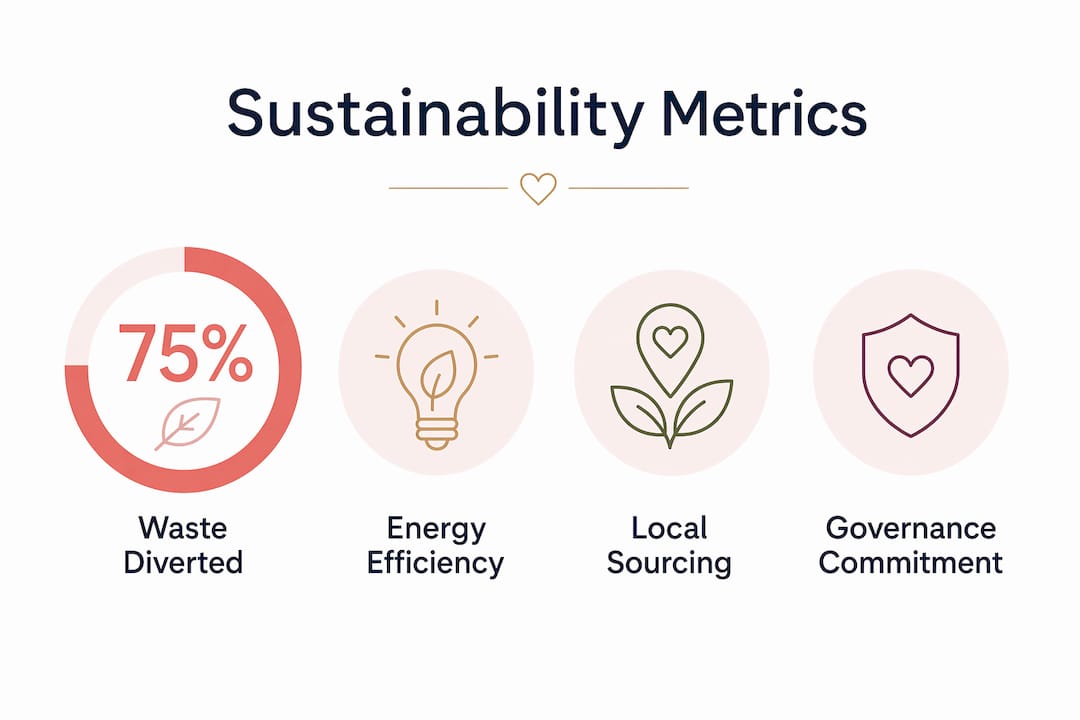
Sustainable sourcing through local catering practices is another area where venues can create a direct, visible impact. Partnering with South Australian producers reduces food miles and supports the local economy at the same time.

How does governance shape venue sustainability outcomes?
Governance is the difference between a venue that talks about sustainability and one that delivers it consistently. Sustainability governance is the foundation that ensures green initiatives survive budget pressures and leadership changes.
Venues with dedicated Green Teams or sustainability officers are nearly 10 times more likely to publish public sustainability reports. That figure reflects a simple truth: when someone owns the responsibility, the work gets done.
Formal governance structures in venues typically include:
- A named sustainability officer or Green Team with defined responsibilities
- Sustainability clauses embedded in supplier contracts and procurement agreements
- Regular internal audits with results reported to senior management
- Public sustainability reports published after events or on an annual basis
- Penalties for supplier non-compliance with agreed environmental targets
Contractual enforcement is where many venues fall short. Symbolic policies fail without contractual enforceability. A sustainability policy document that sits in a drawer does nothing. The same commitment written into a supplier agreement, with specific targets and financial consequences for missing them, creates real accountability.
Public disclosure matters too. Venues that publish their sustainability data build trust with eco-conscious clients and give event planners the evidence they need to justify venue selection to their own stakeholders.
Pro Tip: Avoid one-off green initiatives that look good in a press release but lack follow-through. A single composting trial without a permanent programme is the definition of greenwashing. Build the system first, then communicate it.
What sustainability certifications apply to venues?
Certifications give venues a credible, third-party-verified framework for measuring and communicating their sustainability performance. The most relevant options for event venues sit across two categories: broader ESG frameworks and sector-specific certifications.
| Certification | Focus area | Renewal cycle | Best suited to |
|---|---|---|---|
| ISO 20121 | Sustainable event management systems | Annual surveillance audits | Event venues and organisers |
| B Greenly | ESG criteria for venues: environmental, social, governance | Ongoing audit pathway | Hospitality and event venues |
| Green Star (GBCA) | Building design and operations | Periodic reassessment | Permanent venue buildings |
| EarthCheck | Operational benchmarking for hospitality | Annual | Hotels and large venues |
ESG certification for venues covers environmental, social, and governance criteria that go well beyond carbon emissions. Workforce policies, community impact, accessibility, and governance systems all factor into the assessment. This breadth is what separates a genuine ESG certification from a simple energy rating.
ISO 20121 is the international standard specifically designed for sustainable event management. It covers the full event supply chain, from venue selection through to post-event reporting. For venues that host frequent corporate or public events, ISO 20121 provides a recognised framework that planners in Australia and internationally will recognise.
One-time certifications must evolve through audit pathways and renewals to maintain their value. Renewal cycles identify operational gaps and keep venues improving beyond their initial certification claims. A certificate earned in 2023 and never reviewed tells clients very little about current performance.
Certification focused on the events ecosystem provides stronger credibility than generic building certifications. A Green Star rating confirms a building was designed sustainably. It says nothing about how events are managed inside it.
How do event planners embed sustainability in venue selection?
Event planners are now the primary force driving the impact of sustainability on venues. Planners shape venue behaviour through the contracts they sign, not through goodwill.
Sustainability requirements are now standard in requests for proposal (RFPs), including plastics-free mandates, minimum waste diversion rates, and local catering sourcing percentages. Contracts often impose financial penalties or termination clauses for non-compliance. This embeds sustainability as a business infrastructure requirement, not a preference.
Common sustainability clauses planners include in venue contracts are:
- Minimum 75% waste diversion from landfill across the event
- At least 40% of catering sourced from local or regional producers
- Plastics-free service ware and no single-use plastic bottles
- Post-event sustainability report delivered within 30 days of the event
- Financial penalties for missing agreed targets, with termination rights for repeated failures
Transparent, standardised post-event reporting with verified data builds trust and demonstrates real eco-performance to clients. Venues that provide this data proactively gain a clear competitive advantage. Venues that cannot provide it lose bookings to those that can.
For planners selecting eco-friendly venues in Adelaide, the practical step is to request a venue’s most recent sustainability report before signing any contract. If a venue cannot produce one, that absence is itself useful information.
Pro Tip: Ask venues for raw data, not just summary statements. A venue that reports “we recycled at this event” without a tonnage figure is not giving you verifiable information.
What challenges arise when implementing venue sustainability?
Eco-friendly venue design and operations face real constraints that go beyond good intentions. Understanding these challenges helps planners and venue owners set realistic expectations and avoid common pitfalls.
Temporary and modular venues present a specific risk. A venue constructed from reused materials looks sustainable on paper. Without a funded, enforceable deconstruction plan, those materials often end up in landfill at the end of the event. Treating temporary venue sustainability as a project discipline with contractually enforceable deconstruction plans is the only way to avoid this outcome.
Greenwashing is the most reputational risk venues face. It occurs when sustainability is a design intent or a marketing claim without operational follow-through. A venue with solar panels that sends all its event waste to landfill is not a sustainable venue. Clients and certifiers are increasingly able to identify the gap between claims and data.
Balancing sustainability ambitions with operational costs is a genuine tension. LED retrofits and renewable energy contracts require upfront capital. Smaller venues may need to phase improvements over several years. The key is to start with governance: assign responsibility, set targets, and measure performance. The physical upgrades follow more easily once the system is in place.
Long-term impact depends on ongoing governance, not a single initiative. Sustainability governance that is embedded in procurement, contracts, and reporting cycles outlasts any individual project or leadership team.
Key takeaways
Sustainability in venues requires formal governance, measurable targets, and contractual enforcement to move from aspiration to consistent operational performance.
| Point | Details |
|---|---|
| Governance drives results | Venues with dedicated sustainability roles are nearly 10 times more likely to publish public reports. |
| Certifications require renewal | Audit cycles like ISO 20121 and B Greenly keep venues improving beyond their initial claims. |
| Planners enforce through contracts | RFPs now commonly include 75% waste diversion targets and financial penalties for non-compliance. |
| Data transparency wins clients | Verified post-event sustainability reports delivered within 30 days differentiate venues in a competitive market. |
| Greenwashing is a real risk | Temporary venues need enforceable deconstruction plans, not just sustainable design intent. |
Why governance is the part most venues get wrong
My honest view, after working closely with the Adelaide wedding and events industry, is that most venues underestimate how much governance matters relative to physical infrastructure. A venue can install solar panels, source local food, and print recycled menus. Without someone accountable for tracking the results, those efforts produce no data, no credibility, and no competitive advantage.
The venues I see winning eco-conscious bookings are not necessarily the ones with the newest green infrastructure. They are the ones that can hand a planner a post-event sustainability report with actual numbers. That document is worth more than any certification badge on a website.
The other pattern I notice is that sustainability initiatives tend to disappear when the person who championed them leaves. That is a governance failure, not a sustainability failure. When targets and responsibilities are written into supplier contracts and internal policy, they survive staff turnover. That is the standard worth aiming for.
For venue owners just starting out, the advice is simple: pick three metrics, assign one person to track them, and report the results after every event. Start there before spending a dollar on physical upgrades. The data you collect in the first year will tell you exactly where to invest next.
— Steven
Find sustainable venues in Adelaide with Adelaideweddingvenues
Adelaideweddingvenues makes it straightforward to find venues across Adelaide and South Australia that take sustainability seriously. The directory includes venues with documented green practices, local sourcing commitments, and eco-friendly amenities, giving planners and couples the information they need before making contact.
Whether you are planning an intimate garden ceremony or a large corporate event, choosing the right venue starts with knowing what each space offers. Adelaideweddingvenues also covers sustainable venues in Adelaide specifically for couples who want their event to reflect their values. Browse the directory, filter by location and venue type, and connect directly with venues that match your sustainability requirements.
FAQ
What is the role of sustainability in venues?
Sustainability in venues is the integration of environmental, social, and governance practices into daily operations, supplier contracts, and event management. It covers energy, water, waste, sourcing, and public reporting.
How do event planners enforce sustainability requirements?
Planners embed binding clauses in RFPs and venue contracts, including minimum waste diversion rates, local sourcing percentages, and post-event reporting deadlines. Financial penalties and termination rights apply for non-compliance.
What certifications are most relevant for event venues?
ISO 20121 is the international standard for sustainable event management. B Greenly covers ESG criteria specific to venue operations. Both require ongoing audits, which keep performance improving over time.
Why do venues with Green Teams report more sustainability data?
Venues with dedicated sustainability roles are nearly 10 times more likely to publish public sustainability reports. Assigned responsibility converts good intentions into tracked, reportable outcomes.
What is greenwashing in the context of venues?
Greenwashing occurs when a venue makes sustainability claims without the operational data to support them. A common example is promoting sustainable design while sending event waste to landfill without any diversion tracking.
