
Signing a wedding venue contract is one of the most significant decisions you’ll make during your wedding planning journey, yet many Adelaide couples find themselves overwhelmed by legal jargon and complex clauses. These documents often contain terms that can dramatically impact your budget, flexibility, and overall wedding experience if misunderstood. This guide breaks down the essential elements of wedding venue contract clauses, helping you navigate agreements with confidence and avoid costly surprises on your special day.
Key Takeaways
| Point | Details |
|---|---|
| Deposits and fees | Wedding venue contracts typically outline deposits, cancellation terms and additional charges that affect your budget, so review them carefully before signing. |
| Force majeure and refunds | Read force majeure provisions to understand when refunds or postponements apply if exceptional events disrupt your date. |
| Liability and insurance | Check who bears liability for accidents or damage and confirm required event liability insurance to protect both you and the venue. |
| Fee schedule clarity | Ask for a complete fee schedule in writing including all potential charges to avoid budget shocks. |
Common wedding venue contract terms explained
Wedding venue contracts often include clauses on deposits, cancellation policies, liability, and additional fees that determine your financial obligations and flexibility throughout the planning process. Understanding these fundamental terms transforms a confusing document into a clear roadmap for your wedding day.
Force majeure clauses protect both you and the venue from liability when extraordinary circumstances like natural disasters, pandemics, or government restrictions make your wedding impossible. These provisions typically outline whether you’ll receive refunds, credits, or rescheduling options if such events occur. Read this section carefully, as some venues interpret force majeure narrowly whilst others offer generous protections.
Indemnity clauses require you to compensate the venue for damages or losses caused by you, your guests, or your vendors during the event. This might include property damage, injuries, or legal claims arising from your wedding activities. Understanding your indemnity obligations helps you secure appropriate insurance coverage before your big day.
Non-refundable deposits secure your wedding date but won’t be returned if you cancel, regardless of the reason. Most Adelaide venues require deposits ranging from 20% to 50% of the total booking fee, paid at contract signing. These payments compensate venues for holding your date and turning away other bookings.
Common additional fees that frequently appear in contracts include:
- Cleaning and restoration charges for excessive mess or damage beyond normal wear
- Overtime fees when your event extends past the contracted finish time
- Corkage charges if you supply your own beverages instead of using venue providers
- Service charges or gratuities automatically added to catering and bar services
- Security deposits held until after your wedding to cover potential damages
- Parking fees for guest vehicles or valet services
- Equipment rental costs for items like sound systems, lighting, or furniture
Pro Tip: Request a complete fee schedule in writing before signing, including all potential additional charges. This transparency helps you budget accurately and eliminates surprise expenses closer to your wedding date.
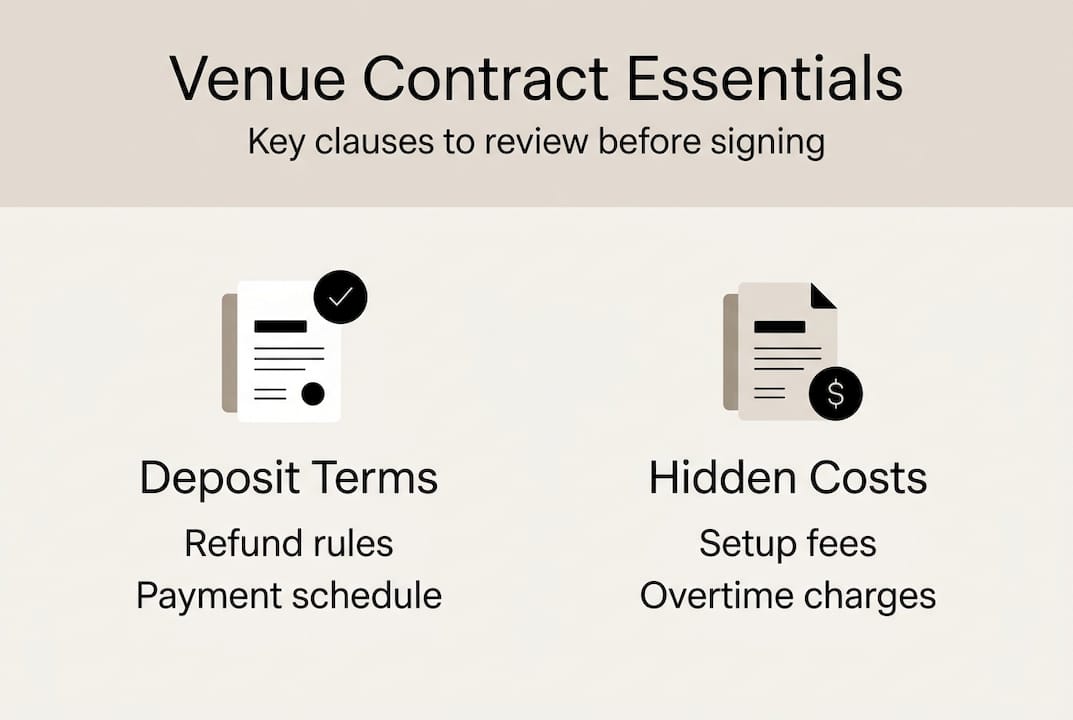
Cancellation and refund policies vary dramatically between venues, with some offering tiered refunds based on cancellation timing whilst others enforce strict no-refund policies. Typical structures provide partial refunds if you cancel 12 months before your date, declining percentages as you approach the wedding, and zero refunds within 90 days.
Liability and insurance responsibilities outlined in contracts clarify who bears financial responsibility if accidents, injuries, or property damage occur during your event. Most venues require couples to carry event liability insurance, typically costing $150 to $300, protecting both parties from catastrophic financial losses.
How to identify tricky clauses and hidden costs
Couples often overlook clauses that stipulate extra charges for changes, strict cancellation penalties, or third-party vendor restrictions buried deep within contract fine print. These provisions can transform an affordable venue into a budget-busting nightmare if you’re not vigilant during the review process.

Variable pricing clauses allow venues to adjust quoted prices based on factors like guest count fluctuations, date changes, or market conditions. Some contracts include language permitting price increases up to 30 days before your wedding, leaving you vulnerable to unexpected costs when it’s too late to change venues. Always insist on fixed pricing guarantees or clear caps on potential increases.
Guest count penalties impose fees when your final attendance drops below the guaranteed minimum you committed to in your contract. If you promise 150 guests but only 120 attend, you’ll still pay for the full 150 meals, beverages, and services. These clauses protect venues from revenue loss but can cost you thousands if your RSVP numbers disappoint.
Date change restrictions and fees make rescheduling expensive or impossible, with some venues charging 25% to 50% of your total booking fee to move your wedding. Others limit date changes to specific off-peak periods or prohibit them entirely within 12 months of your original date. Understanding these limitations before signing preserves your flexibility if circumstances change.
External vendor restrictions represent one of the most financially impactful hidden costs in venue contracts. Many properties require you to use their preferred suppliers for catering, photography, floristry, or entertainment, eliminating your ability to shop competitively or bring your own trusted professionals. When external vendors are permitted, venues often charge coordination fees ranging from $500 to $2,000.
Key red flags to watch for include:
- Automatic contract renewal clauses that extend your booking if you don’t cancel in writing by a specific deadline
- Exclusive supplier lists with limited options and inflated pricing
- Minimum spend requirements that force you to purchase more food, beverages, or services than you need
- Damage deposit forfeiture clauses with vague definitions of what constitutes damage
- Noise curfews or restrictions that could force your celebration to end earlier than expected
“The devil is in the details. I’ve seen couples lose thousands because they didn’t notice a clause requiring them to use the venue’s preferred caterer at prices 40% higher than independent quotes. Always compare the total cost including mandatory services, not just the venue hire fee.”
Pro Tip: Create a comparison spreadsheet listing all potential fees, restrictions, and penalties across your shortlisted venues. This side-by-side analysis reveals which contracts offer genuine value versus those loaded with hidden costs that inflate your final bill.
Decoration and setup restrictions can impose unexpected charges when venues prohibit certain items like candles, confetti, or wall hangings without prior approval. Some charge setup fees if you bring your own decorations or require you to hire their styling team at premium rates. Read these provisions carefully to ensure your wedding vision aligns with venue policies.
Early access and extended time fees apply when you need the venue before or after your contracted hours for setup, rehearsals, or photography sessions. These charges typically range from $200 to $500 per additional hour, adding up quickly if your vendors need substantial preparation time.
Steps to negotiate and clarify your wedding venue contract
Negotiating venue contracts can save costs and secure favourable terms when couples know what to ask and how to communicate clearly with venue managers. Most venues expect some negotiation and build flexibility into their initial proposals, making this an essential skill for budget-conscious couples.
Follow this systematic approach to contract negotiation:
-
Review the entire contract thoroughly before your negotiation meeting, highlighting every clause you don’t understand or want to modify. Prepare specific questions and alternative proposals rather than vague concerns.
-
Research comparable venues and their standard terms to understand market norms in Adelaide. This knowledge strengthens your negotiating position by demonstrating you’ve done your homework.
-
Schedule a face-to-face meeting with the venue manager or owner rather than negotiating via email. Personal conversations build rapport and often yield better results than impersonal written exchanges.
-
Prioritise your negotiation requests, focusing on the three to five terms that matter most to your budget and wedding vision. Asking to modify everything signals you’re a difficult client.
-
Propose win-win solutions that address your concerns whilst respecting the venue’s business needs. For example, offer to book an off-peak date in exchange for reduced rates or waived fees.
-
Request written confirmation of every agreed change before signing, ensuring all verbal promises become binding contract terms. Never rely on handshake agreements or email assurances.
-
Consider engaging a solicitor to review complex contracts, especially for high-value bookings exceeding $15,000. Legal fees of $300 to $500 can prevent costly mistakes.
Critical questions to ask during contract clarification include:
- What exactly is included in the base venue hire fee versus optional add-ons?
- Under what specific circumstances can cancellation fees be waived or reduced?
- Who is responsible for obtaining necessary permits, licences, or insurance coverage?
- What happens if the venue becomes unavailable due to damage, closure, or sale?
- Can we bring our own alcohol, and what are the exact corkage fees per bottle?
- Are there noise restrictions, curfews, or other limitations that could impact our celebration?
- What is your policy on vendor meals, and are these charged at guest rates or reduced prices?
Pro Tip: Record your negotiation meeting (with permission) or bring a trusted friend to take detailed notes. This documentation proves invaluable if disputes arise later about what was agreed verbally.
Successful negotiation requires confidence balanced with respect for the venue’s business constraints. Venue managers appreciate couples who communicate professionally, demonstrate genuine interest in their property, and propose reasonable modifications rather than demanding unrealistic concessions.
Always request clarification in writing for ambiguous contract language, even if the venue manager provides verbal explanations. Email your understanding of key terms after meetings and ask the manager to confirm your interpretation is correct. These written exchanges become evidence if disagreements emerge.
Comparing standard contracts: what to expect in Adelaide venues
Adelaide wedding venues vary in contract strictness and inclusions based on venue type, affecting costs and flexibility across different property styles. Understanding these variations helps you choose venues whose contract terms align with your priorities and risk tolerance.
| Venue type | Typical deposit | Cancellation flexibility | Vendor restrictions | Key contract features |
|---|---|---|---|---|
| Rustic barns | 25-35% | Moderate, 6-month policies | Usually open to external vendors | DIY-friendly, fewer mandatory services |
| Luxury hotels | 40-50% | Strict, 12-month policies | Often require in-house catering | Comprehensive packages, higher minimums |
| Outdoor gardens | 30-40% | Variable, weather clauses | Mixed, some preferred lists | Weather contingency plans, seasonal pricing |
| Historic estates | 35-45% | Moderate to strict | Curated vendor lists | Heritage restrictions, insurance requirements |
| Winery venues | 30-40% | Moderate, off-peak flexibility | Must use venue wine, flexible on others | Beverage minimums, seasonal availability |
Rustic barn venues typically offer the most contract flexibility, with lower deposits and fewer mandatory services. These properties appeal to couples wanting creative control and the freedom to bring their own vendors. However, you’ll assume more responsibility for coordinating suppliers, obtaining insurance, and managing setup logistics.
Luxury hotel contracts tend to be most restrictive but include comprehensive services that simplify planning. Expect higher deposits, strict cancellation policies, and requirements to use in-house catering and beverage services. The trade-off is professional coordination, backup plans, and established vendor relationships that reduce your planning burden.
Outdoor garden venues present unique contract considerations around weather contingencies and seasonal limitations. Most include clauses specifying backup indoor spaces or marquee options if rain threatens your ceremony. Deposits often vary by season, with peak spring and autumn dates commanding premium rates and stricter terms.
Historic estate contracts frequently include heritage preservation clauses restricting decorations, vendor access, and guest activities to protect valuable property features. These venues may require additional insurance coverage and impose strict noise curfews due to residential neighbours or council regulations.
When comparing contracts across venue types, prioritise these factors based on your wedding priorities:
- Budget flexibility: Choose venues with lower deposits and flexible payment schedules if cash flow is tight
- Creative control: Opt for properties permitting external vendors if you have specific suppliers in mind
- Risk tolerance: Select venues with generous cancellation policies if your wedding timeline is uncertain
- Planning support: Consider all-inclusive packages if you prefer professional coordination over DIY management
- Guest experience: Evaluate whether mandatory services enhance or limit your ability to personalise the celebration
Adelaide’s competitive wedding market means many venues will negotiate terms, particularly for off-peak dates or weekday bookings. Winter weddings and Friday celebrations often come with reduced deposits, waived fees, and more flexible cancellation policies as venues seek to fill their calendars.
Plan your ideal wedding venue with confidence
Now that you understand the intricacies of wedding venue contracts, you’re equipped to make informed decisions that protect your budget and vision. Adelaide Wedding Venues simplifies your search by connecting you with diverse properties across South Australia, each offering unique contract terms and inclusions suited to different planning styles.
Our comprehensive directory helps you compare venues side by side, filtering by location, capacity, and amenities to find properties matching your specific requirements. Whether you’re drawn to choosing your ideal wedding venue in rustic countryside settings or sophisticated urban spaces, our platform provides the information you need to evaluate contract terms confidently.
Explore our expert guides on choosing the perfect wedding venue to complement your contract knowledge with practical selection strategies. The Adelaide wedding venues platform offers free access to hundreds of properties, complete with photos, pricing transparency, and direct contact details, streamlining your planning journey from initial research through final contract signing.
Frequently asked questions
What is a non-refundable deposit in a wedding venue contract?
A non-refundable deposit is a payment that secures your wedding date but won’t be returned if you cancel for any reason. Most Adelaide venues require this upfront payment, typically 20% to 50% of the total booking fee, to compensate for holding your date and declining other bookings. This deposit is separate from any damage or security deposits, which are refundable if you meet all contract obligations.
Can I negotiate terms in a wedding venue contract?
Yes, many Adelaide venues are open to negotiation, especially regarding additional fees, payment schedules, and service inclusions. Your negotiating power increases for off-peak dates, weekday weddings, or when booking well in advance. Always make requests clearly and professionally, and ensure any agreed changes are documented in writing as contract amendments before signing. Venues rarely negotiate their core cancellation policies but may offer flexibility on vendor restrictions or minimum spend requirements.
What should I watch out for in cancellation policies?
Look for specific deadlines that trigger different refund levels, as many venues use tiered structures where refunds decrease as your wedding date approaches. Watch for strict non-refundable clauses that prevent any money recovery regardless of cancellation timing. Pay attention to penalties for date changes, which some venues treat as cancellations requiring full forfeiture of deposits. Force majeure provisions are equally important, clarifying whether extraordinary circumstances like illness or disasters offer any protection.
How do external vendors affect my venue contract?
Many Adelaide venues restrict or charge additional fees for external suppliers, requiring you to use their preferred caterers, photographers, or entertainers. Some properties impose coordination fees ranging from $500 to $2,000 when you bring your own vendors, whilst others maintain exclusive supplier lists that limit your choices. Check for clauses requiring vendor insurance certificates or restricting access times for external suppliers. Understanding these restrictions before signing helps you budget accurately and ensures your preferred professionals can work at your chosen venue.
What happens if my guest count changes significantly?
Most contracts require you to guarantee a minimum guest count 30 to 90 days before your wedding, with financial penalties if actual attendance falls short. You’ll typically pay for the guaranteed number regardless of how many guests actually attend, protecting the venue’s catering and service revenue. Some venues allow small reductions of 5% to 10% without penalty, whilst others enforce strict minimums. Increases usually incur additional per-person charges at the contracted rate, though last-minute additions may cost more if they disrupt final planning.
