
TL;DR:
- The venue checklist process involves six steps, from shortlisting to booking, ensuring clear terms and contingency plans. Couples should prepare a focused brief, inspect venues as operational tests, and verify licences and inclusions thoroughly. Using a detailed directory and resources streamlines decision-making and minimizes surprises during the final stages.
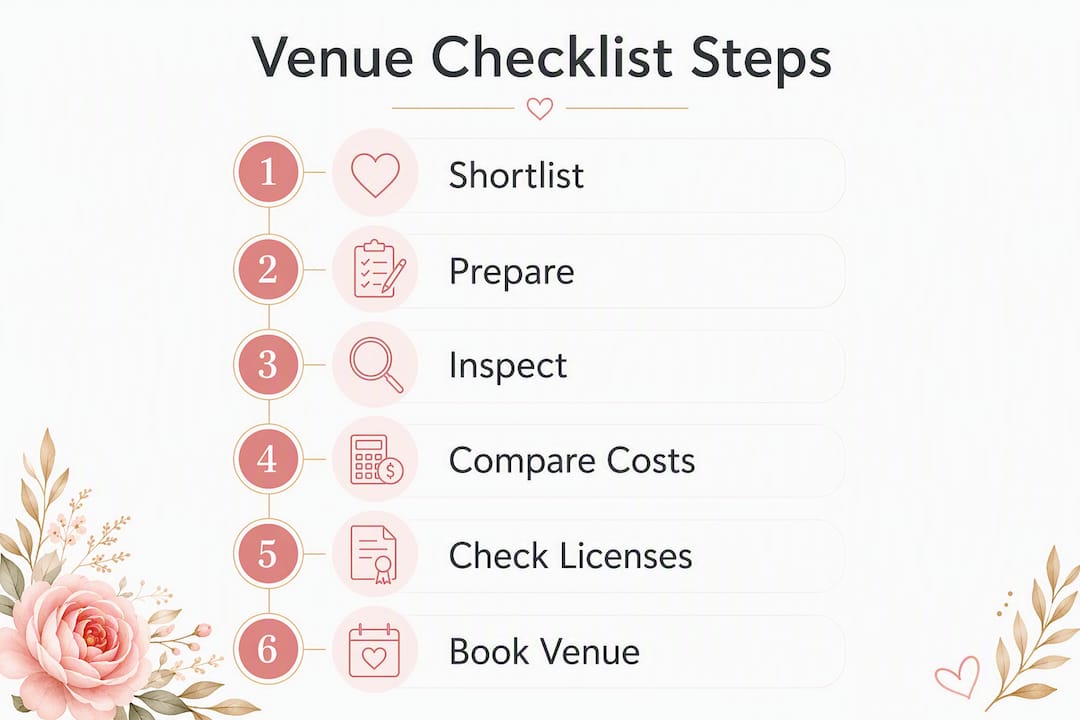
The venue checklist process is a six-step workflow: shortlist → prepare → inspect → compare inclusions and costs → check licences and contingency → decide and book. Follow it in order and you will arrive at a confirmed booking with clear answers on capacity, catering rules, AV capability, wet-weather backup, deposits, and contract terms. Trusted Australian bodies you should expect to encounter along the way include Liquor Control Victoria, the Australian Competition and Consumer Commission (ACCC), and the Adelaideweddingvenues directory.
The six steps at a glance:
- Shortlist: confirm guest numbers, budget, preferred dates, event style, and accessibility needs before approaching venues.
- Prepare: build a standard question sheet and bring it to every inspection so answers are directly comparable.
- Inspect: treat the site visit as a functional test, not a viewing. Walk the full guest journey from arrival to pack-down.
- Compare inclusions and costs: demand an itemised quote and model both per-head and minimum-spend pricing against your real guest count.
- Check licences and contingency: verify liquor licences, public liability insurance, occupancy certificates, and a genuine wet-weather plan.
- Decide and book: use a simple scoring rubric, negotiate any verbal promises into writing, then pay the deposit only after reading the full contract.
Pro Tip: Print this six-step list and tick off each stage as you complete it. Couples who work through a structured venue selection checklist consistently report fewer surprises at the contract stage.
What should you prepare before visiting any venue?
Arriving at an inspection without a clear brief wastes everyone’s time. Before you book a single site visit, lock in four things: your confirmed guest count (both seated and cocktail), a realistic budget range, your preferred date window, and the event format (ceremony only, ceremony and reception, cocktail, sit-down, or hybrid). Add any accessibility requirements for guests with mobility, hearing, or vision needs, because these will immediately rule out some venues.
Once those are settled, build a shortlisting checklist that travels with you to every inspection. A focused pre-visit list of non-negotiables speeds decision-making and keeps visits on the right venues rather than beautiful spaces that cannot actually work for your event.
Pre-visit checklist to bring to every inspection:
- Confirmed seated and cocktail guest numbers
- Budget ceiling (venue hire or minimum spend)
- Preferred date range and any hard blackout dates
- Event format and ceremony requirements (separate licence needed for on-site ceremonies)
- Accessibility needs for guests
- Printed floor plan expectations or rough room dimensions
- Preferred supplier list (caterer, band, florist) to check against venue restrictions
- Phone charged for photos and video walkthroughs
- Tape measure for checking table spacing and aisle widths
- Standard question sheet to use identically across all venues
Use Google Street View to map the arrival experience before you visit. Check parking options, public transport links, and whether the venue has a holding policy for tentative date reservations. Confirming availability before travelling saves a wasted trip.
What to check during your venue site inspection
A site visit should function as an operational test, not a tour. Walk the full event day from guest arrival to supplier pack-down, and test every space under the conditions it will actually run in.
Capacity and layout
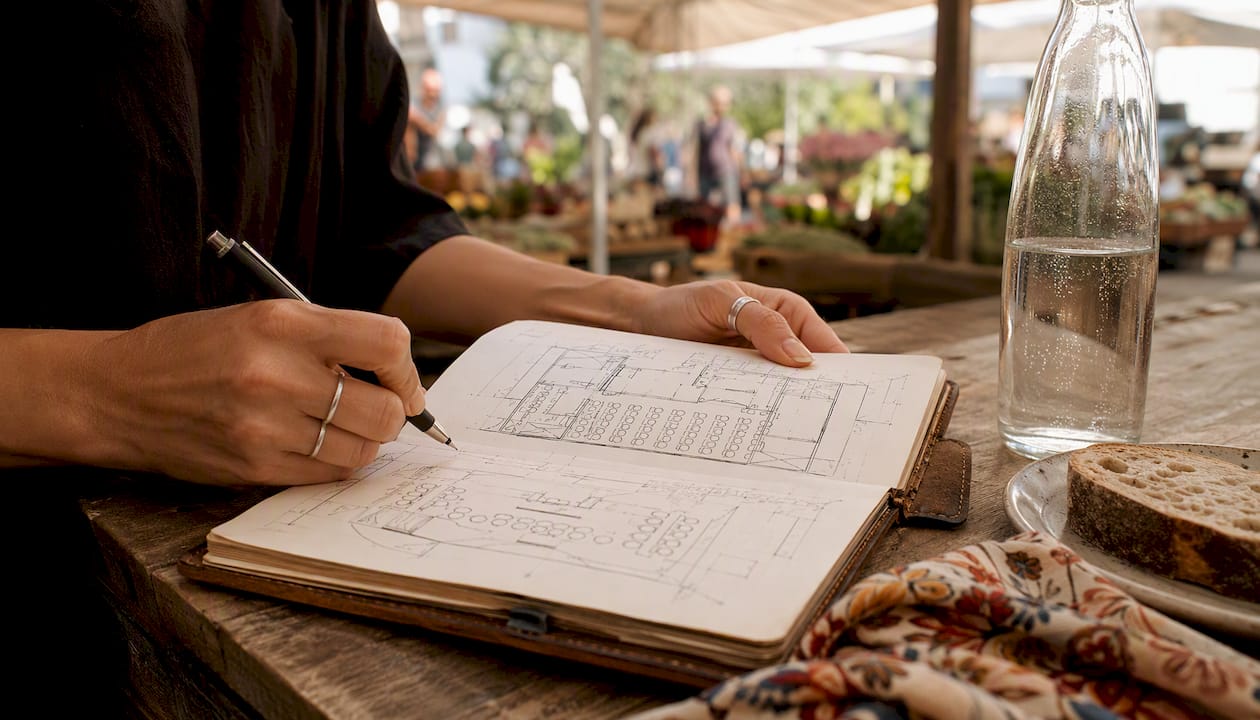
Ask for the comfortable seated capacity with a dancefloor and band included, not the fire-rated maximum. Request sample floor plans for your specific guest count and ask how different table shapes (round vs. rectangular) affect flow and aisle widths. A room that seats 150 in a floor plan may only seat 120 comfortably once a band riser, dancefloor, and cake table are added.
Guest flow and arrival experience
Walk the path guests will take from car park to ceremony space to reception room. Check signage, queuing areas, drop-off points, and the route between ceremony, photo locations, and reception. Shared foyers or lawns used by other events on the same day can compromise the experience significantly.

Back-of-house and supplier access
Ask about delivery windows, loading zones, lift access for heavy equipment, on-site storage, and bump-in and bump-out rules. Suppliers need to know exactly when they can enter and where they stage equipment. Tight bump-in windows are one of the most common sources of day-of stress.
AV, power, and connectivity
| Item to check | Questions to ask |
|---|---|
| Power points and circuits | Are dedicated circuits available for a band or staging rig? |
| Wi-Fi reliability | Is there a venue-managed network or do suppliers bring their own? |
| Projector and screen | In-house or hire-in? Who operates it on the day? |
| AV technician | Is one included, or is it an additional cost? |
| Noise restrictions | Are there curfews that affect music or speeches? |
Amenities and guest comfort
Check restrooms (number and proximity to the main space), private dressing or waiting rooms for the couple and bridal party, heating and cooling systems, shade for outdoor areas, and lighting quality for photography. Ask whether extended-hours options are available and what they cost.
Staffing and service
Find out who coordinates your timeline on the day, whether a dedicated day-of coordinator is included or costs extra, how security staffing is handled, and how transitions between ceremony and reception spaces are managed.
Pro Tip: Ask where photographers usually shoot family groups, bridal party portraits, and couple photos. If the answer is vague or the spaces are far apart, that is a signal the venue has not thought carefully about photography flow and your timeline will feel rushed.
How do you compare inclusions and uncover hidden costs?
Inclusions are frequently where a cheaper-looking quote becomes more expensive once you read the fine print. Venues should provide an itemised breakdown in plain language so quotes are genuinely comparable. Demand this from every venue, not just the ones you suspect of padding.
Items commonly bundled into packages and items commonly charged as extras vary widely. The table below shows what to clarify on every quote.
| Line item | Often included | Often charged as extra |
|---|---|---|
| Tables and chairs | Usually included | Specialty furniture (Tiffany chairs, farm tables) |
| Linen (tablecloths) | Varies | Coloured or premium linen |
| Crockery and cutlery | Usually included | Charger plates, specialty glassware |
| Cleaning | Usually included | Post-event deep clean or damage bond |
| Security | Varies | Often extra for late finishes |
| AV (basic PA, microphone) | Varies | Band riser, lighting rigs, AV technician |
| On-site coordinator | Varies | Day-of coordinator vs. sales coordinator only |
| Cake cutting | Rarely included | Usually charged per person |
| Corkage | Rarely included | Charged per bottle or per person |
Australia has two dominant pricing models: per-head packages and minimum-spend hires. Per-head packages add up quickly on large guest lists; minimum spends can penalise small guest counts. Model both against your actual numbers before comparing venues side by side.
Checklist questions to ask when you receive a quote:
- What is included per head versus per hire?
- What are the overtime rates if the event runs past the agreed finish time?
- Is there a minimum spend, and what happens if you fall short?
- Are service charges added on top, and is GST included in the quoted price?
- What is the bond or damage deposit, and when is it returned?
To compare fairly, normalise every quote to the same guest count and run a quick per-head calculation on minimum-spend venues. A venue with a $15,000 minimum spend for 80 guests results in a clear per-head baseline you can use to compare with per-head packages. Calculating this way makes the comparison honest. For more detail on venue budget considerations, the Adelaideweddingvenues guide covers common hidden fees and budgeting tactics specific to Australian couples.
What questions must you get answered before paying a deposit?
Booking terms in Australia often sit inside standard-form consumer contracts. The ACCC recommends reading contract terms in full before paying any deposit, because many venue contracts contain non-negotiable clauses affecting refunds and date transfers. Treat the contract as part of the venue offering, not a formality to sign after the decision is made.
Deposit and payment schedule:
- What is the deposit amount, and what does it secure (date, spaces, inclusions)?
- When is the balance due, and are staged payments available?
- What payment methods are accepted?
Cancellation, postponement, and transfer terms:
- What is the refund policy if you cancel at 12 months, 6 months, and 30 days out?
- Can the booking be transferred to a new date, and is there a fee?
- Does the contract include a force majeure clause, and what does it cover?
- Are credits available if the venue cancels or becomes unavailable?
Exclusivity and shared use:
- Will other events run on the same day? Ask how spaces are physically separated. Shared-use venues can feel compromised if other-event traffic uses the same foyers, lawns, or photo spots.
- Does exclusivity cost extra, and what exactly does it cover?
Supplier rules and restrictions:
- Is there a preferred or mandatory supplier list for catering, bar service, or AV?
- What are the corkage rules, and what is the charge per bottle or per person?
- Are there penalties for bringing unapproved vendors?
Get every verbal promise in writing before you pay. If the venue coordinator says “we’ll throw in the chair covers,” that needs to be in the contract amendment, not just in an email.
What Australian licensing and compliance checks should you complete?
Regulatory checks are not optional. In Australia, the relevant bodies include Liquor Control Victoria (and equivalent state liquor regulators such as Consumer and Business Services in South Australia), the ACCC, and local council planning and fire or occupancy authorities.
What to verify before booking:
- Valid liquor licence or event permit, including licence conditions (hours, approved areas, RSA requirements)
- Public liability insurance certificate, including issue date, expiry, and coverage amount
- Occupancy certificate or evacuation plan where relevant
- Council permits for temporary structures, amplified sound, or outdoor events
Practical verification steps:
- Ask the venue for copies of their liquor licence and public liability insurance certificate.
- Confirm the licence issue and expiry dates and check that the licence covers your event type and hours.
- Cross-check the licence number with the issuing state authority’s public register.
- Save copies of all certificates with your booking paperwork.
For Adelaide and South Australia events, the Adelaide wedding venue requirements guide on Adelaideweddingvenues covers local obligations in practical detail.
Pro Tip: Red flags in documentation include a liquor licence that expires before your event date, a licence that covers only certain areas of the venue (meaning your reception space may not be licensed), and public liability insurance with a coverage amount below $10 million. Ask directly; reputable venues will show you the paperwork without hesitation.
How do you evaluate a venue’s wet-weather contingency?
A wet-weather option must be tested with the same scrutiny as the main plan. Good contingency preserves guest flow, comfort, and photography rather than being an afterthought. For outdoor venues in particular, the backup plan is as much a part of the offering as the primary space.
Checklist for evaluating a wet-weather option:
- Does the backup space have capacity parity with the primary space, or does it require a reduced guest count?
- Are there covered routes between the outdoor and indoor areas so guests are not caught in the rain?
- Can suppliers access the backup space without significant additional set-up time or cost?
- Is the indoor space photogenic enough to produce quality ceremony and portrait images without travelling to a separate location?
- Does the backup space have equivalent facilities for food service, bar, and guest comfort?
- Who makes the call to move indoors, and how late can that decision be made?
- Are there any additional fees or logistical impacts from switching spaces?
Ask to see the wet-weather space in person during your inspection. If the venue is reluctant to show it, or if it is a marquee with no heating and a concrete floor, that tells you everything you need to know. For more on planning for weather at outdoor events, the Adelaideweddingvenues guide covers contingency planning in detail.
How do you compare final offers and lock in the booking?
Once you have inspected two or more venues and collected itemised quotes, use a simple scoring rubric to make the decision transparent. Rate each venue out of five on the criteria that matter most to your event.
| Criterion | Weight | Venue A score | Venue B score |
|---|---|---|---|
| Capacity fit (comfortable, with dancefloor) | High | — | — |
| Inclusions vs. price per head | High | — | — |
| Wet-weather parity | Medium | — | — |
| AV capability and power access | Medium | — | — |
| Supplier flexibility | Medium | — | — |
| Day-of coordinator included | High | — | — |
| Cancellation and postponement terms | High | — | — |
Negotiation tips:
- Ask for an itemised inclusions list before negotiating on price. You cannot negotiate what you cannot see.
- If a venue verbally offers to match an inclusion from another quote, request a written contract amendment before signing.
- Ask whether the venue will add items (upgraded linen, extended hours, additional staff) rather than discount the hire fee. Venues often have more flexibility on inclusions than on price.
Final booking checklist — what to get in writing at the point of deposit:
- Confirmed date, start time, and finish time
- All spaces included in the hire and their hours
- Full itemised inclusions list as an attachment to the contract
- Cancellation, postponement, and transfer terms
- Supplier access times for bump-in and bump-out
- Contact details and name of the day-of coordinator
- Bond amount and return conditions
How Adelaideweddingvenues supports your venue selection process
Adelaideweddingvenues is a searchable directory of Adelaide and South Australia wedding venues built specifically to speed up the shortlisting stage of the venue checklist process. Location filters, capacity and price filters, category selections, and keyword search for specific amenities let you generate a focused shortlist without visiting venues that cannot meet your basic requirements.
The platform also publishes practical planning resources that pair directly with this guide. The site-visit checklist mirrors the inspection workflow above and is designed to be printed and brought to every venue tour. Budget worksheets help couples normalise quotes to the same guest count, and vendor lists support the supplier-restriction checks covered in the questions-before-booking section.
How to use the directory alongside this guide:
- Use location and capacity filters to generate an initial shortlist of venues that meet your guest count and budget.
- Download the site-visit checklist and print one copy per venue before your inspections.
- Use the directory’s venue detail pages to compare inclusions and contact venues directly to request itemised quotes.
- Check venue listings for notes on AV capability, catering arrangements, and accessibility features before committing to a visit.
The directory is maintained by wedding industry professionals with deep knowledge of local venues, which means the listings reflect real operational detail rather than marketing copy.
Key takeaways
A thorough venue checklist process covers six stages: shortlist, prepare, inspect, compare inclusions and costs, check licences and contingency, then decide and book with every promise confirmed in writing.
| Point | Details |
|---|---|
| Itemise every quote | Demand a plain-language inclusions breakdown so quotes are genuinely comparable across venues. |
| Model both pricing structures | Per-head packages and minimum-spend hires suit different guest counts; run the numbers on both before deciding. |
| Verify licences before booking | Check the liquor licence, public liability insurance, and occupancy certificate; save copies with your paperwork. |
| Test the wet-weather plan | The backup space must have capacity parity, covered access, and equivalent facilities, not just a tent in the car park. |
| Adelaideweddingvenues directory | Use the platform’s filters, site-visit checklist, and budget worksheets to shortlist and compare Adelaide venues efficiently. |
What experienced planners notice that checklists often miss
Most venue checklists are written for the best-case scenario. The real test of a venue is how it handles the things that go slightly wrong: a supplier who arrives late, a guest who needs wheelchair access to a space the floor plan does not show, or a coordinator who is managing three events simultaneously and cannot answer your calls.
The single most revealing question you can ask during an inspection is not about inclusions or pricing. Ask the venue coordinator what happened at the last event that did not go to plan, and how they resolved it. Evasive answers, or an insistence that nothing ever goes wrong, are a meaningful signal. Venues with genuine operational experience will answer this question directly and with specifics.
A few red flags worth watching for on any site visit:
- Evasive or inconsistent answers about what is included versus what costs extra
- Inability to produce a current liquor licence or insurance certificate on request
- No clear wet-weather alternative, or a backup space that is visibly inadequate
- Floor plan numbers that change between the initial quote and the site visit
- A day-of coordinator who turns out to be the same person managing sales, bookings, and three other events
When to walk away: if a contract contains non-negotiable clauses that remove your right to a date transfer in any circumstance, if the venue insists on mandatory use of in-house suppliers at prices significantly above market rate, or if the day-of coordination capacity is clearly insufficient for your event size, those are not negotiating points. They are reasons to choose a different venue.
The best venues are transparent about their limitations. A venue that tells you honestly that their indoor backup space seats 20 fewer guests, or that their preferred caterer is the only option, is giving you the information you need to make a good decision. That honesty is itself a quality signal.
Adelaideweddingvenues makes shortlisting faster and simpler
Searching for the right venue across Adelaide and South Australia is time-consuming when you are doing it manually. Adelaideweddingvenues cuts that time significantly by giving couples and planners a searchable directory with filters for location, capacity, price, and specific amenities, so you only visit venues that genuinely fit your brief.
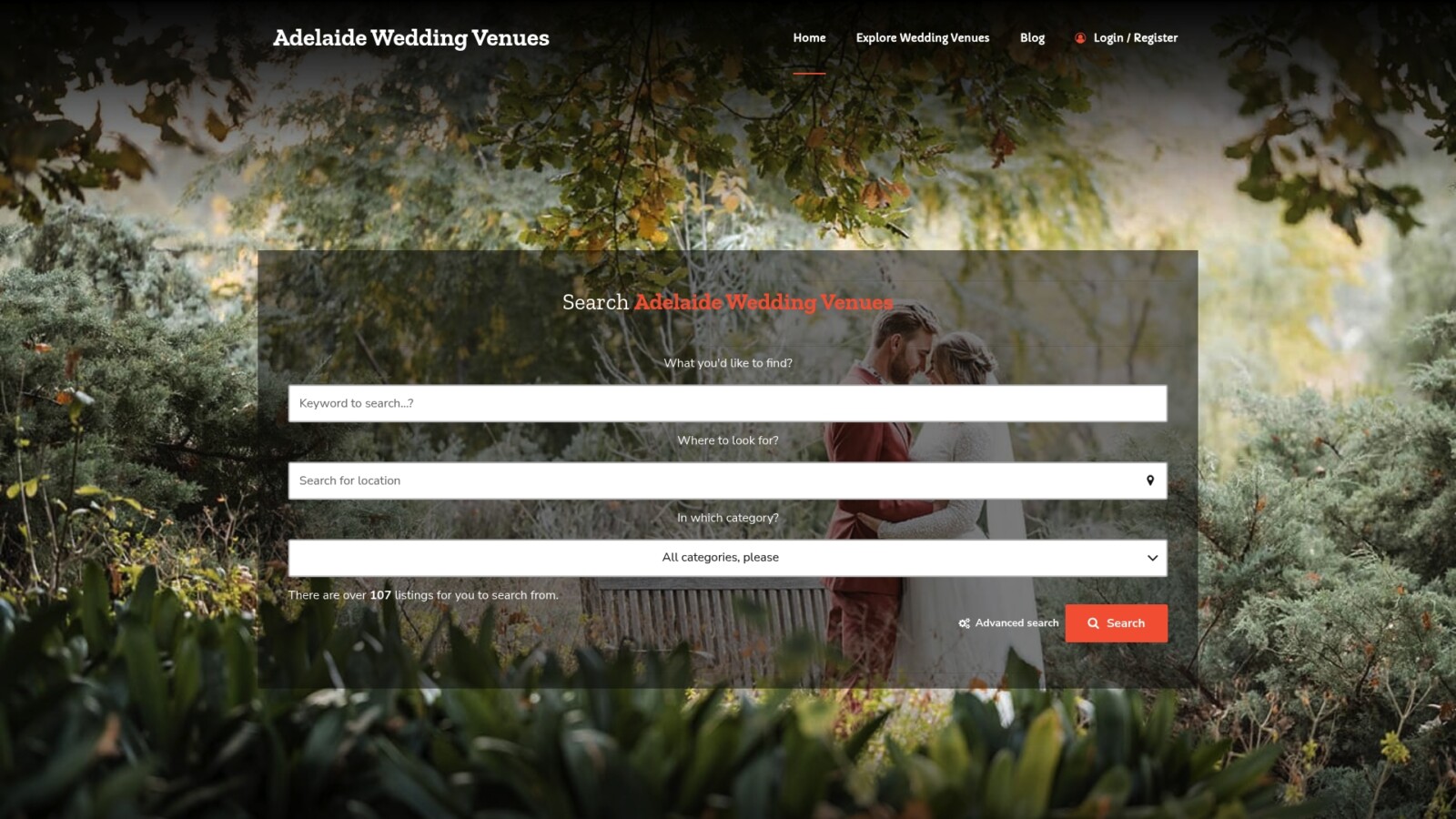
The platform pairs well with the checklist process in this guide. Generate your shortlist using the directory’s filters, then download the site-visit checklist to bring to each inspection. The budget worksheets help you normalise quotes across venues, and the venue detail pages give you the inclusions and contact information you need to request itemised quotes before you visit. For couples ready to start comparing options, the guide to choosing your ideal wedding venue on Adelaideweddingvenues covers style and setting considerations that complement the checklist approach.
Visit Adelaideweddingvenues to generate your shortlist, download the site-visit checklist, and contact venues directly to lock in inspection dates.
Useful sources
The following Australian sources are worth bookmarking for licence verification, contract guidance, and additional inspection templates.
Regulators and compliance:
- Liquor Control Victoria venue checklist — the state regulator’s own checklist for licensed venues; useful for cross-checking a venue’s compliance obligations.
- ACCC guidance on standard-form consumer contracts — search “standard form contracts” on the ACCC website for current guidance on unfair contract terms and your rights before signing.
- Your state or territory liquor authority’s public licence register — use this to verify a venue’s licence number, conditions, and expiry date.
- Local council planning authority — check permit requirements for temporary structures, amplified sound, and outdoor events in your area.
Inspection templates and planning checklists:
- VenueGuide.au — questions to ask a wedding venue — a practical question list grouped by topic, useful for cross-checking your own question sheet.
- EasyRegistry — essential questions to ask a wedding venue — covers pricing models, exclusivity, and contract terms with Australian context.
- EasyWeddings — wedding venue questions — grouped inspection questions covering availability, logistics, catering, and timeline.
- Ballara — how to test a wedding venue in one visit — practical guidance on treating a site visit as a functional test rather than a viewing.
- Ivory Tribe — questions to ask on a wedding venue tour — covers wet-weather plans, vendor restrictions, accommodation, and accessibility.
- Adelaideweddingvenues — site-visit checklist — printable inspection template tailored to Adelaide and South Australia venues.
Reminder: save copies of the venue’s liquor licence and public liability insurance certificate with your booking paperwork, and compare itemised inclusions across every quote before making a final decision.
FAQ
What is the venue checklist process in simple terms?
The venue checklist process is a six-step workflow: shortlist venues against your brief, prepare a standard question sheet, inspect each site as a functional test, compare itemised inclusions and costs, verify licences and contingency plans, then decide and book with all terms confirmed in writing.
What should be included in an itemised venue quote?
A complete quote should list tables and chairs, linen, crockery and cutlery, cleaning, security, AV equipment, on-site coordinator, cake cutting, and corkage as separate line items, with a clear note on whether GST and service charges are included.
How do you check a venue’s liquor licence in Australia?
Ask the venue for a copy of their current licence and cross-check the licence number against your state liquor authority’s public register. Confirm the licence covers your event type, the specific spaces you are using, and the hours of your event.
When should you read the venue contract?
Read the full contract, including cancellation, postponement, and transfer clauses, before paying any deposit. The ACCC’s guidance on standard-form consumer contracts applies to many venue agreements, and non-negotiable clauses affecting refunds are common.
How does Adelaideweddingvenues help with venue shortlisting?
Adelaideweddingvenues provides a searchable directory with filters for location, capacity, price, and amenities, along with printable site-visit checklists and budget worksheets that pair directly with the venue checklist process outlined in this guide.
