
TL;DR:
- Choosing the right wedding venue type is essential for managing costs, guest experience, and logistics.
- Indoor venues offer weather protection but may limit personalization, while outdoor venues provide scenic beauty with added planning needs.
- Matching venue type to your wedding vision and priorities helps avoid surprises and ensures a memorable celebration.
Many couples assume that once you’ve seen one wedding venue, you’ve seen them all. That belief can lead to real regret. Choosing the wrong venue type means unexpected costs, style clashes, and a guest experience that falls flat. The good news is that comparing venue types early in your planning process is one of the smartest moves you can make. This guide walks you through the key differences between popular Adelaide venue types, how each one affects your budget and logistics, and how to match your priorities to the right setting before you sign anything.
Key Takeaways
| Point | Details |
|---|---|
| Venue type drives the experience | Choosing the right venue type shapes your wedding’s atmosphere, convenience, and guest comfort. |
| Comparing saves time and stress | Early comparison helps avoid mismatches between budget, style, and practical needs. |
| Consider the big picture | Total cost, guest access, and the day’s flow are all influenced by venue type—not just surface details. |
| Match to your values | Pick based on your priorities, not just what’s popular or traditional. |
Why venue types matter more than you think
The word ‘venue’ covers an enormous range of spaces. An indoor ballroom, a rustic barn, a beachside pavilion, a winery, a heritage building, and a blank-canvas warehouse are all technically venues. But they deliver very different experiences, come with different rules, and carry very different price tags.
Venue type refers to the physical category and service model of a space. Some venues are full-service, meaning they bundle catering, furniture, and coordination into one package. Others are blank-canvas spaces where you bring in every supplier yourself. Outdoor venues offer natural beauty but expose your day to weather risk. Indoor venues protect against the elements but can feel less organic or scenic.
Understanding venue types complete guide distinctions matters because each type shapes your guest experience from the moment people arrive. A heritage building with narrow corridors may look stunning in photos but create flow problems for 150 guests. A garden venue may feel relaxed and romantic but require hired toilets, a generator, and a wet-weather backup plan.
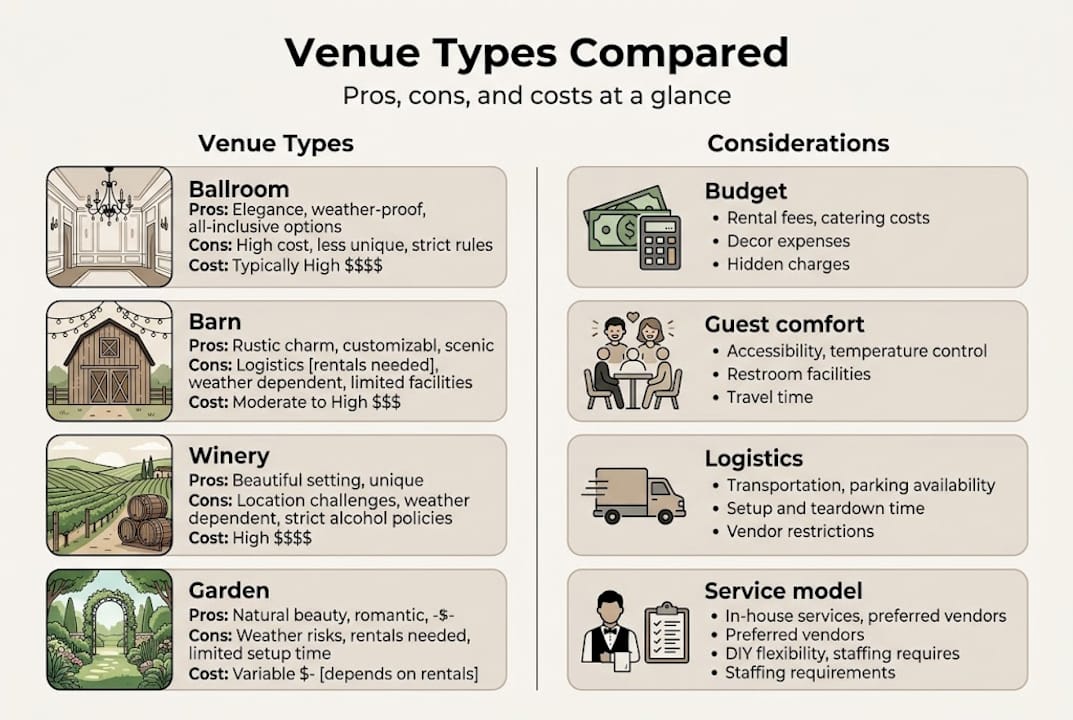
Here is a quick overview of common venue types and what they bring to the table:
- Indoor ballroom or function centre: Weather-proof, fully accessible, often full-service, but less flexibility for personalisation.
- Rustic barn or farm: Relaxed atmosphere, often photogenic, but may have noise curfews and limited facilities.
- Winery or vineyard: Scenic and sophisticated, usually includes catering packages, but often has early finish times.
- Beachside or coastal venue: Stunning backdrop, great for casual celebrations, but requires weather contingency planning.
- Garden or parkland: Natural and romantic, suits daytime events well, but may need additional infrastructure.
- Blank-canvas warehouse or studio: Maximum flexibility and personalisation, but all costs are on you.
“The wrong venue type doesn’t just affect aesthetics. It can compromise guest experience and push up unanticipated costs in ways couples simply don’t expect until it’s too late.”
This is precisely why couples compare venues before committing. Comparing types early saves stress, money, and the sinking feeling that something doesn’t quite fit.

Comparing popular Adelaide venue types: pros, cons and costs
With a grounding in why types matter, let’s directly compare the main options Adelaide couples usually consider. The table below gives you a structured view across the most important decision factors.
| Venue type | Style | Guest capacity | Approx. cost range | Flexibility | Common restrictions |
|---|---|---|---|---|---|
| Ballroom/function centre | Formal, polished | 80 to 300+ | $8,000 to $25,000 | Low to medium | Preferred suppliers, set menus |
| Rustic barn/farm | Relaxed, organic | 60 to 200 | $5,000 to $18,000 | Medium | Noise curfews, BYO limits |
| Winery/vineyard | Scenic, sophisticated | 40 to 180 | $7,000 to $22,000 | Low to medium | Early finish, in-house catering |
| Beachside/coastal | Casual, romantic | 30 to 150 | $4,000 to $15,000 | Medium to high | Permits, weather contingency |
| Garden/parkland | Natural, elegant | 40 to 200 | $3,500 to $14,000 | Medium | Infrastructure hire, curfews |
| Blank-canvas space | Fully custom | 50 to 500+ | $3,000 to $20,000 | Very high | Nothing included, all costs extra |
A few key takeaways from this comparison:
- Full-service venues reduce planning stress but limit creative control.
- Scenic outdoor venues create beautiful moments but increase logistical complexity.
- Lower hire fees don’t always mean lower total costs, especially for blank-canvas spaces.
- Capacity limits vary widely, so always confirm the venue’s maximum before falling in love with a space.
When choosing your ideal venue, look beyond the headline hire fee. Some venues charge separately for furniture, staffing, overtime, and even rubbish removal. Understanding the wedding venue costs breakdown before you compare is essential.
Pro Tip: Always ask venues for a full inclusions list and a sample invoice from a recent event. Hidden costs like overtime fees, mandatory security, or required vendor packages can add thousands to your final bill.
How venue type affects your budget, guest comfort and logistics
Now that you’ve compared the high-level features, it’s essential to understand how your venue type influences the details that define the day. The hire fee is just the beginning.
Beyond the base cost, your venue type drives a range of additional expenses:
- Catering model: Full-service venues include catering; others require you to hire an external caterer, which adds cost and coordination.
- Alcohol policy: Some venues require you to use their licensed bar; others allow BYO with a corkage fee.
- Styling and infrastructure: Blank-canvas spaces need furniture, lighting, and décor hire. Garden venues may need a marquee.
- Vendor restrictions: Many full-service venues have preferred supplier lists, limiting your choice of photographer, florist, or band.
| Venue type | Estimated all-up cost (100 guests) | Key cost drivers |
|---|---|---|
| Ballroom/function centre | $18,000 to $35,000 | Catering packages, bar tabs, AV |
| Rustic barn | $14,000 to $28,000 | External catering, décor, transport |
| Blank-canvas space | $16,000 to $40,000+ | All infrastructure, all suppliers |
Guest comfort is another area where venue type makes a real difference. The accessibility and flow of a space directly shapes how your guests feel throughout the day. Indoor venues are generally fully accessible and climate-controlled, but they can feel rigid in terms of guest movement. Garden or beach venues feel relaxed and open, but guests with mobility challenges may struggle.
Here are four logistics checks every couple should run for their chosen venue type:
- Accessibility for mobility-impaired guests: Does the venue have ramps, accessible bathrooms, and level pathways? Check venue accessibility tips for a full checklist.
- Weather contingencies: Outdoor venues need a solid backup plan. Confirm what the venue provides and what you’ll need to arrange.
- Vendor coordination: Who manages bump-in and bump-out? Does the venue have a coordinator, or is that on you?
- Flow between ceremony and reception: Can guests move easily from one space to another? Poor flow creates confusion and delays.
These are the key venue factors that separate a smooth, memorable day from a stressful one.
Matching venue type with your wedding vision and priorities
Understanding the impact of detail and logistics enables a more informed match with what you truly want. Before you tour a single venue, get clear on your priorities.
Start by answering these questions honestly:
- What atmosphere do you want guests to feel when they arrive?
- Do you have cultural or religious requirements that affect the space?
- What is your absolute maximum spend, including all extras?
- How many guests are non-negotiable on your list?
- Are there must-have features like a dance floor, outdoor ceremony space, or on-site accommodation?
Once you have those answers, you can filter venue types rather than wasting weekends on spaces that will never work. Aligning your venue with your vision from the start saves enormous time.
Some of the most common mismatches to avoid:
- Booking a winery but wanting late-night dancing: Most wineries have early curfews. If a big party is your priority, a function centre or blank-canvas space suits you better.
- Choosing a garden venue but needing full accessibility: Beautiful gardens often have uneven terrain. Always inspect with accessibility in mind.
- Falling for a blank-canvas space on a tight budget: The hire fee looks low, but once you add every supplier and item, costs can exceed a full-service venue.
- Picking an outdoor coastal venue without a weather plan: Adelaide’s summer heat and spring winds are real factors. Confirm your backup option in writing.
Keeping an eye on 2026 venue trends can also inspire ideas, but trends should inform rather than drive your decision.
Pro Tip: Your venue doesn’t just provide a setting. It sets the rhythm and mood of your entire day. Pick for your priorities first, and let the aesthetics follow.
The truth most venue comparisons miss
Most venue guides focus on aesthetics and price. That’s understandable, but it misses the deeper truth: your venue type shapes the entire experience of your wedding, not just the backdrop.
We’ve seen couples choose a stunning heritage building because of its visual appeal, only to discover the layout made speeches awkward, the stairs excluded elderly guests, and the noise restrictions ended the night at 10pm. The venue looked perfect on paper and in photos. In practice, it worked against them.
The venues that lead to the most memorable celebrations are not always the most photogenic. They are the ones that support effortless flow, allow personalisation, and make every guest feel genuinely welcome. That comes from understanding venue type at a functional level, not just a visual one.
When you’re deciding your wedding location, resist the urge to start with aesthetics. Start with your guest list, your non-negotiables, and your budget ceiling. Then let the venue type filter do its work. You’ll end up with a shortlist of spaces that can actually deliver your day, not just look good in the brochure.
Find your match: Adelaide’s top venue guides and resources
You now have a solid framework for comparing venue types with confidence. Browse All Adelaide Wedding Venues to apply these priorities to your shortlist. The next step is putting that knowledge to work with the right tools.
Adelaide Wedding Venues brings together expert-curated venue lists, detailed comparison resources, and practical cost and capacity breakdowns to make your search faster and less stressful. Whether you’re drawn to rustic barns, beachside settings, or elegant ballrooms, the venue selection guide gives you a strong starting point. For something a little different, browse unique Adelaide venues to discover spaces you might not have considered. And before you commit to anything, the cost and capacity guide helps you understand exactly what you’re paying for.
Frequently asked questions
Is it worth comparing more than one wedding venue type?
Yes, comparing multiple venue types helps you find the best match for style, budget and guest needs. It also reveals hidden pros and cons that only become clear when you look side by side.
What’s the main difference between indoor and outdoor venues?
Indoor venues offer weather-proofing and controlled environments, while outdoor scenic venues provide beautiful backdrops but require weather contingency planning and additional infrastructure.
How does venue type affect my total wedding budget?
Venue type influences far more than the hire fee. It drives catering model, décor requirements, vendor restrictions, and accessibility costs, all of which can significantly change your total spend.
Are certain venue types better for big or small weddings?
Yes. Ballrooms and large rustic barns suit bigger guest lists well, while boutique gardens, private homes, and intimate function rooms work better for smaller, more personal celebrations.
