
Plan to allocate roughly 40–45% of your total wedding budget to venue and catering combined. That single figure is the most important thing to know before you start comparing spaces, signing anything, or falling in love with a ballroom that is quietly out of reach. According to EasyWeddings, the average Australian venue cost sits at approximately $17,518, and when catering is added, that combined line routinely becomes the dominant item in any wedding budget.
The fastest way to reduce that cost is not to negotiate harder on florals or skip the videographer. It is to reduce your guest numbers. The 80/20 principle applied to wedding spending is clear: venue, catering, and photography drive the bulk of cost and guest experience, so those are the decisions that deserve the most attention and the most flexibility. Every other saving is secondary.
Two immediate actions make the biggest difference to your venue budget considerations:
- Reduce guest numbers. Fewer guests lower your per-head catering cost, your minimum spend threshold, and often your room hire requirement simultaneously.
- Choose off-peak dates or regional locations. Fridays, Sundays, and winter dates regularly reduce hire fees by 15–30% compared with a peak Saturday booking.
What does a venue quote actually include?
Understanding what you are paying for is the first step to comparing quotes fairly. Venues use several different pricing models, and the same headline number can mean very different things depending on what is bundled in.
The four main pricing models:
- Flat room hire. A fixed fee for the space, regardless of guest count. Catering, staffing, and beverages are then quoted separately.
- Minimum spend. You commit to spending at least a set amount on food and beverage. If your guests drink and eat less than that threshold, you pay the minimum anyway.
- Per-head pricing. A single per-person rate that bundles food, basic beverages, and sometimes staffing. Easy to calculate, but the inclusions vary widely between venues.
- Hybrid packages. A ceremony hire fee plus a minimum reception spend, or a room hire fee plus a per-head catering rate. Common in full-service venues.
Once you know the model, you can inspect the line items. A thorough venue quote should itemise each of the following:
- Room hire or minimum spend
- Food per head (canapes, entrée, main, dessert, tea and coffee)
- Beverage package (fixed time, consumption tab, or cash bar)
- Service and staffing (waitstaff, bar staff, event coordinator)
- Furniture and linen (tables, chairs, tablecloths — often assumed to be included but sometimes charged separately)
- AV and lighting (microphones, screens, uplighting, dance floor)
- Cleaning and venue recovery fee
- Security (sometimes mandatory after a certain hour or guest count)
- Insurance and council permits (especially for outdoor or marquee events)
- Corkage and cakeage (per-bottle or per-head fees for external alcohol or cake)
- External supplier or access fees (charged when you bring in your own florist, photographer, or caterer)
How inclusions change the total cost is significant. A venue that includes furniture, staffing, and a ceremony space in its package may quote a higher per-head rate than a blank-canvas space, yet cost less overall once you add the rentals and labour the blank canvas requires separately.
Pro Tip: Ask every venue for a fully itemised quote and a sample invoice from a recent comparable event. That sample invoice will show line items that never appear in the initial quote, and it is the fastest way to compare apples with apples.
How guest numbers drive your venue cost
Guest count is the most powerful lever in any wedding budget, and the maths behind it explains why. Every additional guest adds a per-head catering cost, a per-head beverage cost, and often a per-head venue allocation. Those three figures multiply together, and the total moves fast.
Consider a mid-range venue and catering package priced at $170 per person (a reasonable mid-tier benchmark for venue and catering combined):
- 50 guests: $8,500 in venue and catering costs
- 100 guests: $17,000 in venue and catering costs
- 150 guests: $25,500 in venue and catering costs
That $8,500 gap between 50 and 150 guests does not account for the downstream savings that also follow a shorter guest list. A smaller group often fits a smaller room, which reduces the hire fee. Fewer guests means fewer hours of staffing, less linen and crockery, fewer stationery items, and reduced expectations around transport and accommodation. Cutting 25 guests from a 150-person list can save several thousand dollars across multiple categories simultaneously.
Trimming 10–25 guests from a mid-sized list consistently saves more than cutting lower-impact items like centrepieces, stationery, or favours. Those items feel significant when you are choosing them, but they rarely move the total budget by more than a few hundred dollars. Guest count moves it by thousands.
What does a wedding venue cost in Australia?
Australian venue costs vary considerably by city, region, and season. Setting realistic expectations early prevents couples from building a budget around a figure that does not reflect their market.
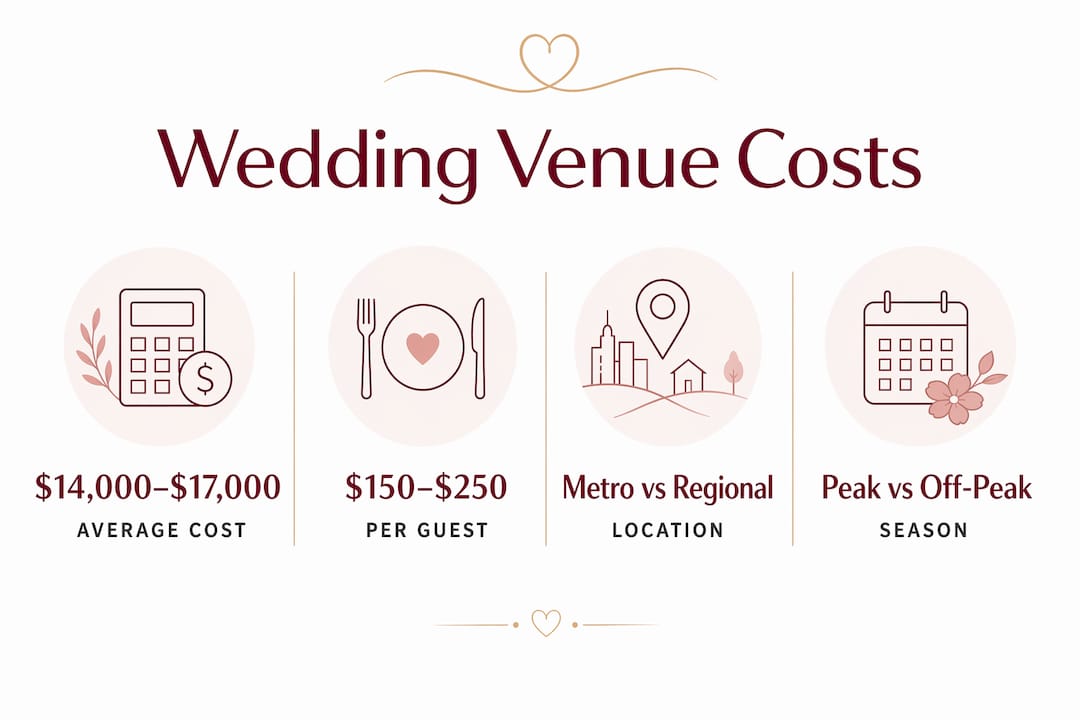
National average: Bridebook places the average venue cost in Australia at $14,000–$17,000, separate from catering. EasyWeddings reports an average of approximately $17,518 when venue costs are considered as a standalone line. Total wedding spend averages around $37,000, meaning venue alone can represent roughly 45% of the whole budget before catering is added.
Metro vs regional pricing: Sydney and Melbourne carry the highest venue costs, driven by demand and iconic locations. Brisbane and Perth offer more variety at lower price points. Regional areas, including South Australian wine regions, private estates, and rural properties, generally cost $2,000–$3,000 less than comparable city venues. For Adelaide and South Australia specifically, regional venues offer genuine savings without sacrificing character or quality.
Peak vs off-peak: Saturday bookings during spring and summer (September through December) attract the highest hire fees. Fridays, Sundays, and winter dates (June through August) typically reduce hire fees by 15–30%. A Sunday wedding in July at a regional South Australian property can represent a very different cost from a Saturday in November at a city venue with the same guest count.
Per-head indicators: Mid-tier venue and catering packages in Australia typically run $150–$250 per guest, covering food, drinks, table settings, and service staff. Higher-end full-service venues in major cities can push well above that range.
Hidden venue fees that blow budgets
The initial quote rarely tells the full story. These are the fees that most commonly push a final invoice above what couples expected, along with the questions to ask before signing anything.
Common hidden fees to check:
- Overtime charges. Most venues quote for a set number of hours. Extra time triggers additional venue, staffing, and security fees, sometimes charged per half-hour at rates that add up quickly.
- Cakeage. A per-head or flat fee to cut and serve an external cake. Ask before you commission a custom cake from an external baker.
- Corkage. A per-bottle fee if you supply your own wine or spirits. Some venues prohibit external alcohol entirely.
- Beverage minimums. A minimum bar spend that applies regardless of what guests actually consume.
- Service or gratuity percentage. Some venues add 10–15% on top of the food and beverage total as a service charge.
- Cleaning and waste removal. Not always included, particularly in blank-canvas or outdoor venues.
- Security. Often mandatory after a certain hour or guest count, and priced per guard per hour.
- Council permit fees. Required for outdoor events, amplified music, or events in public spaces.
- Noise curfews. An early music cut-off can trigger an early finish charge if the venue’s licence requires a coordinator to remain on site.
- Supplier access or bump-in fees. Charged when external florists, decorators, or photographers need access outside standard hours.
- Furniture and linen. Chairs, tablecloths, and centrepiece stands are sometimes listed as inclusions but are actually charged separately.
Contract red flags: Vague cancellation terms, undefined minimum spend mechanics, no cap on overtime rates, and inclusions lists that use the word “standard” without defining what standard means.
For unexpected venue expenses, the best protection is a written inclusions list attached to the contract before you pay a deposit. Verbal promises are difficult to enforce once money has changed hands.
Negotiation tips tied to the checklist:
- Ask for all inclusions confirmed in writing, not just described in a brochure.
- Offer date flexibility (a Friday or Sunday) in exchange for a reduced minimum spend or a waived corkage fee.
- Request a capped overtime rate so you know the worst-case cost if the night runs long.
- When negotiating with venues, ask for small cost-free additions (an extra hour of room access, a complimentary tasting, or a waived supplier fee) before asking for a price reduction.
To compare multiple quotes fairly, normalise each one to the same guest count and event duration, then compare line by line. A venue that looks cheaper at first glance often becomes more expensive once you add the items it excludes.
Sample venue budget templates by guest count
These three scenarios use a mid-range per-head rate and typical Australian venue pricing to give couples a starting point. Adjust the per-head figures up or down based on your venue type and inclusions.
Assumptions: $170 per head for venue and catering (mid-tier), beverage package at $60 per head, 5-hour reception.
| Budget line | Micro (30 guests) | Mid-sized (80 guests) | Large (150 guests) |
|---|---|---|---|
| Hire fee / minimum spend | — | — | $8,000 |
| Food (per head) | $3,000 | $8,000 | — |
| Furniture and rentals | $500 | — | $2,000 |
| AV and lighting | $500 | — | — |
| Cleaning / venue recovery | — | $500 | — |
These figures cover venue-related costs only. Photography, attire, florals, and entertainment sit outside this table.
How to use this as a spreadsheet: Lock your guest count and per-head price as fixed inputs. Make hire fee, beverage package, and contingency percentage the variables you test. Running three scenarios (low, mid, high per-head) against your confirmed guest count gives you a realistic range before you contact a single venue.
Venue type affects the template significantly. A restaurant buyout for 30 guests often has no hire fee but a minimum food and beverage spend. A cocktail-style event for 80 guests may reduce the per-head food cost but increase the beverage spend. A marquee event for 150 guests adds infrastructure costs (flooring, power, furniture) that a built venue includes by default.
Deposits, payment schedules, and contract questions
Understanding the payment timeline before you sign protects your flexibility and your money. Most Australian venues follow a broadly similar structure, though the exact terms vary.
Standard payment milestones:
- Holding fee (initial deposit). Typically $500–$2,000, paid to secure a provisional date. This is often refundable if you decide not to proceed within a short window (commonly 7–14 days).
- Booking deposit. Usually 20–30% of the estimated total, paid to confirm the booking. This is generally non-refundable if you cancel.
- Staged payments. Some venues require a mid-point payment (often 6 months before the event) to cover confirmed catering and staffing costs.
- Final balance. Typically due 30 days before the event, once final guest numbers are confirmed. Some venues require final numbers 14–21 days out, with the invoice adjusted accordingly.
Contract checklist before signing:
- Cancellation and postponement clauses (what triggers a forfeit of the deposit, and whether postponement to a new date is treated as a cancellation)
- Force majeure wording (how the venue handles government-mandated closures or natural events)
- Overtime rates (ideally capped per hour, not open-ended)
- Inclusions list (attached as a schedule to the contract, not just referenced in a brochure)
- External supplier policy (whether you can bring your own vendors and any associated fees)
- Liability and insurance requirements (public liability insurance for external suppliers is standard and reasonable)
- Minimum guest or spend clauses (what happens if your final numbers fall below the contracted minimum)
- Refund and transfer rules (whether a credit applies if you cancel, and under what conditions)
How to protect yourself: Request an itemised invoice at each payment milestone. Insist on a capped extra-hour fee in writing. If a venue coordinator makes a verbal promise (a complimentary tasting, an extra hour of room access), ask them to confirm it by email and attach that email to your contract file. Cost-saving strategies for SA venues often come down to this kind of documented clarity rather than dramatic price negotiations.
Tools and local resources to match venues to your budget
Finding venues that fit your budget is faster when you use the right tools from the start, rather than contacting venues at random and discovering they are out of range after a site visit.
What to look for in a venue search tool: Price filters, capacity filters, amenity tags (in-house catering, inclusive furniture, outdoor ceremony space), and the ability to save a shortlist for comparison. Without those filters, you spend time on venues that were never going to work.
Adelaideweddingvenues is built specifically for couples searching across Adelaide and South Australia. The directory lets you filter by price range, guest capacity, and specific amenities, so you can build a shortlist of venues that already match your budget profile before you make a single enquiry. The platform’s guides include case studies on how budget shapes venue choice in practice, which is useful context when you are deciding how to allocate your total spend. You can search the Adelaide Wedding Venues directory to start narrowing your options by price and capacity today.
Other useful local resources:
- State-based average-cost reports (EasyWeddings and Bridebook both publish Australian figures annually) are useful for benchmarking your per-head and total venue budget against national averages.
- Regional venue guides help couples weigh the trade-offs between metro convenience and regional savings, particularly for South Australian wine regions and rural properties.
- Venue specialists and wedding planners add value for complicated logistics: remote locations, large guest lists above 150, or events that require council permits and infrastructure planning.
Combining tool results with on-the-ground checks: Once you have a shortlist of three to five venues that pass the budget filter, visit each one in person. Ask for a sample menu tasting, walk the ceremony and reception spaces at the time of day your event would run, and request a recent sample invoice from a comparable event. That invoice is the most reliable indicator of what your final bill will actually look like.
Key takeaways
Venue and catering combined typically consume 40–50% of an Australian wedding budget, making guest count and date flexibility the two most powerful levers for keeping costs under control.
| Point | Details |
|---|---|
| Venue and catering share | Plan for 40–45% of your total budget to go to venue and catering combined. |
| National average venue cost | Australian venue costs average approximately $17,518, separate from catering. |
| Guest count is the biggest lever | Cutting 25 guests from a 150-person list can save several thousand dollars across multiple categories. |
| Off-peak savings are real | Fridays, Sundays, and winter dates typically reduce hire fees compared to a peak Saturday. |
| Adelaideweddingvenues | Use the directory’s price and capacity filters to build a shortlist of South Australian venues that match your budget before making any enquiries. |
A planner’s view on starting venue budgeting early
The most common mistake couples make is treating the venue as one item among many, rather than the item that sets the parameters for everything else. Once you know your venue cost, your guest count, and your date, the rest of the budget almost writes itself. Without those three anchors, every other decision is provisional.
Couples who start with a venue shortlist and a realistic per-head figure tend to spend less overall, not because they are more frugal, but because they make fewer expensive course corrections. Booking a venue that is too large for your guest count, then trying to fill it with décor, is a pattern that adds cost at every stage. Booking a venue that includes furniture, staffing, and a ceremony space in its package can often cost less than assembling those elements separately.
The negotiation tactic that works most consistently is bringing two or three comparable written quotes to a venue conversation. Venues know their market, and a written quote from a comparable property gives you a specific, polite basis for asking whether they can match an inclusion or adjust a minimum spend. Asking for a price reduction rarely works. Asking for an extra hour of room access, a waived corkage fee, or a complimentary tasting in exchange for signing before a certain date works far more often.
One scenario worth considering: a couple planning a 120-guest Saturday reception in a metro venue found that shifting to a Friday and reducing to 95 guests brought their venue and catering cost down by close to $8,000. The guest experience was not materially different. The saving was the equivalent of their entire photography budget. Date and guest-count flexibility, applied together, is the most reliable path to a venue budget that does not require compromise on the things that actually matter.
How Adelaideweddingvenues helps you find the right venue for your budget
Searching for a wedding venue without a price filter is like shopping without a price tag. Adelaideweddingvenues gives Adelaide and South Australian couples a searchable directory where price range, guest capacity, and amenities are filters, not afterthoughts. You can narrow a field of venues down to a shortlist that already fits your budget before you spend time on site visits or enquiry emails.
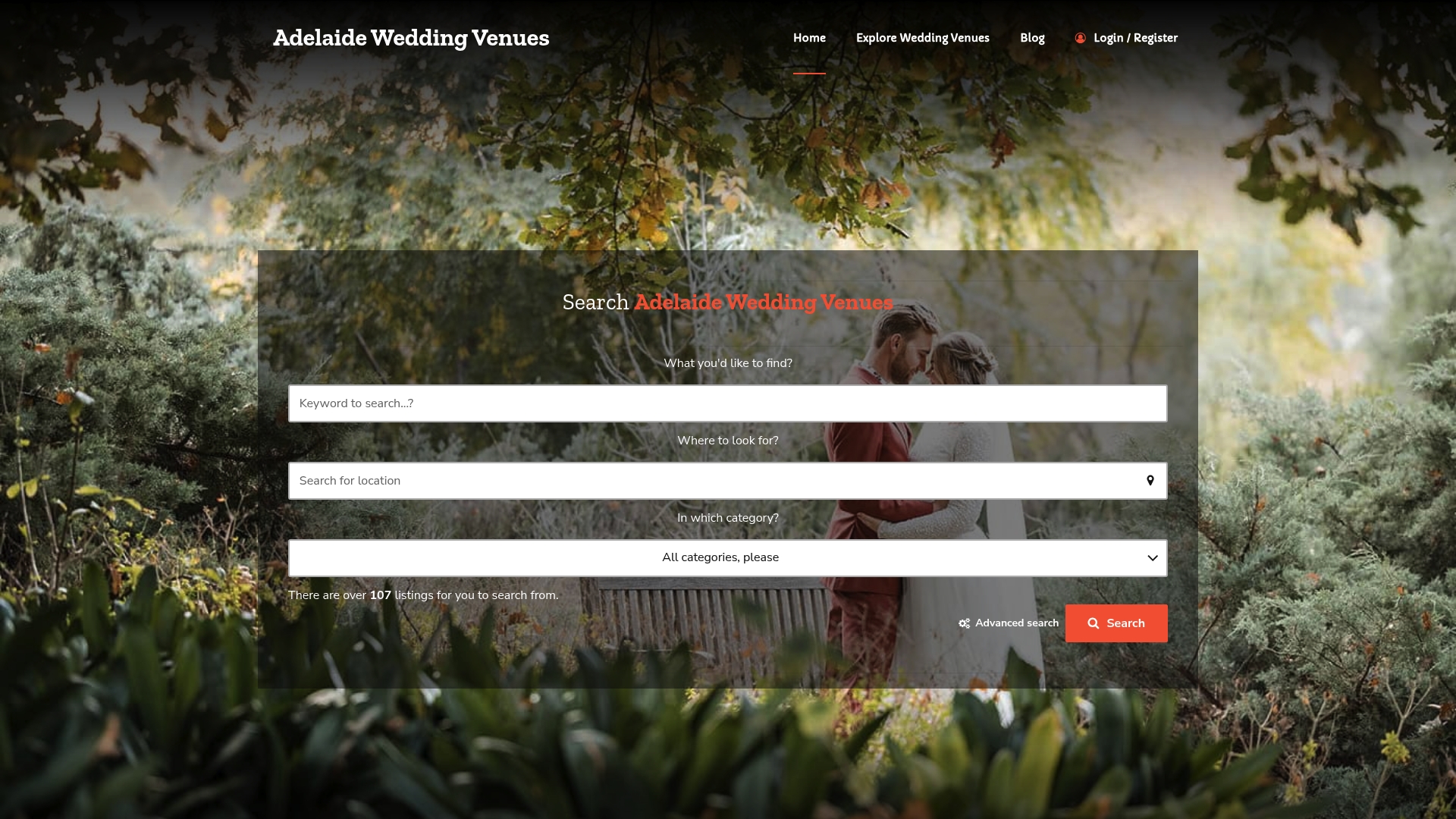
The practical starting point is straightforward: set your price range and guest count in the filters, save three to five venues that match, and request itemised quotes from each. Because the directory covers venues across Adelaide and regional South Australia, you can compare a metro ballroom against a Barossa Valley estate or a McLaren Vale winery in the same search. That comparison is where the real savings often appear.
Adelaideweddingvenues is free for couples to use. Venues pay to promote their listings, which means the directory has a genuine incentive to keep the venue information accurate and current. To start building your shortlist, visit the Adelaide Wedding Venues directory and use the price and capacity filters to find venues that match your budget today.
Useful sources and further reading
These Australia-focused resources are worth bookmarking as you work through your venue budget:
- EasyWeddings — Wedding Venue Cost Guide: The most detailed Australian source for average venue costs, pricing models, and per-head benchmarks. Best for setting national expectations.
- Bridebook Australia — Wedding Budget Breakdown: Covers average total wedding costs, venue cost ranges by city, and category-by-category budget splits. Useful for checking your allocation percentages.
- Polkadot Wedding — Australian Wedding Budget Guide: Practical guidance on off-peak savings and regional pricing differences. Best for understanding how date and location flexibility changes costs.
- Paperlust — How to Save Money on a Wedding: Covers guest-count reduction as a savings lever with concrete examples. Useful for the guest-list conversation.
- Central Coast Leagues Club — Hidden Venue Costs: A transparent breakdown of the fees that rarely appear in initial quotes. Best for building your pre-signing checklist.
- Adelaideweddingvenues — The real role of budget in venue choice: Case-study style guidance on how budget shapes venue selection in South Australia. Best for Adelaide-specific context.
- Adelaideweddingvenues — 7 smart wedding venue budget tips for Adelaide couples: Localised, tactical tips for couples planning in Adelaide. Best for quick wins and checklist items.
- Adelaideweddingvenues — Negotiating with wedding venues: Step-by-step negotiation tactics for discussing price and inclusions. Best for the contract and deposit stage.
FAQ
What share of a wedding budget should go to the venue?
Venue and catering combined typically account for 40–45% of a total Australian wedding budget, with venue alone averaging approximately $17,518 nationally.
What is the 80/20 rule for weddings?
The 80/20 rule recommends directing roughly 80% of your wedding budget toward the highest-impact categories: venue, catering, and photography. These three areas drive the majority of both cost and guest experience.
What should be included in a wedding venue budget?
A complete venue budget should cover hire fee or minimum spend, food per head, beverages, service and staffing, furniture and rentals, AV and lighting, cleaning, permits, and a contingency of 10–15% for unexpected costs.
What do you need to consider when choosing a venue?
Key venue budget considerations include pricing model (flat hire, minimum spend, or per-head), what is included versus charged separately, guest capacity, date availability, and whether off-peak or regional options can reduce the hire fee by 15–30%.
How does guest count affect venue costs?
Every additional guest adds per-head catering, beverage, and staffing costs simultaneously. At a reasonable mid-range per-person rate for venue and catering, increasing guest count substantially raises that cost line., before accounting for larger room hire requirements.
