
TL;DR:
- A venue coordinator manages all venue operations and ensures compliance during your wedding day, but does not oversee personal vendors or the full event timeline. Their role is limited to the venue’s staff, rules, and in-house services, typically arriving hours before and leaving after dinner. Couples should clarify coverage, scope, and complementary roles with their venue to avoid operational gaps and ensure a smooth celebration.
A venue coordinator is the professional responsible for managing all venue operations on your wedding day, ensuring the space functions according to its policies and your agreed arrangements. This role, sometimes called a venue manager, sits at the heart of how venue coordination responsibilities are carried out on the day itself. Where couples often get confused is in assuming this person manages their entire wedding experience. The role of venue coordinators is specific, operational, and venue-focused. Understanding that distinction before you book saves significant stress and helps you plan the right support team from the start.
What do venue coordinators actually do on your wedding day?
A venue coordinator’s core responsibility is to manage venue operations, serving as the main contact between you and the venue’s internal staff. Their focus is the building, the grounds, and the people employed by the venue. They are not managing your florist, your photographer, or your ceremony timeline.
The tasks of event coordinators working in a venue capacity typically include:
- Confirming venue access and readiness before guests arrive
- Overseeing the setup of venue-provided items such as tables, chairs, linens, and lighting
- Coordinating venue staff including catering teams, bar staff, and cleaning crews
- Managing food and beverage service and ensuring facility systems like power and lighting remain operational
- Enforcing venue rules, safety protocols, and noise restrictions
- Handling on-site emergencies such as staff shortages or equipment failures
On timing, venue coordinators typically arrive one to two hours before the first scheduled event and depart after dinner service concludes. This means they may not be present for your late-night dancing or post-reception farewells. That window matters when you are planning a long reception or a late finish.
Pro Tip: Ask your venue coordinator for their exact arrival and departure times during your initial planning meetings. If your reception runs past their standard hours, confirm whether extended coverage is available and whether it incurs an additional cost.

Venue coordinators also act as the authoritative voice on approved vendor behaviour within the space. They know which areas are off-limits, where deliveries must enter, and what the venue’s insurance requires. This knowledge is genuinely useful and not something an external planner can replicate.
How do venue coordinators differ from wedding planners?
This is the question most couples ask too late. The clearest way to understand it: a venue coordinator works for the venue, while a wedding planner works for you. Their loyalties, priorities, and scope are fundamentally different.
The venue coordinator’s loyalty is to the venue, not the couple. They function like a hotel’s general manager during your event. Their job is to protect the venue’s operations, reputation, and compliance. That is not a criticism. It is simply the reality of their role, and it shapes everything they will and will not do for you.
| Responsibility | Venue coordinator | Wedding planner or day-of coordinator |
|---|---|---|
| Manages venue staff and operations | Yes | No |
| Oversees full wedding timeline | No | Yes |
| Coordinates external vendors (florist, DJ, photographer) | No | Yes |
| Handles personal wedding details and décor | No | Yes |
| Enforces venue rules and safety policies | Yes | No |
| Manages off-site ceremony or pre-wedding events | No | Yes |
| Acts as couple’s personal advocate on the day | No | Yes |
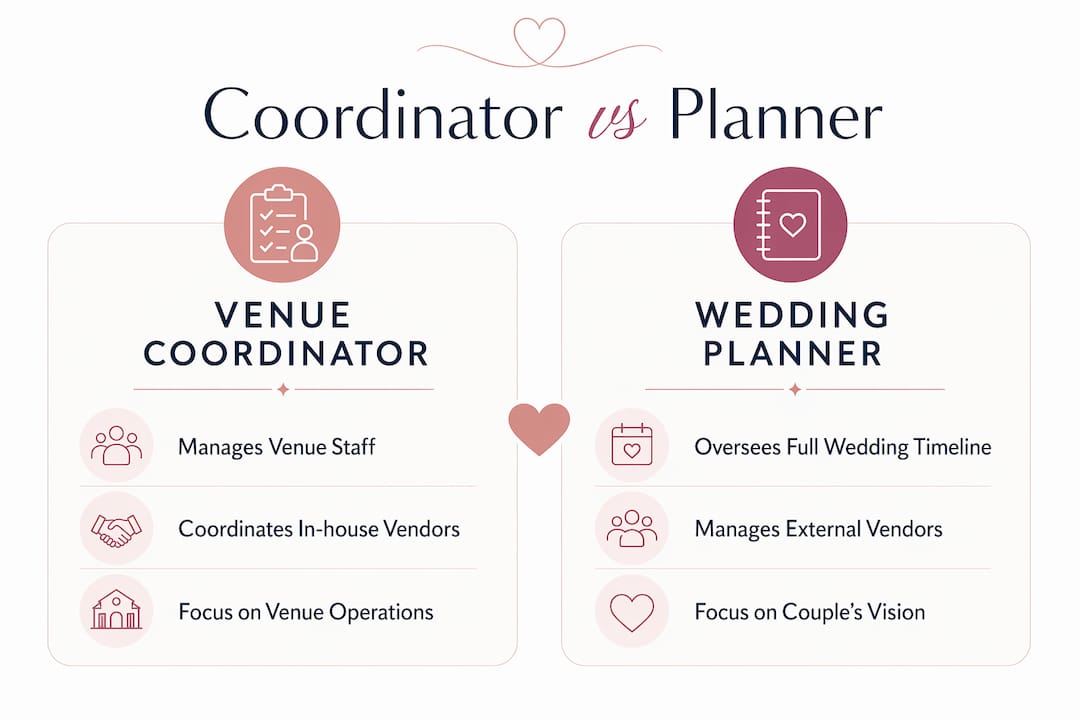
Venue coordinators manage vendor communication only for in-venue services such as catering and bar. They are not responsible for liaising with your florist about delivery timing or telling your DJ when to start. Those tasks fall to a wedding planner or day-of coordinator.
The practical implication is significant. If your ceremony is held off-site and your reception is at the venue, the venue coordinator’s involvement begins only when your guests arrive at the reception space. Venue coordinators generally do not cover off-site events or any segment outside the venue grounds. Couples who assume otherwise often find themselves without adequate support during the ceremony or the transition between locations.
Having both professionals creates a complementary team where venue operations and the couple’s broader vision are each managed by the right expert. There is no duplication when the roles are clearly defined. Each person focuses on their area, and the result is a more structured, less stressful day for everyone involved.
When should couples consider hiring a venue coordinator?
Many venues include a coordinator as part of their standard package, but the scope of what that person covers varies considerably. Confirming exactly what coordinator services are provided, including coverage times and specific tasks, is one of the most practical steps you can take during venue negotiations.
Here are four questions worth asking your venue directly:
- What hours will the venue coordinator be on-site on our wedding day?
- Which tasks are included in their coordination role, and which fall outside their scope?
- Will the same coordinator be our contact throughout planning and on the day itself?
- Does the coordinator manage external vendors, or only venue staff and services?
The answers will tell you quickly whether you need additional support. You can compare venue options in All Adelaide Wedding Venues. A venue that provides a coordinator who handles setup, catering, and compliance but leaves at 9pm is not covering your full event. You will need a day-of coordinator to manage the remainder of the evening and any vendor-related logistics throughout the day.
Pro Tip: Review your venue contract details carefully before assuming coordinator services are included. Some venues list coordination as a paid add-on, while others include it only for premium packages.
For off-site events, destination weddings, or receptions with complex vendor arrangements, the importance of venue coordinators becomes even clearer when you understand what they do not cover. Knowing their boundaries helps you fill the gaps with the right professionals rather than discovering the gaps on the day itself.
What are the real benefits of a professional venue coordinator?
The most direct benefit is operational clarity. Hiring a venue coordinator reduces planning stress by providing a dedicated, knowledgeable contact for all venue-related logistics. Their presence allows your wedding planner, photographer, and other vendors to focus on their own roles without being pulled into venue-specific questions.
“A venue coordinator handles the operational infrastructure of your wedding day. When they are doing their job well, you will not notice them at all. The venue will simply work.”
The skills needed for venue coordinators include strong communication, problem-solving under pressure, and deep knowledge of the venue’s physical layout and policies. These are not generic event management skills. They are specific to the building and its systems. A coordinator who has managed fifty weddings at the same venue knows where the power points are, which supplier entrance avoids the main foyer, and how to handle a catering delay without it reaching the guests.
Concrete benefits couples and planners experience include:
- Faster resolution of on-site issues because the coordinator has direct authority over venue staff
- Consistent guest experience because service standards are managed internally
- Reduced risk of policy breaches that could result in bond deductions or venue complaints
- Clear communication between the couple’s planner and the venue’s team, avoiding crossed messages
The alignment of your wedding timeline with venue staff schedules and service windows is one of the less-discussed but genuinely valuable contributions a venue coordinator makes. When your planner and venue coordinator communicate early and clearly, service timing, room transitions, and meal courses all run to schedule. That coordination behind the scenes is what creates the impression of a flawless event for your guests.
For a closer look at how this works in practice, the venue setup and teardown process at most Adelaide venues illustrates exactly how much operational work happens before and after the event itself.
Key takeaways
A venue coordinator manages venue operations and compliance on your wedding day, and their role is distinct from and complementary to that of a wedding planner or day-of coordinator.
| Point | Details |
|---|---|
| Venue coordinator’s core focus | They manage venue staff, operations, and compliance, not the couple’s full wedding timeline. |
| Timing and coverage limits | Coordinators typically arrive one to two hours before the event and leave after dinner service. |
| Role boundaries matter | They do not manage external vendors, off-site events, or personal wedding details. |
| Ask the right questions | Confirm coverage hours, included tasks, and whether the same coordinator handles planning and the day itself. |
| Best outcome uses both roles | Pairing a venue coordinator with a wedding planner covers all operational and personal aspects of the day. |
Why couples consistently underestimate this role
In my experience working with Adelaide venues and the couples who book them, the most common misunderstanding is not that couples dislike venue coordinators. It is that they assume the venue coordinator is their coordinator. That assumption leads to gaps in coverage that only become visible on the day itself, usually at the worst possible moment.
The venue coordinator is an expert in their building. They know its quirks, its staff, and its rules better than anyone. What they are not is your personal advocate. They will not chase your florist when the centrepieces are late, and they will not hold your timeline together if your ceremony runs long. That is not a failure on their part. It is simply not their job.
What I consistently recommend is treating the venue coordinator as a critical part of your venue management team, not as a substitute for broader planning support. Proactive communication between your wedding planner and the venue coordinator before the day is the single most effective way to avoid operational friction. Share your run sheet, confirm service windows, and clarify who calls whom when something needs to change. That conversation, held weeks before the wedding, prevents most of the issues couples describe as “things that went wrong on the day.”
If you are planning without a wedding planner, read the on-site coordinator guide before your final venue meetings. It will help you ask better questions and set clearer expectations with your venue team.
— Steven
Find venues with strong coordination support across Adelaide
Adelaideweddingvenues is South Australia’s dedicated wedding venue directory, built to help couples find spaces that match their vision and their practical needs. Coordination quality varies significantly between venues, and knowing what to look for makes a real difference to your planning experience.
Whether you are drawn to a heritage ballroom in the Adelaide Hills or a coastal venue on the Fleurieu Peninsula, the directory gives you the tools to filter by type, size, and location. Start with the ideal venue guide to understand which venue features, including coordination services, should be on your checklist. For couples planning a destination celebration, the top destination venues for 2026 highlights spaces with professional coordination already built into their offering.
FAQ
What is the main role of a venue coordinator at a wedding?
A venue coordinator manages all venue-specific operations on the wedding day, including staff coordination, catering service, setup oversight, and compliance with venue policies. Their focus is the venue’s internal functioning, not the couple’s broader wedding experience.
Do I still need a wedding planner if my venue has a coordinator?
Yes, in most cases. A venue coordinator works for the venue and does not manage your full timeline, external vendors, or personal wedding details. A wedding planner or day-of coordinator fills those gaps and acts as your personal advocate throughout the day.
How long does a venue coordinator stay on-site during a wedding?
Venue coordinators typically arrive one to two hours before the first event and depart after dinner service. They may not be present for the full reception, so confirming their hours with your venue is important for late-running events.
What questions should I ask my venue about coordinator services?
Ask about the coordinator’s exact hours, which tasks are included in their role, whether they manage external vendors, and whether the same person handles both planning meetings and the wedding day itself. These questions to ask your venue clarify coverage and help you identify any gaps.
Can a venue coordinator manage my entire wedding day?
No. Venue coordinators have authority limited to venue needs and do not manage the full wedding timeline or non-venue vendors. Couples who need comprehensive day-of management require a separate wedding planner or day-of coordinator in addition to the venue’s team.
